Pig Kidney Patient Marks One Year Off Dialysis
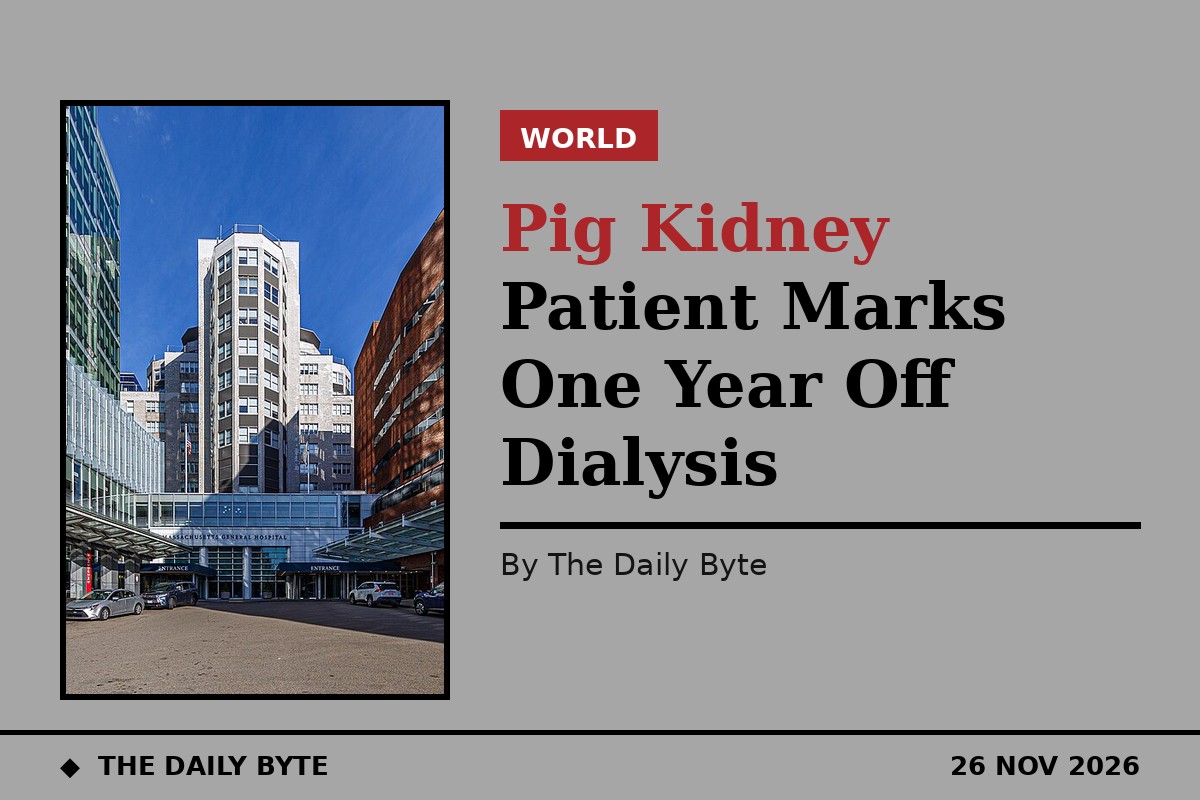
A woman from New Hampshire has become the first patient known to live for more than a year with a kidney from a gene-edited pig, and to remain free from dialysis for that long after the transplant.
Molly Falco, 58, reached the milestone on Sunday, one year after she received the kidney at Massachusetts General Hospital in Boston on 22 November 2025. The kidney, developed by the biotechnology company eGenesis, continues to function, filtering waste from her blood, making urine and keeping her fluid and mineral levels in balance.
The announcement was made on Monday by eGenesis and Mass General Brigham, which described the result as the longest sustained function of a genetically engineered pig kidney in a living human recipient, and a significant step towards making xenotransplantation, the transplant of animal organs into people, a viable treatment option.
Falco was born with a condition that damaged her kidneys, and her kidney function declined quickly in her fifties. She began dialysis in 2024 and spent 11 months on the treatment before her transplant. She had some complications soon after the surgery, but she has not needed a hospital stay since February.
Her doctors say the result is encouraging but early. Dr Leonardo Riella, who leads kidney transplant research at Mass General Brigham and oversees Falco's care, said the kidney working for a year gave the team a lot of confidence that the approach was feasible, but added: "It is not a victory lap yet." He said he hoped the kidney would keep working for at least another year.
Falco herself said she was amazed every day that the kidney was still working. She has named it Lily, after the flowers relatives in Colorado sent following the surgery. Her life is now almost normal: she is cooking family meals again, seeing friends and driving, which she could not manage while on dialysis. She still tires easily and gets short of breath, wears a mask in public to avoid infections, and her medication causes a slight tremor. She has been cleared to travel to Colorado for Christmas.
How the kidney was engineered
The kidney she received, known as EGEN-2784, was transplanted under the US Food and Drug Administration's Expanded Access pathway, which allows experimental treatments to be used outside a formal trial. It carries three classes of genetic modifications designed to make a pig organ compatible with the human body: the inactivation of viruses embedded in the pig's DNA, the removal of three sugar molecules that can trigger immediate rejection, and the insertion of seven human genes to regulate the immune response, reduce inflammation and improve compatibility of blood clotting and complement activation.
Six patients have now received the eGenesis kidney through the Expanded Access pathway. The milestone builds on that growing experience, and doctors say each patient has taught them more about how the human immune system responds to the organs, helping them refine the treatment.
A severe organ shortage
The shortage the work aims to address is severe. More than 825,000 Americans suffer from end-stage kidney disease, and fewer than 28,000 kidney transplants were performed in the United States in 2024. About 90,000 people are on the waiting list for a kidney, yet fewer than 26,000 transplants were carried out last year. On average, 12 people die each day while waiting for a kidney to become available. For those who cannot receive a transplant, dialysis is the only option, and the five-year death rate on dialysis is greater than 55 percent.
A formal trial is now close. The FDA has cleared eGenesis to run a trial of the kidney in 33 patients at 10 medical centres across the United States, and it is due to begin in January. The trial will test whether the approach can work more widely, and for longer, than in the handful of patients treated so far.
For Falco, the milestone is personal before it is scientific. "A year ago, I didn't know what the future would hold," she said. "Living with kidney disease had taken so much away from me, and I wanted the chance to get my life back." Her hope, she said, was that one day everyone waiting for a kidney transplant could have xenotransplantation as an option that was readily available to them.


