PKK leaves 14 more bases in northern Iraq
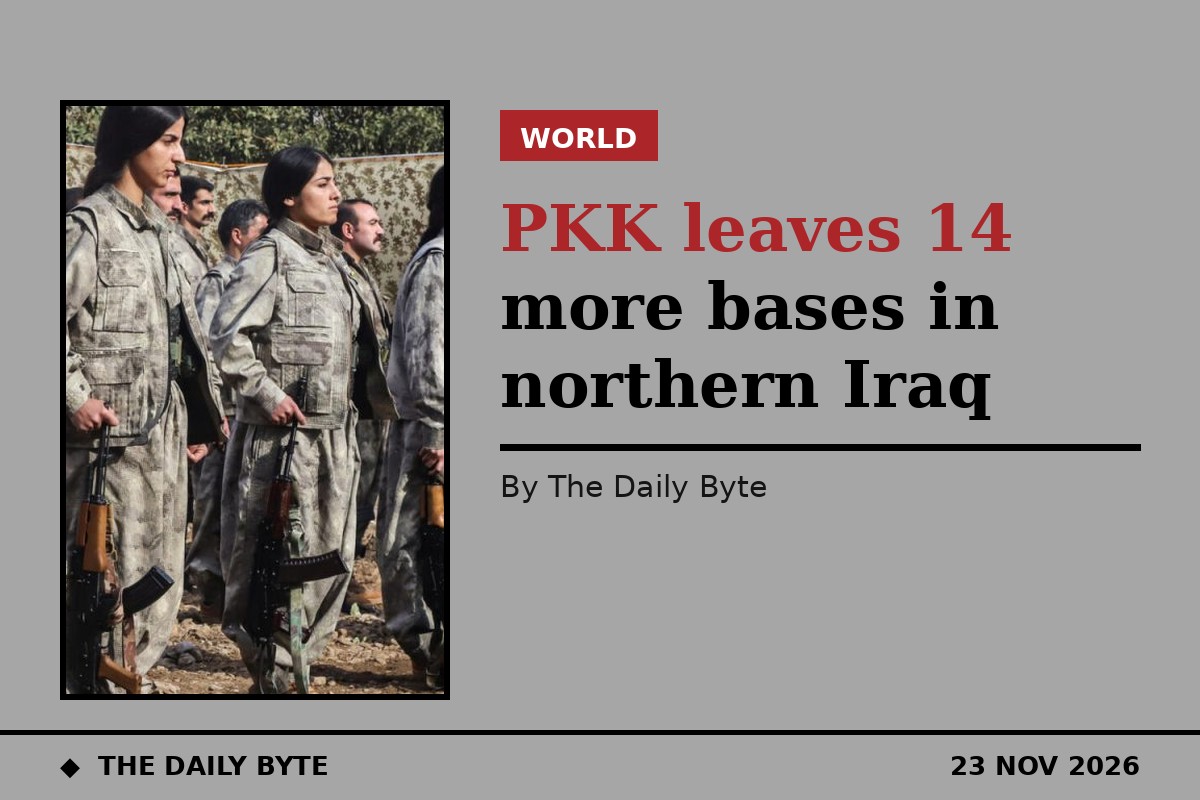
Kurdistan Workers’ Party (PKK) fighters have withdrawn from 14 more bases in northern Iraq, Turkish security sources said on Monday, in the latest step in a peace process aimed at ending a conflict that has lasted for more than four decades. The announcement was reported by Türkiye’s state news agency Anadolu, citing security sources, and carried by wire services on Monday 23 November.
The 14 sites are in the Hakurk region, a mountainous area at the junction of Iraq, Türkiye and Iran that has long been one of the militants’ main rear bases. According to the reports, the positions were evacuated on 18 November, and Türkiye’s defence ministry said the caves and shelters left behind had been rendered unusable. Turkish media aired footage of empty tunnels and fighters leaving with their belongings.
What the withdrawal covers
The withdrawal is presented as a core part of the deal between the PKK and Ankara. Evacuating the group’s bases in northern Iraq is one of the practical tests of whether the PKK is carrying through on its decision to disarm and dissolve itself.
Ankara had previously acknowledged that the PKK vacated four bases in October. On 8 October, fighters pulled out of the Hebat, Yajk, Sabri and Sason shelter areas in the Baze area of the Metina region, also in northern Iraq. Monday’s announcement brings the number of bases Ankara has acknowledged as vacated to 18, although the PKK said last month that it had withdrawn all of its fighters from Turkish territory to northern Iraq, a broader claim Türkiye has not confirmed in full.
The claim rests on Turkish security sources, and no independent verification of the latest evacuations was reported on Monday. That caution matters: the process is being judged as much on what can be verified on the ground as on what either side announces.
A process that began in 2024
The peace process was launched in 2024 with the aim of ending an armed conflict that has killed tens of thousands of people since the PKK took up arms in the 1980s. It gathered pace after Abdullah Öcalan, the PKK’s imprisoned founder, called in February 2025 for the group to lay down its weapons and dissolve itself.
On 12 May 2025, the PKK announced that it would disarm and disband, following Öcalan’s call. Öcalan has been held in prison on İmralı Island, off Istanbul, since 1999, and his messages have remained central to the process ever since.
In October, the PKK said it was withdrawing all of its forces from Türkiye to northern Iraq, in a statement read out at a ceremony in the Qandil area. Türkiye’s parliament has also passed framework legislation offering conditional legal relief for certain PKK-related offences, once the authorities verify that the group has dissolved and disarmed. That verification must be formally confirmed by Türkiye’s National Security Council and published in the government’s official journal before the law can take effect.
Öcalan meeting and what comes next
The political track moved in parallel over the weekend. A delegation from the pro-Kurdish DEM Party met Öcalan on 22 November, and the party said his prison conditions had improved and that he had been moved to new facilities. It stressed the importance of keeping communication channels open so that he can continue his role as what it called the coordinator of peace and political integration.
For Ankara, the withdrawals are evidence that the disarmament phase is progressing. Turkish security sources described the latest evacuations as progress towards disarmament and towards security and stability in the region, and said the coordination committee overseeing the process and its sub-committees would continue to monitor it.
For the PKK, the pace of political steps in Ankara remains a concern. The group has previously faulted the government for moving slowly on legal and political measures, even as fighters leave their positions. Whether the 14 evacuations in Hakurk are followed by the formal confirmation Türkiye requires — and by the legal relief parliament has prepared — is now the next test of a process that has already outlasted several earlier, failed attempts at peace.


