Poki Lets AI Agents Drive a Real iPhone
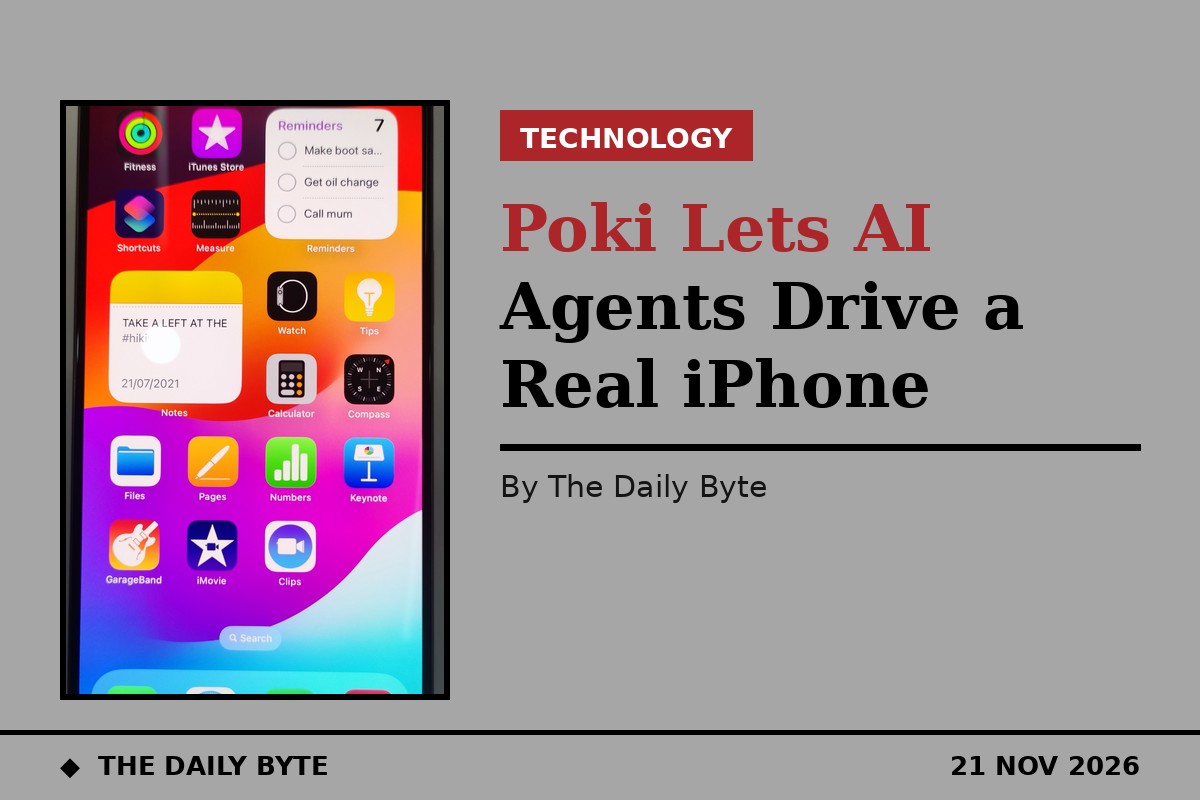
An open-source project called Poki lets an artificial intelligence agent operate a real iPhone the way a person does, reading the screen and then tapping, typing and scrolling inside real apps. The repository opened on GitHub on 5 November, and a preview iPhone app followed on 9 November. By 16 November the project had gathered 1,432 stars and 231 forks, an unusually fast rise for a tool that demands a Mac, full Xcode and a USB cable.
Poki was built by Joseph Zhou, with co-creator Zhehan Zhang, for anyone who wants an agent to do work that only exists inside phone apps: checking a delivery, looking something up, sending a message, instead of handing over a summary and asking the user to do the job themselves. It is released under the AGPL-3.0 licence, and it works with no jailbreak and no extra hardware.
How Poki drives the phone
Poki is a loop with three parts. A daemon runs on the Mac and speaks MCP, the Model Context Protocol, to an agent such as Claude Code or Codex. A native bridge, written in Rust, talks to the iPhone over USB using Apple's own developer tooling, the same plumbing Xcode uses. And a small Poki app on the phone puts it in Automation Mode, so the bridge can drive it.
The agent reads the phone twice before it acts: a screenshot to see the screen, and the accessibility tree to know what each element is. It finds the app it needs, taps it open, taps the address bar, types the query, reads the results and writes back a summary. Then it reads the screen again to see what happened. While it types, Poki's own typing panel shows on the phone with a Take Over button, so the user can step in at any moment.
Poki also remembers. It records the route a task took, which taps in which order, and reuses it on repeat, so the second time the same job is asked for it runs faster. Tasks can arrive through the MCP route, or through Poki Agent, a standalone agent that takes requests from a terminal, iMessage or Telegram. In MCP mode Poki uses the client's own model access rather than a separate account; Poki Agent defaults to GPT-6.1 Terra.
What it can do, and what it will not do alone
Because Poki controls a real iPhone, the actions it takes are real. Ask it to send a message or make a payment and it will. Payments, deletions and messages need the user's approval in the Dynamic Island first, and the project pauses for sensitive actions. Screen contents are sent to the configured model service, so the project warns users to understand the privacy and account implications before they run it.
The requirements are specific. The source installation needs macOS 15 or later, full Xcode from the App Store, Node.js 24 or later, Rust with 2024-edition support, Python 3 and ffmpeg, plus an iPhone on iOS 18 or later, meaning an iPhone XS, XR, SE second generation or newer. The app also installs on iPad with iPadOS 18 or later. A free Apple account signs the iPhone app for seven days, then needs renewal.
The project is candid about what has not been tested. Physical iPhone support has been verified only on devices set to the Chinese interface, in portrait orientation, and landscape is not supported. The iOS 18 to 26 control path has not been tested on a physical device yet, and the preview app, version 0.2.9, is an untested snapshot that the author warns may break. Automating third-party apps may also violate their terms of service and risk account restrictions.
Why it is getting attention
Until now, AI agents have mostly lived in the browser and the terminal, while the small jobs of daily life live inside phone apps. Poki closes that gap with ordinary developer tooling rather than a hack, which is why developers have picked it up so fast. The demos show it working across apps such as Maps, WeChat, Reminders, Notes and Calendar, and the project lists a native iOS app and Telegram integration as coming soon.
Whether it becomes a daily tool depends on the rough edges being smoothed: more verified devices, more screen languages and more model providers are all listed as planned work, without dates. For now, it is a preview that does something no mainstream assistant does: it does the tapping itself.


