Poland Bank Warns Glapinski Tribunal Would Hit Economy
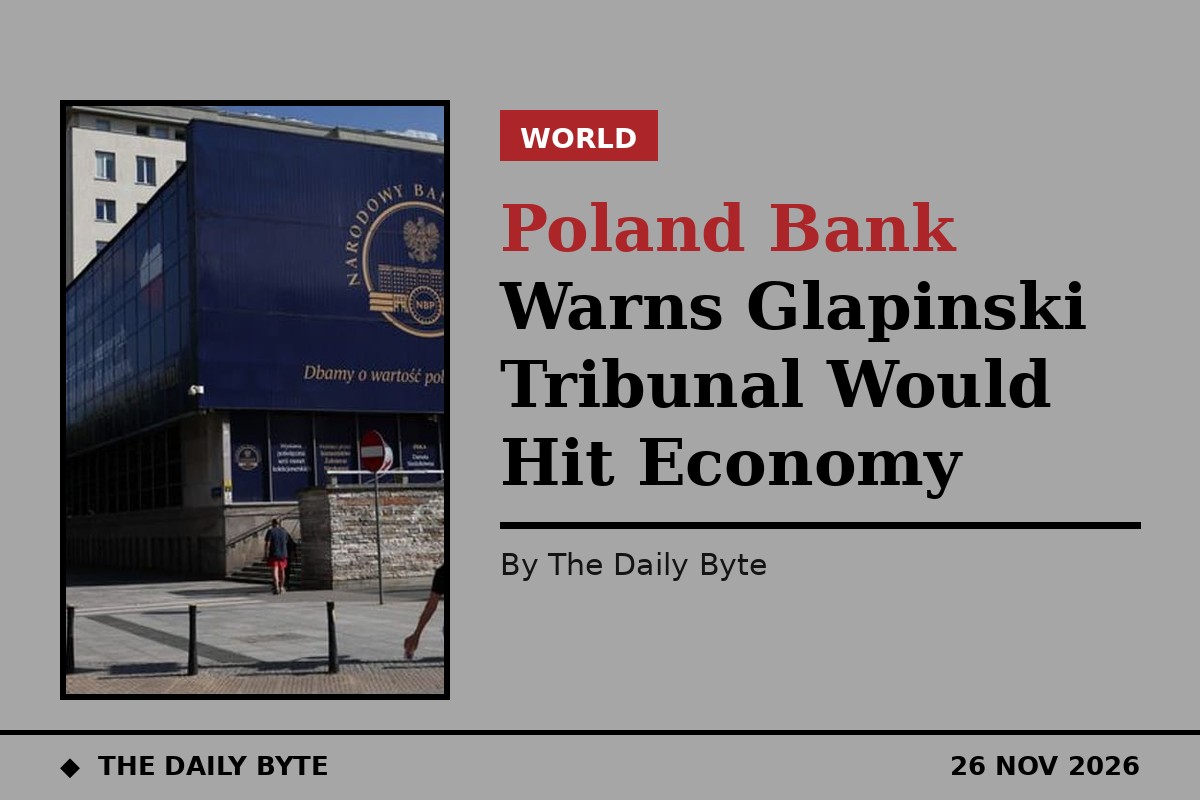
The deputy head of Poland's central bank has warned that any attempt to bring its governor before the country's State Tribunal would be illegal and would undermine the stability of the bank, in a direct challenge to the Polish government.
Marta Kightley, deputy governor of the National Bank of Poland (NBP), told Reuters on Tuesday that a tribunal case against Governor Adam Glapinski would damage the economy. "A lack of stability at the central bank could affect the state's financial situation through higher bond yields, and consequently higher debt-servicing costs, as well as a weakening of the exchange rate," she said.
In October, a parliamentary committee, the Constitutional Accountability Commission, recommended that Glapinski be brought before the State Tribunal, a court that hears cases against high officeholders, to answer accusations of constitutional violations in office. A majority on the committee accused him of indirectly financing the budget deficit through asset purchases in 2020-21, conducting such operations without proper authorisation from the Monetary Policy Council, and politicising the central bank.
The case against the governor
The heaviest charge concerns the bond purchases. Ludwik Kotecki, a newly appointed member of the NBP management board who testified before the committee, put the indirect financing of the budget deficit at 144 billion zloty. He said the committee's concern was not the purchases themselves, since many central banks buy bonds, but the apparent lack of clear legal frameworks and mandates for the interventions.
The bank has pushed back hard. On 10 November it published a formal statement responding to the committee's report, arguing that such proceedings should not take place at all, pointing to the independence of the central bank under the Polish Constitution, Constitutional Tribunal case law and EU law. The statement set out eight groups of counterarguments and called the report's conclusions one-sided, selective and biased.
Kightley echoed that position in the Reuters interview. "The actions taken by the Constitutional Accountability Commission regarding the Governor of the National Bank of Poland, as well as the report resulting from the Commission's work, run counter to the principle of central bank independence," she said. She called the committee's report one-sided and said it failed to address the explanations the bank had provided.
A vote with no date
It is still unclear when parliament, the Sejm, will vote on the matter. The vote had been planned for the second half of November, but the speaker of parliament has said the date will be set only after consultations within the ruling coalition.
The rules for the vote are themselves disputed. By statute, parliament would need an absolute majority of votes, with at least half of the deputies present, to adopt a motion to bring Glapinski before a tribunal. But the Constitutional Tribunal ruled in 2024 that such a vote would require a three-fifths majority and that a referral would not automatically suspend the governor from office. The government disputes the legality of those rulings, but Kightley said "the legal situation is such that this would be an unlawful action."
The European Central Bank has already taken a position. It said in 2023 that any attempt to suspend the governor could be challenged before the Court of Justice of the European Union. "Such an action would be unlawful," Kightley said, adding that the proceedings were attracting "significant interest from colleagues at other central banks, including the European Central Bank."
The dispute goes back to before Prime Minister Donald Tusk took power in 2023, when he promised to hold Glapinski to account, accusing him of compromising the central bank's independence by being too close to the previous nationalist government. Glapinski rejects the accusations, and his term runs until 2028. Kightley did not say what steps the bank might take if the Sejm votes to proceed, but warned: "Such actions are detrimental to Poland's image abroad and can create legal uncertainty, negatively affecting the country's financial stability."


