Pope Leo Calls Arms Race a Trap for Humanity
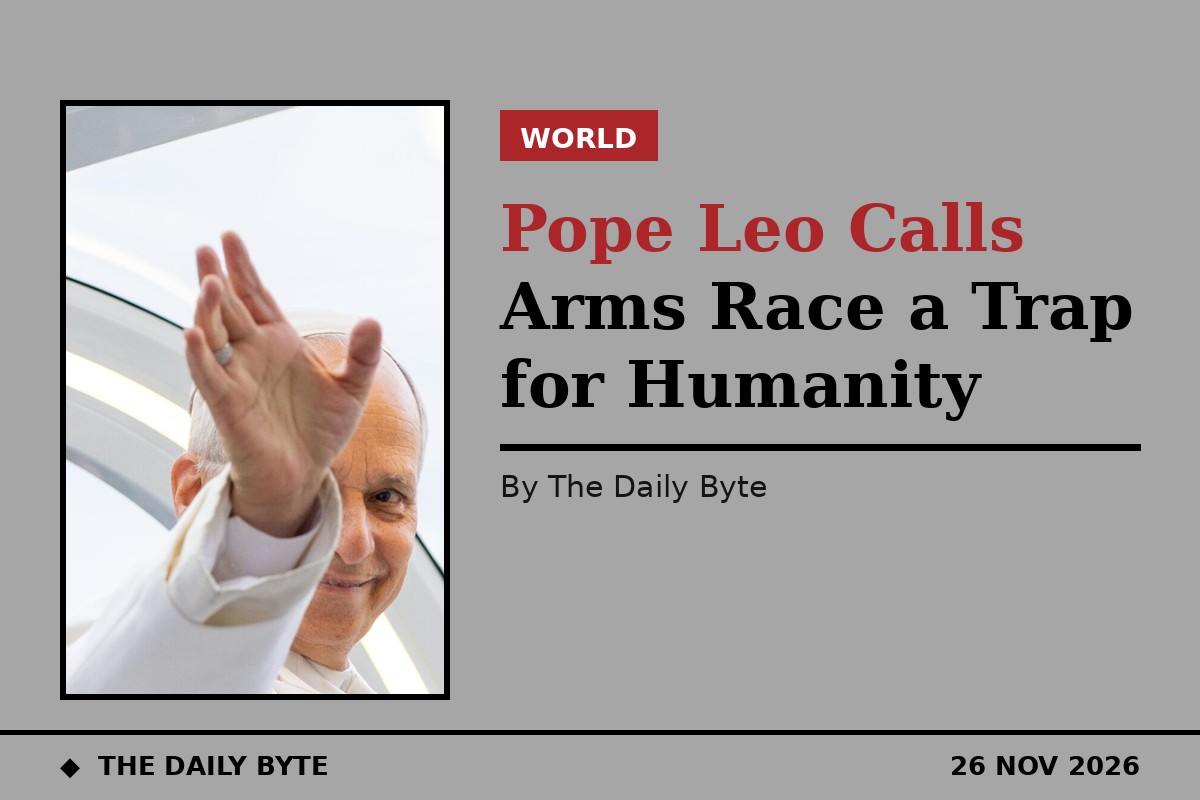
Pope Leo XIV has called the arms race "an utterly treacherous trap for humanity", warning that unchecked military spending harms the poor above all and that new technology is changing war in dangerous ways.
The pope made the remarks during his weekly general audience in St Peter's Square on Wednesday 25 November, delivered outdoors despite a cold and rainy morning in Rome. He was continuing his series of reflections on the Second Vatican Council, turning to the chapter of its pastoral constitution Gaudium et Spes devoted to the promotion of peace.
Quoting the document, which was promulgated by St Paul VI in December 1965, he said: "It must be strongly reiterated that 'the arms race is an utterly treacherous trap for humanity, and one which ensnares the poor to an intolerable degree.'" He added the council's warning that if the race continues, "it will eventually spawn all the lethal ruin whose path it is now making ready."
A warning that still applies
For the pope, those words from six decades ago are prophetic and "resound today as an even more urgent warning". He described them as "the very cry that rises to the world's powerful from the suffering of peoples, of children killed and maimed, and of destroyed families".
He stressed that the council's teaching on peace is not naive. It recognises that human beings are flawed, and that "peace is never attained once and for all, but must be built up ceaselessly". For that reason, he said, "there is no room for resignation, as if violence were inevitable". The council fathers, faced with the horrors of modern war, concluded that such atrocities "compel us to undertake an evaluation of war with an entirely new attitude".
The pope also made clear that the Church's call for peace does not deny governments the right to legitimate defence. Instead, he said, it underlines the need for international bodies able to intervene effectively, to restore justice that has been violated and to act in defence of the oppressed. He urged support for institutions dedicated to peace and for a global political and economic order built on "cooperation, dialogue, and the sharing of nations' cultural and material resources, at the service of integral human development".
Technology is changing war
A large part of the pope's reflection dealt with how technology is reshaping conflict. Quoting his first encyclical, Magnifica Humanitas, he said: "The digital revolution is changing the nature of conflict. Alongside conventional warfare, there are hybrid forms such as cyberattacks, information manipulation, campaigns of influence, and the automation of strategic decisions."
He warned that what is created for defence can quickly be turned to offence, so that "the fine line between protection and aggression becomes blurred". Conflicts today, he said, "appear increasingly inhuman and devastating", fuelling "hatred and injustice amongst peoples, whilst also disfiguring creation and its beauty".
The audience was part of a continuing series in which the pope is working through the documents of the Second Vatican Council. He recalled that God's plan is for all people to become "in Christ Jesus the family of the sons of God", and that Christians are therefore called to build a world of peace. That peace, he said, "springs from the cross of Christ" and is offered to all peoples and to the whole of creation, as both "a gift of grace, to be received, and a commitment to freedom, to be lived out".
Called to the front line
Closing the audience, the pope urged the faithful to take an active part in building peace rather than watching from the sidelines. "Trusting always in the grace of God, we must not be afraid of working on the front line to build peace and defend human dignity," he said, through constant prayer and through consistent social and political choices.
He finished with an appeal to persevere: "Let us never tire of seeking and sharing that true peace, which is at once a gift from God and the fruit of tireless human endeavor." The message comes as wars continue in several parts of the world and as governments across Europe and beyond raise military spending, making his words a direct challenge to leaders who argue that security can only be bought with bigger arsenals.


