CVE-2024-49138 POS Flaw Steals 1 Million Cards
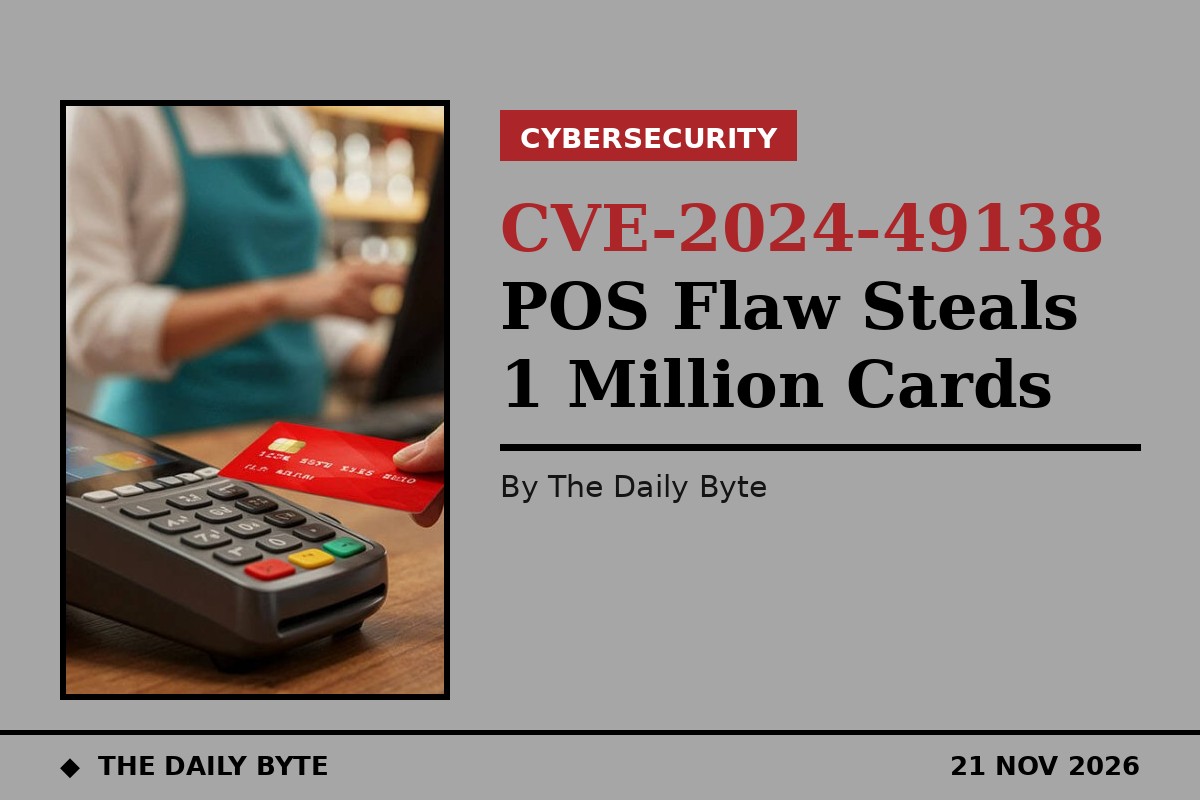
Attackers stole at least one million credit and debit card records from shop tills in more than 20 countries by exploiting a Windows flaw that Microsoft patched almost two years ago, according to research published by Cybernews on 18 November.
Cybernews researchers found an exposed server belonging to the attacker that held the operation in one place: malware source code, exploitation tools, and a carding panel named “VINY JUNIOR TRILHAS” storing the stolen payment card data. The server showed infections across more than 700 point-of-sale terminals, with technical records for 782 compromised systems, each listed with its Windows version, city and country.
The compromised terminals were in daily use, so every card swiped or tapped on them could be captured, and the stolen dataset is likely to have kept growing throughout the campaign. At least a million cardholders now face potential financial fraud, including unauthorised purchases and account takeovers, depending on their banks’ fraud detection and cardholder protection policies.
The flaw behind the theft
The attack leveraged CVE-2024-49138, an elevation of privilege vulnerability in the Windows Common Log File System driver, known as CLFS. Microsoft patched the flaw in December 2024, and the US cybersecurity agency CISA added it to its known exploited vulnerabilities catalogue weeks later, yet every compromised terminal in this attack was running software that had not been updated for at least one year and nine months when Cybernews found the server in August 2026.
The flaw is a local privilege escalation, which means it needs an attacker who already has a foothold as an unprivileged local user; it does not give remote access on its own. Cybernews has not disclosed how the attackers reached that first foothold on the infected terminals, so the initial access route remains unconfirmed.
Once the malware gained system-level access through the flaw, it installed a remote access trojan that continuously harvested payment card data from the terminal’s memory as transactions were processed, the same memory-scraping approach point-of-sale malware has used for more than a decade. The recovered source code shows the attacker adapted a public proof-of-concept exploit published on GitHub within weeks of the patch, crediting the original researcher in the files, rather than writing a fresh exploit.
What was stolen
The carding panel contained credit and debit card details for at least one million unique cards, including primary account numbers, validity periods, bank identification numbers, issuing countries, issuing banks, exfiltration dates, and card types and brands. The server also held the operating system versions and geographic locations of the 782 compromised systems.
Brazil was hit hardest. Most of the infected terminals were located there, and most of the stolen cards were issued by Brazilian banks. Cybernews assesses the threat actor as Brazilian, based on the language used in the recovered attack reports and documentation, and says the campaign focused heavily on retail and service businesses using Windows-based point-of-sale systems.
Two years unpatched
The researchers reported their findings to Brazil’s national computer emergency response team, CTIR, on 8 September 2026. The exposed server was observed to have gone offline on 31 August 2026, nine days before the report. Cybernews has not named the specific remote access trojan involved, so whether it is a known tool or a custom build remains unconfirmed.
The attack shows how neglecting software updates can enable large-scale exploitation across entire industries. The bug the attacker exploited was publicly known and patched in December 2024, and proof-of-concept code was freely available, yet hundreds of shop tills stayed vulnerable nearly two years later because retailers delayed patches over downtime, compatibility testing or simply a lack of awareness.
Point-of-sale systems often run on legacy infrastructure with infrequent update cycles, but the lesson of this campaign is blunt: a till that processes card payments is a computer like any other, and leaving it unpatched for almost two years hands attackers the keys. Cardholders should check their statements for unfamiliar transactions and report anything suspicious to their bank immediately.


