Pound Steadies at $1.31 After 13 Falls in 16 Days
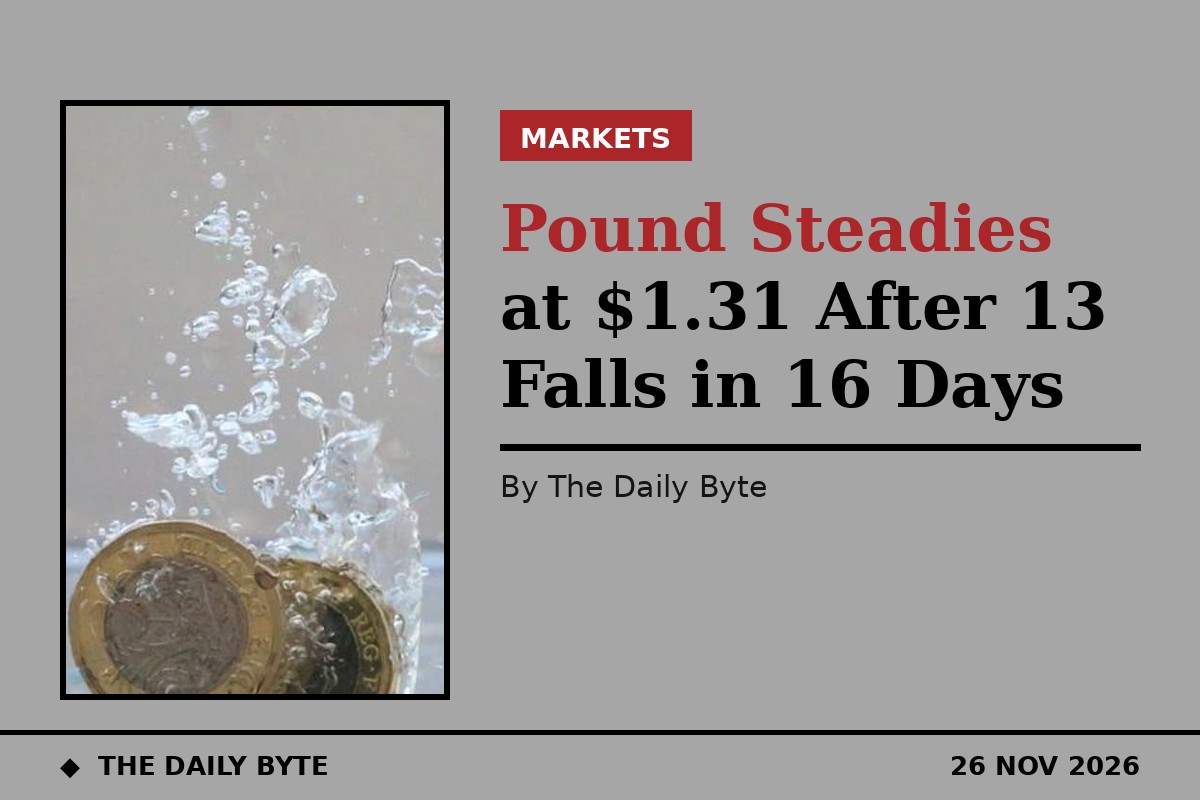
The pound held steady on Thursday after a run of falls that had pushed it to its lowest levels in a year, as the dollar paused with US markets closed for the Thanksgiving holiday.
Sterling was last marginally lower at 1.3107 dollars, Reuters reported, after falling in 13 of the past 16 sessions and losing more than 2 percent of its value against the dollar during November.
Against the euro, the pound edged weaker to 83.76 pence. In early Asian trading it had changed hands near 1.3120 dollars, according to TradingPedia.
The pound had touched a more than 19-month low of 1.3011 dollars on Monday, hurt by worries about a hawkish Federal Reserve and weakening sentiment towards the artificial intelligence trade that had powered markets for much of the year.
Part of the recent weakness has come from the equity selloff. Tomás García-Purriños, a senior strategist at Santander Asset Management, told Reuters the pound tends to perform well when the market is in risk-on mode. The market has not been in that mode, he said, so it was only natural that the pound had corrected, particularly as it had been performing relatively well for some time.
Garcia-Purrinos added that both fundamental and valuation indicators have improved in favour of the pound recently. He said Santander prefers to bet on the dollar against the euro rather than against the pound, where it remains neutral.
Bank of England Governor Andrew Bailey said on Wednesday that British inflation may not rise as high as the Bank forecast earlier this month if international energy prices stabilise at current levels. Members of the Bank's Monetary Policy Committee mostly reaffirmed their previously stated views when they appeared before parliament's Treasury Committee, and financial markets showed little reaction.
Traders have nevertheless increased their bets on the Bank raising interest rates at its December and February meetings, LSEG data showed, with a majority now expecting two back-to-back increases. Money markets are pricing in another three Bank of England rate increases by September 2027.
Market pricing implied almost an 80 percent probability of a rate rise at the Bank's 17 December decision, according to TradingPedia. Bailey, Deputy Governor Clare Lombardelli and Monetary Policy Committee member Catherine Mann all emphasised that they could not overlook inflation risks from persistently elevated energy prices, and that policy action would be required unless a sudden resolution in the Middle East drives energy costs lower.
Scotiabank strategists noted that Monetary Policy Committee member Greene had said it would be appropriate to tighten policy further unless the Iran conflict is resolved suddenly or the data improves. Swaps indicate around 19 basis points of implied tightening for the 17 December decision, and the bank judged sterling's losses to be starting to look stretched, with a push above the 1.3110 to 1.3120 zone potentially opening the way towards 1.32 dollars.
Firm price pressures in the United States are also keeping Federal Reserve officials on course for a possible rate rise in December. The US personal consumption expenditures price index rose 3.8 percent year on year in October, with core PCE up 3.3 percent.
The Bank of England raised interest rates by 25 basis points earlier this month, its first increase of the year after a lengthy wait-and-see approach. Attention now turns to the 17 December decision, and to Friday's shortened US trading session, for the next test of whether sterling's slide has run its course.


