President Accepts Resignations of Justices Shah and Minallah
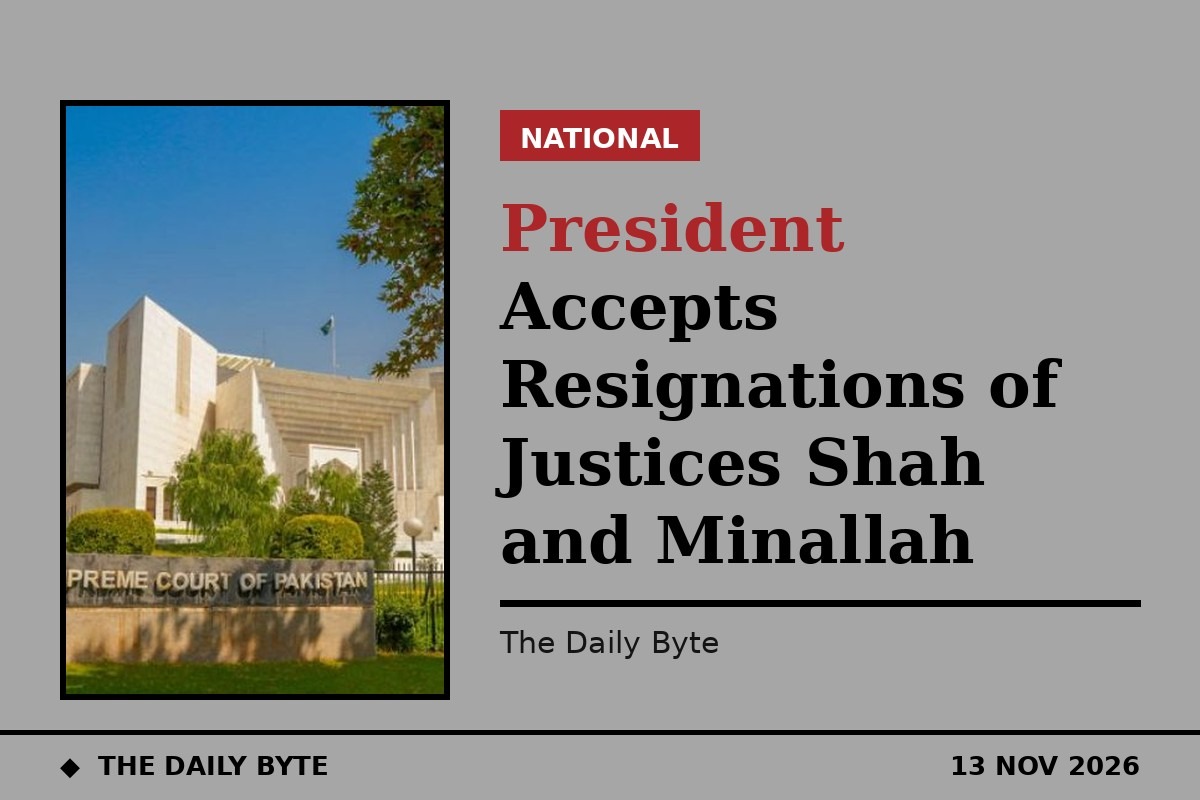
President Asif Ali Zardari has accepted the resignations of Supreme Court Justices Mansoor Ali Shah and Athar Minallah, a day after the two senior judges stepped down in protest at the 27th Constitutional Amendment.
The acceptance was announced on Friday in a post on the President's official X account. The two judges had handed in their resignations on Thursday, hours after the contentious amendment was signed into law by the president, describing the legislation as an affront to the judiciary and the 1973 Constitution.
Justice Shah, the senior-most judge of the Supreme Court, set out his reasons in a 13-page resignation letter issued in both English and Urdu. "I therefore resign as the senior-most judge of the Supreme Court of Pakistan, in full awareness of the reasons that compel it and in loyalty to the Constitution that has guided every step of my judicial life," he wrote.
In his letter, Justice Shah assailed the amendment as "a grave assault on the Constitution of Pakistan", which "dismantles the Supreme Court of Pakistan, subjugates the judiciary to executive control, and strikes at the very heart of our constitutional democracy". He said he had a choice between continuing as a Supreme Court justice under an arrangement he believed undermined the institution he had sworn to protect, or handing in his resignation.
Minallah: an oath to "the Constitution"
Justice Minallah, in his own letter, recalled that when he took the oath of office 11 years ago, he swore to uphold not "a constitution" but "the Constitution". Both judges had recently written separately to Chief Justice of Pakistan Yahya Afridi, calling for a full court meeting and a judicial conference to debate the 27th Amendment.
According to a Supreme Court press release, there was no discussion of the amendment at the full court meeting called by Chief Justice Afridi on Friday. The meeting gave its final approval to the Supreme Court Rules, 2025.
Separately, former attorney general Makhdoom Ali Khan tendered his resignation from the Law and Justice Commission of Pakistan to the chief justice, in another fallout from the amendment.
How the 27th Amendment passed
The president's assent came hours after the Senate approved the bill for the amendment for a second time amid opposition protests. Senate Chairman Yousuf Raza Gilani announced that 64 lawmakers had voted in favour and four against, meeting the two-thirds majority requirement.
The bill had first been presented in the Senate on Monday and passed the same day, before being forwarded to the National Assembly, which approved it with amendments and sent it back to the upper house.
The amendment promises, on paper, to "streamline" governance through new constitutional courts, revived executive magistrates and a relook at how the armed forces are commanded. At its heart is the creation of a Federal Constitutional Court, which would draw superior court judges from all provinces and hear constitutional matters, while the regular courts continue to hear all other cases.
Clause 23 of the amendment states that the incumbent chief justice, Justice Yahya Afridi, will maintain his office until the end of his tenure. Sources told Dawn that the president was expected to administer the oath to the chief justice of the new Federal Constitutional Court at the Presidency on Friday, following the enactment of the amendment.
Reaction from the legal community
Lawyers and civil society members have hailed the two judges for stepping down to preserve their constitutional oath, with a joint statement from 60 citizens and lawyers describing them as national heroes who "prized principles over expediency". The statement, printed in Dawn, said Justice Shah "undisputedly ranks among the finest jurists ever produced by Pakistan".
The resignations mark one of the most serious ruptures between the judiciary and the executive in Pakistan's recent history, and leave the Supreme Court diminished just as the new Federal Constitutional Court prepares to take up constitutional jurisdiction.