Prison Education Cuts Raise Reoffending Risk
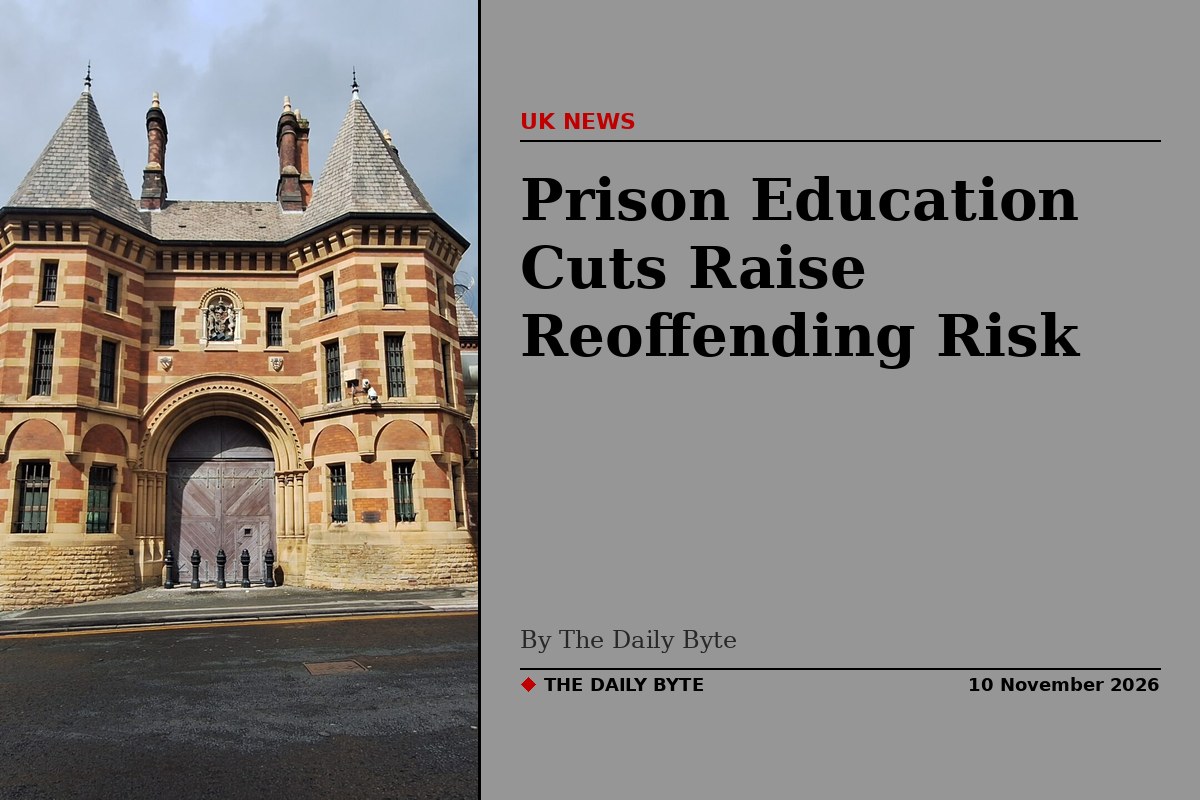
Two of England and Wales's most senior inspectors have warned that cuts to education in prisons risk leaving people more likely to commit crime after release. In a joint letter published on Tuesday 10 November, the Chief Inspector of Prisons, Charlie Taylor, and the Chief Inspector of Ofsted, Martyn Oliver, told Justice Secretary Alex Norris that the government has failed to transform prison education in the decade since a landmark review called for change.
The inspectors said prisoners leaving some of the country's highest-risk jails could leave custody no better equipped to turn their lives around than when they arrived, and in some cases even more likely to offend. They linked the decline in teaching and training to reoffending figures that are now higher than before the pandemic, reaching 28.8 per cent between January and March 2024.
"We feel that it is reasonable to assume that poorer quality provision has contributed to this picture," the two chief inspectors wrote.
A decade after the Coates review
The intervention comes ten years after Dame Sally Coates published her independent review of prison education, which called for high-quality teachers, better funding to support ambitious curriculums and digital systems that would allow flexible learning. Taylor and Oliver said that instead of the transformation Dame Sally called for, too many prisons are now characterised by a lack of education, skills and work activity and limited regimes.
Dame Sally told FE Week that the letter made her question the value of carrying out the review in the first place, describing it as potentially little more than a "dusty review on a shelf somewhere". She said prison education was the "biggest driver" of reducing reoffending, and pointed to the estimated £59,000 annual cost of an adult prison place, against Ministry of Justice data from 2020 showing that 57 per cent of adult prisoners had literacy levels below those expected of an 11-year-old.
"We just park things by saying let's do a review, and everybody thinks something's happening," she said. "But actually, what action happens as a result of the review?"
Grades have fallen sharply
Ofsted grades for prisons across England and Wales have fallen sharply over the same period. In 2017, 44 per cent of prisons were rated good or outstanding. By 2025, that figure had dropped to just 18 per cent, the inspectors said.
The letter blames the "significant real-terms cuts" to prison education introduced in October 2025, under the new Prison Education Service contract. Some prisons lost more than half of their education hours. Six months ago, Justice Minister Alex Norris acknowledged that at least 79 prisons had suffered education budget cuts of up to 58 per cent under the contract. Ministers have faced accusations of downplaying the impact of the cuts since the contract was approved.
The inspectors also found that places in essential core subjects, including maths, English and English for speakers of other languages, have been reduced significantly, along with support for prisoners who need to improve their reading.
High-security jails hit hardest
The letter pays particular attention to the long-term high-security estate, where prisoners serve the longest sentences and where education matters most for eventual release. At HMP Manchester, inspectors found that cuts had led to the loss of "many" education staff and a "severe curtailment" of learning opportunities. The prison was rated inadequate across all Ofsted judgments at its inspection earlier this year, repeating its previous performance.
At HMP Norwich, much of the vocational training at its category C site has ended. Governors across the country have reported the loss of vocational courses that equip prisoners with practical skills and improve their chances of finding work, including construction, catering, cycle mechanics, engineering technology and electrical installation.
The inspectors said the few prisons still maintaining good provision were doing so through the "tenacity and innovation" of their staff, achieving results "despite" the funding environment rather than because of it.
Long-term thinking needed
Dame Sally warned that the long-term benefits of investing in prison education are often overlooked by governments, because spending on education behind bars is not necessarily at the top of the public agenda. "I just think a lot of governments don't think about long term," she said.
The Ministry of Justice has been approached for comment on the inspectors' letter.