PSNI Launches Plan to Tackle Violence Against Women
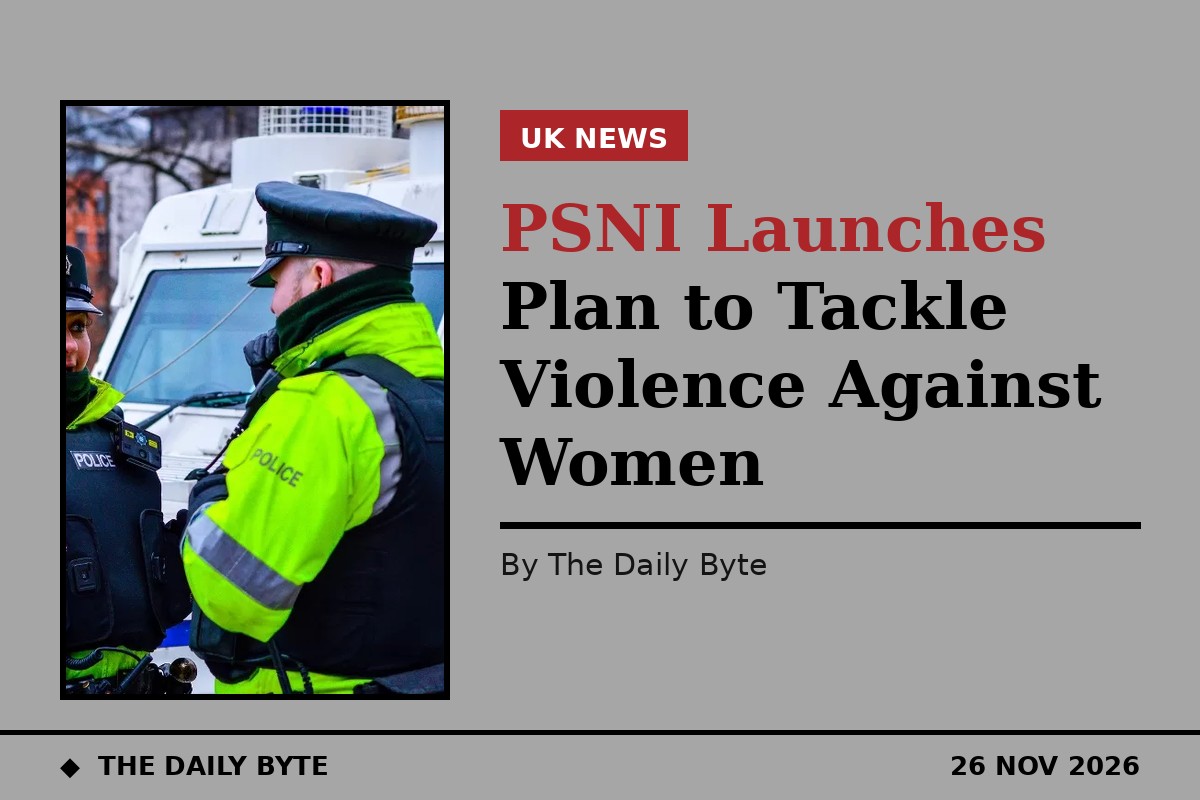
The Police Service of Northern Ireland has launched a new three-year framework to tackle violence against women and children.
The Violence against Women and Children Strategic Framework 2026-2029 was announced on 25 November, during the 16 Days of Activism against Gender-Based Violence. It is the next stage of a seven-year commitment that began with the Tackling Violence against Women and Girls Action Plan in 2022.
Four commitments and 42 actions
The framework is built around four commitments: Protect, Prevent, Pursue and Prepare. Its delivery plan contains 42 core actions, made up of 22 new commitments, 17 enhanced commitments and three carried forward from the earlier plan. The PSNI said 38 of the original programme’s 41 actions were completed in its first three years.
The framework covers six areas of harm: domestic abuse and interpersonal violence, sexual violence, violence against children, harmful cultural practices, cyber-enabled violence and high-harm perpetration. It puts a stronger emphasis on children than the earlier plan, with child-centred safeguarding, earlier intervention and work to prevent cycles of violence and abuse.
Offences down, but still high
Police figures show recorded offences falling, but still at a high level. The PSNI performance dashboard recorded 22,571 offences in the 12 months to 15 November 2026, down 13.6 per cent from 26,126 in the 12 months to 15 November 2023.
Between 2022-23 and 2025-26, violence with injury involving female victims fell by 13.7 per cent, violence without injury fell by 20.9 per cent, and stalking and harassment fell by 33.9 per cent. Sexual offences involving female victims were broadly unchanged, rising from 3,283 to 3,284.
More than half of all sexual offences recorded in Northern Ireland in the past year involved children, accounting for 51.7 per cent of the total, the PSNI said. Since the action plan launched in 2022, officers have made 8,216 arrests for domestic abuse, stalking and non-fatal strangulation.
What the framework will do
Under the Protect commitment, the PSNI will strengthen victim contact, improve referrals to specialist advocacy and support, and focus on how cases move through the criminal justice system. That includes stronger pathways to The Rowan, the regional sexual violence service, and work with partners to understand why cases do not progress.
Under Prevent, the focus is on identifying vulnerability and intervening before violence escalates. Project Vigilant, which brings plain-clothed and uniformed officers together around nightlife locations, is now operating after a pilot in Derry-Londonderry in October 2025. Officers carried out 25 targeted deployments and made 72 interventions in the last year. Sexual offences in Belfast City are down 9.5 per cent on a rolling 12-month basis, and in Derry-Londonderry they are down 18.7 per cent.
Under Pursue, the PSNI will target repeat and high-risk perpetrators, with work on offender management, digital evidence and risk assessment. A coordinated operation across five policing districts on 12 March 2026 resulted in 36 arrests linked to domestic abuse, serious assault and other investigations.
Under Prepare, the framework includes a coordinated training programme covering domestic abuse, coercive control, rape and serious sexual offences, stalking, trauma and the needs of children.
Reviews and accountability
The framework also takes in recommendations from independent reviews led by Dr Jan Melia and Rachel Langdale KC, and the PSNI said progress will be tracked through a performance dashboard, quality assurance and regular review, with scrutiny by the Northern Ireland Policing Board.
Detective Chief Superintendent Zoë McKee, head of the PSNI Public Protection Branch, leads the work. The PSNI said recorded crime alone cannot capture all abuse, and it will weigh victim feedback, repeat harm and safeguarding outcomes alongside the figures when judging whether the framework is working.


