Putin pushes Kostyantynivka truce; Kyiv warns of trap
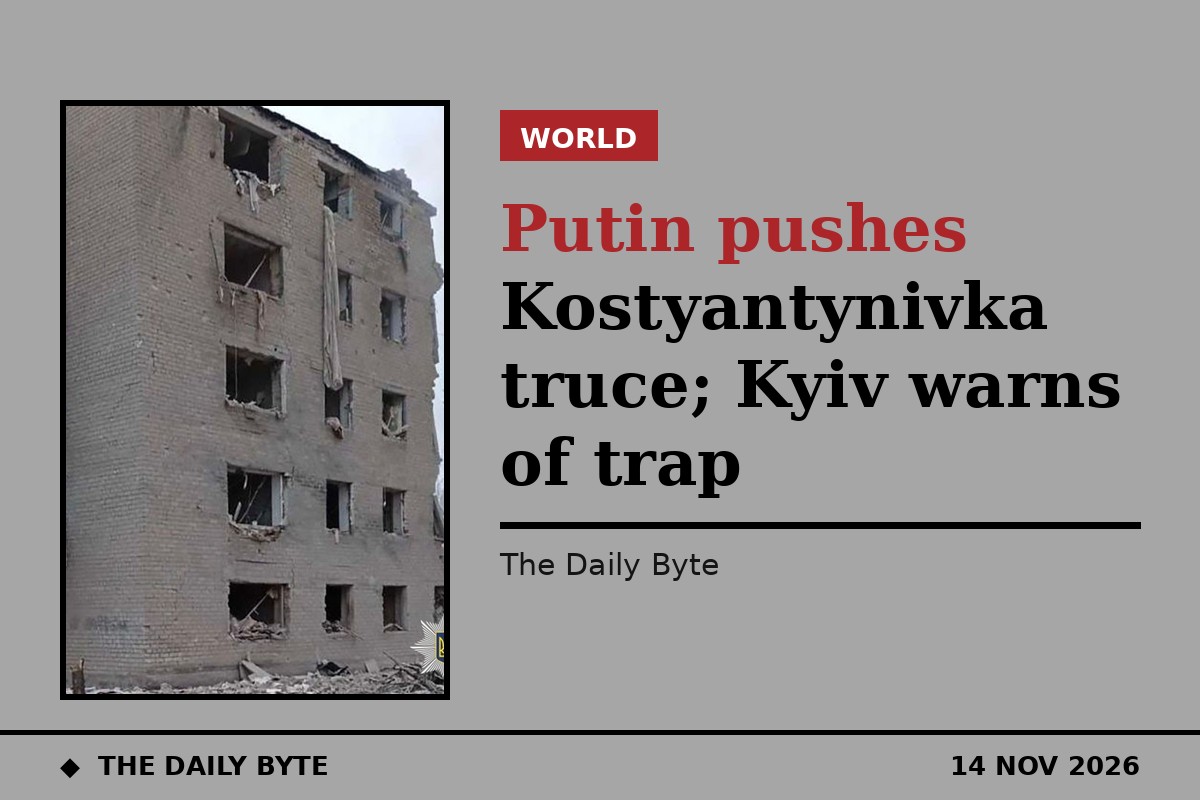
Russia is pressing Ukraine to agree a local ceasefire in the frontline city of Kostyantynivka, in Donetsk Oblast, so civilians can be evacuated — but Kyiv and military analysts warn the proposal could be used to mask a Russian troop build-up. President Vladimir Putin put the idea to US envoys Steve Witkoff and Jared Kushner in Moscow on 12 November, and Kremlin spokesman Dmitry Peskov repeated the call on 13 November.
Putin proposed what he called a “humanitarian mission” in Kostyantynivka, saying about 400 to 500 civilians remained in the city. He suggested inviting foreign journalists, including Americans, and Ukrainian and Russian human rights representatives to oversee the evacuation, and pointed to a recent evacuation operation in occupied Oleshky, in Kherson Oblast, as the model, according to the Institute for the Study of War (ISW).
Why Kyiv and analysts are wary
Peskov called the proposal “a very important initiative” and urged US and European officials to pressure Ukraine into agreeing to a localised ceasefire. He said Witkoff and Kushner actively supported the idea.
But the ISW says a ceasefire like the one in Oleshky cannot work in Kostyantynivka, because the frontline situations are not comparable. Russian forces fully control Oleshky, a settlement about 3.7 kilometres from the frontline, so the two sides only had to halt strikes across the Dnipro River that separates them. In Kostyantynivka, Russian and Ukrainian forces are intermingled in active combat, and Russia does not control the town — despite Putin’s claim since 3 July that it does. The ISW says it has observed evidence of at least 41 Ukrainian positions in and around Kostyantynivka since 1 September 2026.
“In Oleshky they brought in equipment and rotated troops under the cover of a humanitarian operation,” said Dmytro Lytvyn, an adviser to President Volodymyr Zelenskyy, challenging the precedent Putin cited. The ISW assesses that the Kremlin is very likely seeking a temporary local ceasefire to build up forces for a push north towards Druzhkivka, one of Ukraine’s most heavily fortified cities on the Fortress Belt defence line.
No wider breakthrough in Moscow
The Kostyantynivka proposal was the narrowest outcome of the Moscow meeting, which followed two days of US-mediated talks between Russian and Ukrainian delegations in Abu Dhabi on 10 and 11 November. Those talks produced an agreement in principle on a large prisoner exchange, but no breakthrough on ending the war, according to the Daily Inference.
Putin refused to soften Russia’s territorial demands in Moscow, rejected demilitarised or “grey” zones, and ruled out foreign peacekeeping troops in Ukraine after any settlement, describing their presence as a “continuation of war” and saying Russia would treat them as a “legitimate target”. “For us, there is only one line of demarcation: the state border,” Putin said.
Kushner said after the Moscow meeting that European representatives would take part in the next round of talks, although the date, venue and terms remain unsettled. Russian officials disputed that account, with foreign ministry spokeswoman Maria Zakharova claiming on 13 November that Putin had not discussed European participation with the US envoys. Russia launched 117 drones against Ukraine overnight, the ISW reported.
Sources: Institute for the Study of War and Daily Inference.


