QNB Rules Out Full Bank of England Rate-Hike Cycle
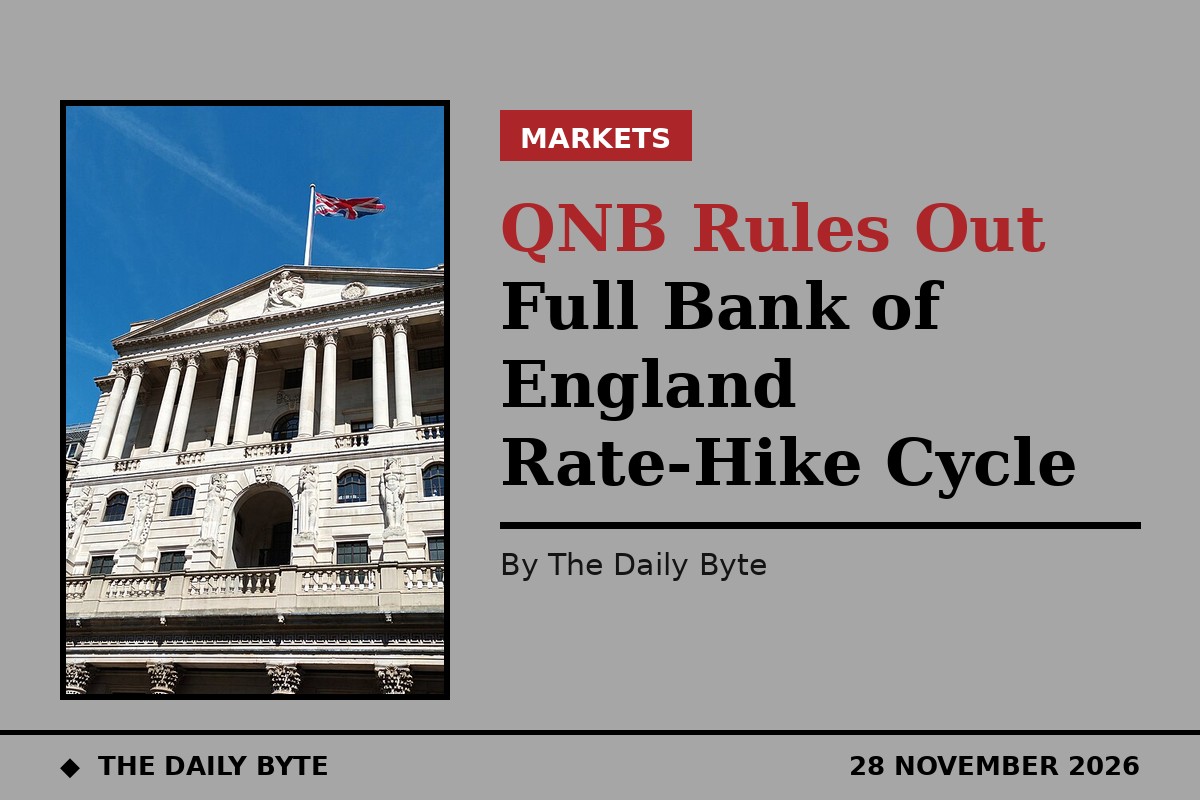
Qatar National Bank has ruled out the prospect of the Bank of England embarking on a full interest-rate tightening cycle, arguing that Britain's inflation problem is an energy shock imported from abroad rather than excess demand at home.
In its weekly report, published on Saturday 28 November, QNB said the Bank was unlikely to follow the US Federal Reserve into a sustained series of rises, even though Bank Rate rose to 4% this month and markets still price a further increase in December.
The argument cuts against market pricing: traders have spent the month pricing a December move at between 80% and 91%, and the Bank's own November report projects inflation rising to around 5% by mid-2027. QNB's view is that one or two rises do not make a cycle — and that a cycle would do more harm than good.
Three reasons QNB says no cycle is coming
QNB set out three factors behind its view: the energy-driven nature of UK inflation, slack in the labour market, and financial conditions that are already restrictive.
First, it argued that inflationary pressure in Britain is largely energy- and supply-driven, which monetary policy is not well equipped to address. Headline inflation reached 3.6% in October, 1.6 percentage points above the Bank's 2% target, and QNB said transport alone accounted for around 1.1 percentage points of that overshoot, driven by a 33% year-on-year rise in motor fuel prices. Rate rises would not lower oil and gas prices, it said; they would mainly weigh on activity.
QNB also pointed to limited evidence of second-round effects so far. Core inflation, which strips out volatile energy and food prices, stood at 2.8%, while services inflation was 3.7% and food price inflation had fallen to 0.9%. As long as the shock stays confined to energy, the bank argued, the Bank can look through it, as central banks typically do with temporary supply disruptions.
Labour market slack weakens the case
The second factor is the labour market. Wages are the main channel through which higher energy costs turn into persistent inflation, QNB said — and that channel remains weak in Britain.
Unemployment reached 5.2% at the start of the year, its highest since early 2021, before easing to 4.6%, still above its 2022 low of 3.6%. Regular private-sector wage growth stood at 3.1% in the third quarter, down from 3.3% at the start of 2026. QNB contrasted that with 2022, when a tight labour market amplified the shock, and with the United States today, where the Fed has cited resilient growth and a strong labour market to justify rises.
Financial conditions have already tightened
The third factor, QNB said, is that financial conditions have already done some of the Bank's work for it. By holding Bank Rate at 3.75% instead of delivering the two cuts markets had expected before tensions escalated, and then raising it to 4%, the Bank has effectively tightened policy already.
Markets have amplified the effect, QNB added, with the 10-year gilt yield reaching around 5.5% in October — a 19-year high, the bank said — and staying above 5.2%. Those elevated yields feed into mortgage and corporate borrowing costs, helping to curb demand without further action from the Bank.
What the Bank itself has said
The Bank's own account is more cautious. At its meeting ending on 4 November, the Monetary Policy Committee voted 8–1 to raise Bank Rate by 0.25 percentage points to 4%, with one member favouring a larger half-point rise to 4.25%. The Bank said there was still limited evidence of knock-on effects onto other prices and wages, but that the pipeline of inflationary pressure was now enough to justify a rise.
The Bank also stressed that monetary policy is not on a pre-set path and that future decisions will depend on how far high energy prices feed into wages and prices. Governor Andrew Bailey has said market expectations include a risk premium over energy prices and do not represent a predetermined path — a point QNB cited.
Other analysts are less convinced. UOB's 6 November note said December remained live but February was the likelier timing for the next 25-basis-point rise, to 4.25%. Inside the Bank, Alan Taylor has stressed the November rise did not start a hiking cycle, while other members have warned further rises may be needed.
The warning that could change everything
QNB attached a clear condition: a prolonged escalation between the United States and Iran could push energy costs higher and feed more broadly into prices and wages — the one development that would force the Bank to reconsider.
QNB concluded that a full rate-hiking cycle now could mean excessive tightening. The next test comes on 17 December, when the Monetary Policy Committee meets again.


