Quad Business Forum Set for Early 2027, Rubio Says
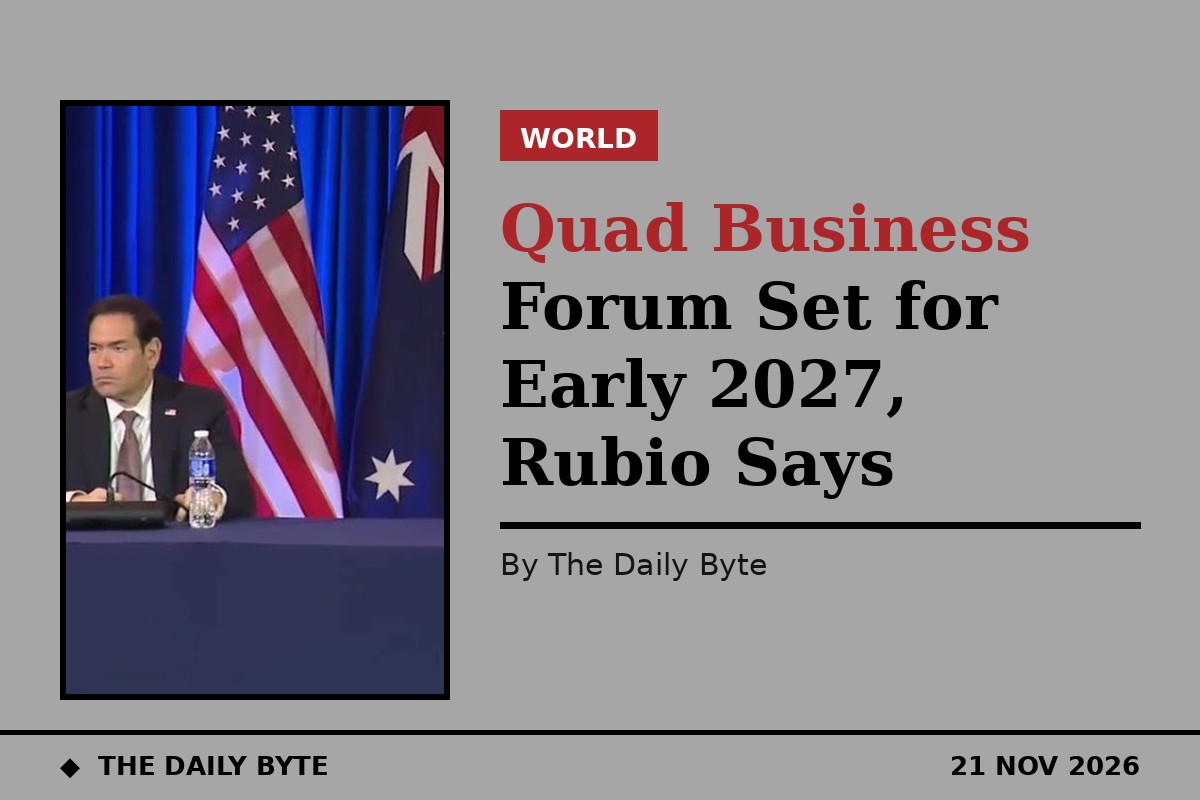
Leading companies from India, the United States, Japan and Australia will meet early next year to explore commercial deals, US Secretary of State Marco Rubio confirmed on 21 November, giving the Quad grouping its most explicitly commercial project yet.
Rubio outlined the plan at a White House news conference after President Donald Trump returned from Asia. He said the top businesses in the four countries were going to meet early next year, describing commercial agreements as the outcome he hoped the meeting would produce. He did not name the companies expected to attend, and he did not specify a date or a venue.
The forum was announced at the Quad leaders' summit in Manila on 17 November, where Trump met Prime Minister Narendra Modi of India, Prime Minister Anthony Albanese of Australia and Prime Minister Sanae Takaichi of Japan. A joint press release from the four governments announced the inaugural Quad Business Leaders' Forum, scheduled for early 2027, bringing together business leaders, government officials and policy experts to foster business ties, including commercial deals and partnerships.
Trump puts the forum under his sponsorship
Rubio placed the forum explicitly under Trump's sponsorship, saying the four economies together could create jobs and markets for American products. He said Washington saw the meeting as a chance to find buyers for American goods and create jobs at home, and that the administration would look for gains that workers and households in the United States could see, including more jobs and lower prices.
Rubio pointed to the Philippines as an example of the commercial results Washington sought from its diplomacy in Asia. He said the US defence commitment to Manila should be reflected in the two countries' trading relationship, and that Trump had personally negotiated a framework for reciprocal trade with Philippine President Ferdinand Marcos.
Trump said his meetings with Southeast Asian leaders had secured more than 17 billion dollars in commercial deals. Among the purchases he cited were 20 Boeing 787 Dreamliners with General Electric engines for Philippine Airlines. He also said the Philippines and Malaysia had agreed to use American technology and services for their cloud infrastructure.
AI initiative comes with a US-first condition
At the Manila summit, the four leaders also launched an initiative to develop advanced artificial intelligence. Trump attached a significant condition: while the four countries shared common interests in the technology, he said he wanted most of the work to take place in the United States.
He made that preference explicit on data centres, saying US companies that built them abroad could face a substantial tax. He did not give a rate or say when such a tax might take effect. He also urged American communities to negotiate directly with developers over electricity supplies and payments to residents.
The joint press release affirmed a Super Intelligence Accelerator, announced earlier by the four foreign ministers in Atlanta, intended to coordinate and fund efforts to support trusted super intelligence access, deployment and technical assistance across the Indo-Pacific.
Security cooperation widens alongside trade
Beyond trade, Trump said the Quad leaders agreed in Manila to expand cooperation on maritime security and surveillance. He also identified cyber security and the protection of undersea cables as priorities, and the joint statement announced enhanced Quad cybersecurity cooperation and welcomed a new Indo-Pacific Maritime Surveillance Collaboration.
In 2027, the four countries' P-8 and P-3C patrol aircraft are scheduled to fly in a maritime exercise together for the first time in a Quad context. The leaders also reaffirmed their support for ASEAN centrality and their commitment to a free and open Indo-Pacific.
The Quad grew out of humanitarian cooperation among the four countries after the Indian Ocean tsunami of December 2004. Their first leaders' summit took place by video in March 2021, followed by an in-person meeting in Washington later that year, when supply chains were already on the agenda. The 2026 Manila summit, and the business forum it produced, represent the most commercially explicit iteration of that agenda yet.
For now, the forum exists as an announcement and a confirmation, not a schedule. No companies have been named, no city has been chosen, and no deals have been signed. All eyes will now turn to early 2027, when the depth of the Quad's commercial ambitions, and the balance between US-first conditions and genuinely multilateral deals, will face their first real test.


