Rackspace Spot Breach Exposed Customer Cloud Secrets
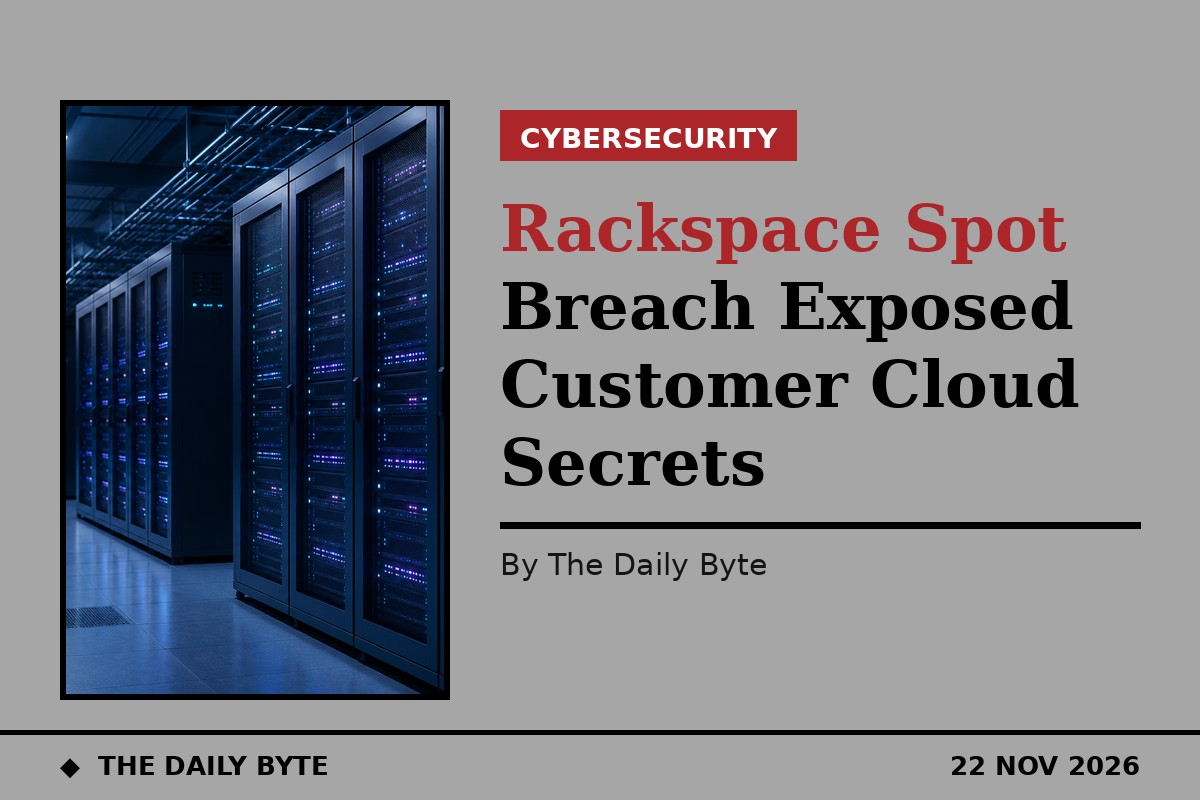
Rackspace has told customers that attackers used leaked credentials to break into its Rackspace Spot cloud platform and read Kubernetes secrets stored in customer clusters. The intrusion ran for most of 17 November 2026, and the company says it has since revoked compromised tokens, removed unauthorised workloads and restored the service.
According to a customer notification obtained by BleepingComputer, which first reported the breach on 21 November, the unauthorised access ran from about 00:20 to 22:00 UTC on 17 November. Rackspace says it learned of the intrusion on 18 November, after a customer reported it, and confirmed that customer's organisation was affected the same day.
What the attackers could do
Rackspace Spot is a cloud platform that lets organisations deploy and manage containerised applications using Kubernetes, the widely used system for running software in containers. In the affected customer organisations, the attackers were able to act as legitimate users. That meant they could create pods, the smallest units of work in Kubernetes, in customer clusters, read Kubernetes Secrets, and list nodes and volumes.
Kubernetes Secrets hold sensitive information such as passwords, authentication tokens and API keys that applications use to connect to databases, cloud services and other systems. Rackspace warned that the attackers could have read any Secret stored in an affected user's clusters, as well as any Spot API tokens or refresh tokens held by that user. Because Kubernetes Secrets are only base64-encoded by default rather than encrypted, anyone who can read them gets the plain values.
The company has not said how many customers were affected, whose credentials leaked, or whether any information was actually stolen from the clusters. It has also not said what the unauthorised pods actually did once they were running.
Indicators and customer advice
Rackspace shared indicators of compromise with customers: the IP address 23.224.79.106, the address range 23.224.0.0/15, and suspicious Kubernetes pod and object name prefixes beginning with i1, glm- and probe. Affected customers have been told to reissue their Spot API tokens, replace refresh tokens used in automation tools, download fresh Kubernetes configuration files, and rotate every credential stored in their cluster Secrets.
Customers were also advised to review logs for databases, container registries, Git repositories, cloud storage and third-party services dating back to 17 November, to look for any abuse of exposed credentials. That advice matters because a stolen database password or cloud key can be used well after the original intrusion is closed, and often from outside the compromised platform entirely.
Outage and recovery
The breach also caused an extended outage of the Rackspace Spot administration console, temporarily stopping customers from managing their clusters and rotating credentials that may have been exposed. Sirish Raghuram, co-founder and chief growth officer of Platform9, which co-developed Spot with Rackspace, said in a public discussion that the teams deliberately disabled access while securing the infrastructure. After several delays, Rackspace announced that Spot service had been fully restored on 21 November.
The incident is a reminder of how much damage a single set of leaked credentials can do on a managed cloud platform. One login gave the attackers the rights of a legitimate user, and from there they could move across clusters, read secrets and run their own workloads. For any organisation using managed Kubernetes, the lesson is familiar but worth repeating: rotate credentials promptly, limit what any single token can do, and treat every secret in an affected cluster as compromised until it has been replaced.