Ramaphosa Wins Phala Phala Court Battle
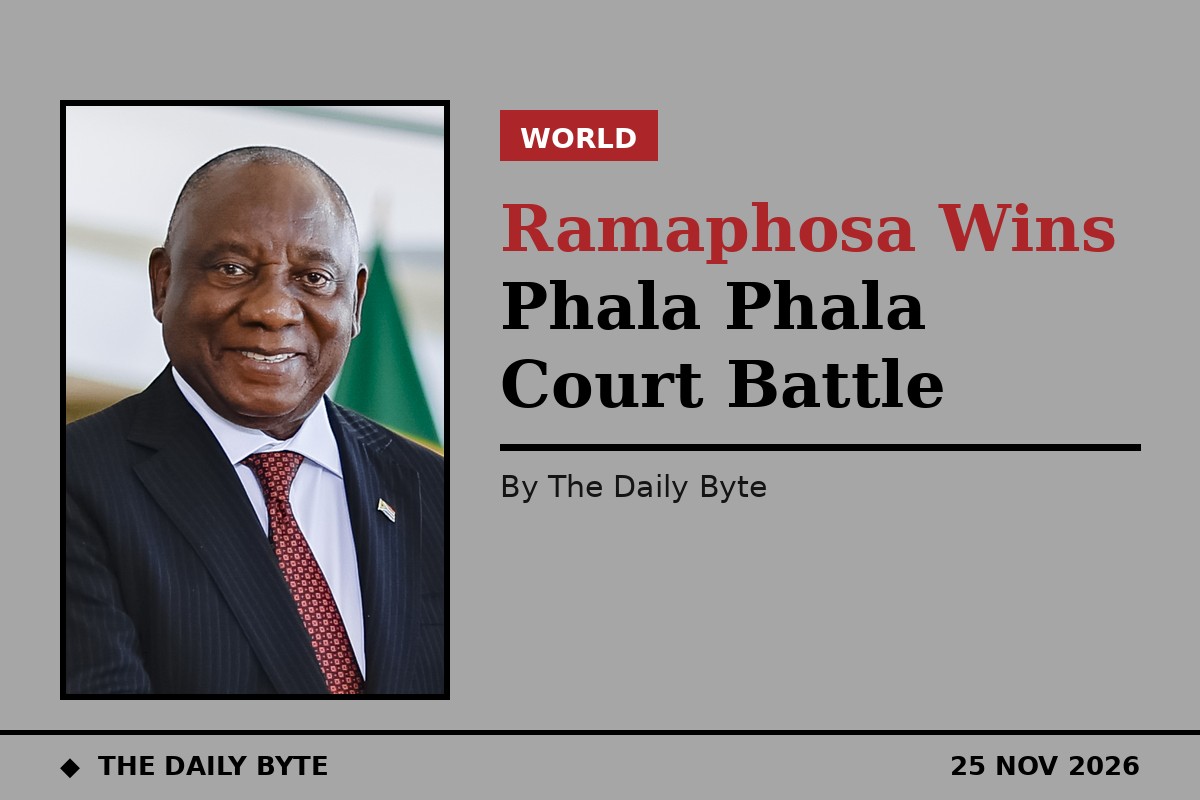
The Western Cape High Court has set aside the independent panel report that found President Cyril Ramaphosa may have committed a serious violation of the law over the theft of foreign currency at his Phala Phala farm, bringing Parliament's impeachment process against him to an end. The full bench delivered its judgment in Cape Town on Wednesday, 25 November 2026.
The court declared the 2022 Section 89 panel report unlawful and set it aside in its entirety, and also set aside any steps the National Assembly had taken on the basis of the report. Each side was ordered to pay its own costs. The ruling can still be appealed.
Panel 'misconstrued its mandate'
The judgment, handed down by Judge President Nolwazi Mabindla-Boqwana with Judges Mark Sher and Ncumisa Mayosi, found that the panel, chaired by former Chief Justice Sandile Ngcobo, had gone beyond its lawful remit, asked the wrong questions and made several material errors of law.
Parliament had asked the panel to establish whether sufficient evidence existed that the president had breached the law. The court found that the panel instead applied a different test, asking whether, on the information before it, Ramaphosa had a case to answer. Because the process it followed and the conclusions it reached were not rationally related to the task Parliament had set it, the report could not stand.
Ramaphosa had challenged the report mainly on procedural grounds, arguing that the panel made a legal misstep when it found that prima facie information suggested he may have committed serious violations of the constitution. The panel had only 30 days to complete its work.
The Farmgate background
The case dates back to February 2020, when thieves broke into the main farmhouse at Ramaphosa's Phala Phala game farm in Limpopo and stole about $580,000 in US dollar bills that had been concealed inside a sofa. The farm is privately owned by the president's family trust.
The panel found that Ramaphosa may have a case to answer because he reported the theft to General Wally Rhoode, a member of the Presidential Protection Unit, rather than directly to the police. South African law requires a person in a position of authority to report the theft of R100,000 or more to the police.
The matter became public in June 2022, when Arthur Fraser, the former director-general of state security, laid criminal charges against the president at a Johannesburg police station. The panel delivered its report later that year, and Parliament initially rejected its findings. In May 2026, however, the Constitutional Court ruled that lawmakers had erred in blocking the process and ordered Parliament to establish a committee to investigate the president's conduct. The Western Cape High Court ordered that committee to pause its hearings in August while Ramaphosa's review application was heard.
What happens next
With the report declared null and void, there is no longer a basis for Parliament to proceed with the next phase of its inquiry. Opposition parties have signalled they will continue to contest the matter, and an appeal remains possible.
Ramaphosa has consistently maintained that his actions were lawful and that the panel's report contained significant inaccuracies. The judgment does not itself decide whether any criminal wrongdoing took place; it rules on the legality of the panel's process. The criminal investigation arising from Fraser's complaint is a separate matter.
The ruling closes a chapter that has shadowed Ramaphosa's presidency for more than four years, since the burglary first came to light. For now, the prospect of South Africa's first president facing formal removal proceedings under the 2018 parliamentary rules has been removed.


