Record Migrant Arrivals Strain Canary Islands
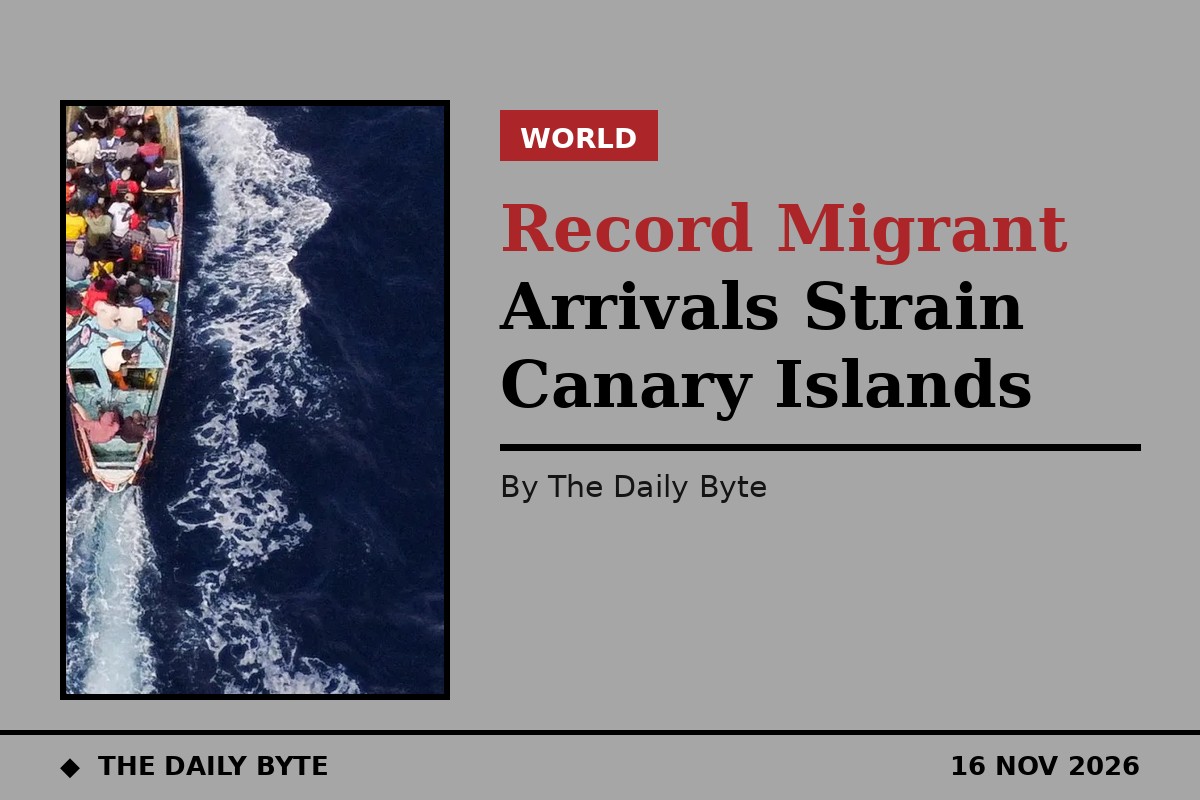
More than 2,300 migrants reached Spain's Canary Islands by boat in two days, Spain's Maritime Rescue Service said on Sunday, 15 November 2026, in the heaviest surge yet on the Atlantic route to Europe.
Saturday, 14 November, was the busiest single day on the route in six years. Al Jazeera, citing the rescue service, reported that 1,488 migrants were rescued aboard 14 dinghies, known as pirogues, most of them arriving on El Hierro, the smallest and westernmost island in the archipelago. The figure passed the previous one-day record of 1,461 people rescued on 7 November 2020.
The Associated Press, also citing the rescue service, reported that 1,324 migrants had been assisted aboard 14 boats heading for or arriving at El Hierro. The two figures differ because they cover different counts and because tallies were still provisional when they were compiled, with some rescues still under way. What both accounts agree on is the scale: about 2,300 arrivals in two days, concentrated on an island of roughly 11,000 to 12,000 residents.
El Hierro bears the brunt
Spanish media reported that 12 boats carrying 1,235 people reached El Hierro on Saturday alone, with further boats landing on Gran Canaria and Tenerife. One boat rescued on Saturday was carrying 240 people, including 12 women and 36 children, according to the authorities.
Most of those arriving had departed from West Africa, many from Senegal, with others from Gambia and Guinea, according to Deutsche Welle and Al Jazeera reporting. The crossing from the West African coast to the Canary Islands covers more than 1,000 kilometres of open Atlantic, usually in small, overcrowded wooden boats.
Spain's Minister of Territorial Policy, Angel Victor Torres, travelled to El Hierro on Sunday to discuss the surge with local officials. The island's reception centre at La Restinga has been overwhelmed by the pace of arrivals, and local leaders have urged the central government in Madrid to move people on to other islands and to the Spanish mainland more quickly.
A migration emergency already declared
The surge follows a migration emergency declared in the archipelago on 11 November, after arrivals rose sharply in recent weeks. Madrid held an emergency meeting on 10 November and announced extra funding for reception capacity.
More than 9,000 people have arrived in the Canary Islands since the start of November, according to Al Jazeera, and the total for the year has already set a record in the 32 years since statistics on the route have been collected. Spain's Interior Ministry said about 28,000 people reached Spain by sea between January and October, of whom about 13,000 landed in the Canary Islands.
The route is one of the deadliest ways into Europe. The International Organization for Migration recorded at least 450 deaths on the Western African Atlantic route in the first 10 months of 2026.
Why arrivals are rising now
Al Jazeera's correspondent in Dakar, Nicolas Haque, said favourable weather conditions in the Atlantic have made departures from the West African coast easier in recent years. The boats leave mainly from Senegal, Gambia, Guinea and Mauritania, and the journey can take several days.
The European Union's new Pact on Migration and Asylum came into force on 12 June 2026, introducing new rules for asylum claims across the bloc. Al Jazeera reported that EU states remain under pressure to control migration from Africa, but the new rules have not stopped the flow of boats to Spain and its enclaves.
For El Hierro, the immediate question is capacity. With reception facilities full and boats still arriving, the island's authorities are pressing for faster transfers and more support from Madrid, while the rescue service continues to patrol a route on which the next boat is never far away.
Sources: Associated Press; Al Jazeera.


