Regenvanu Warns World Must Phase Out Fossil Fuels
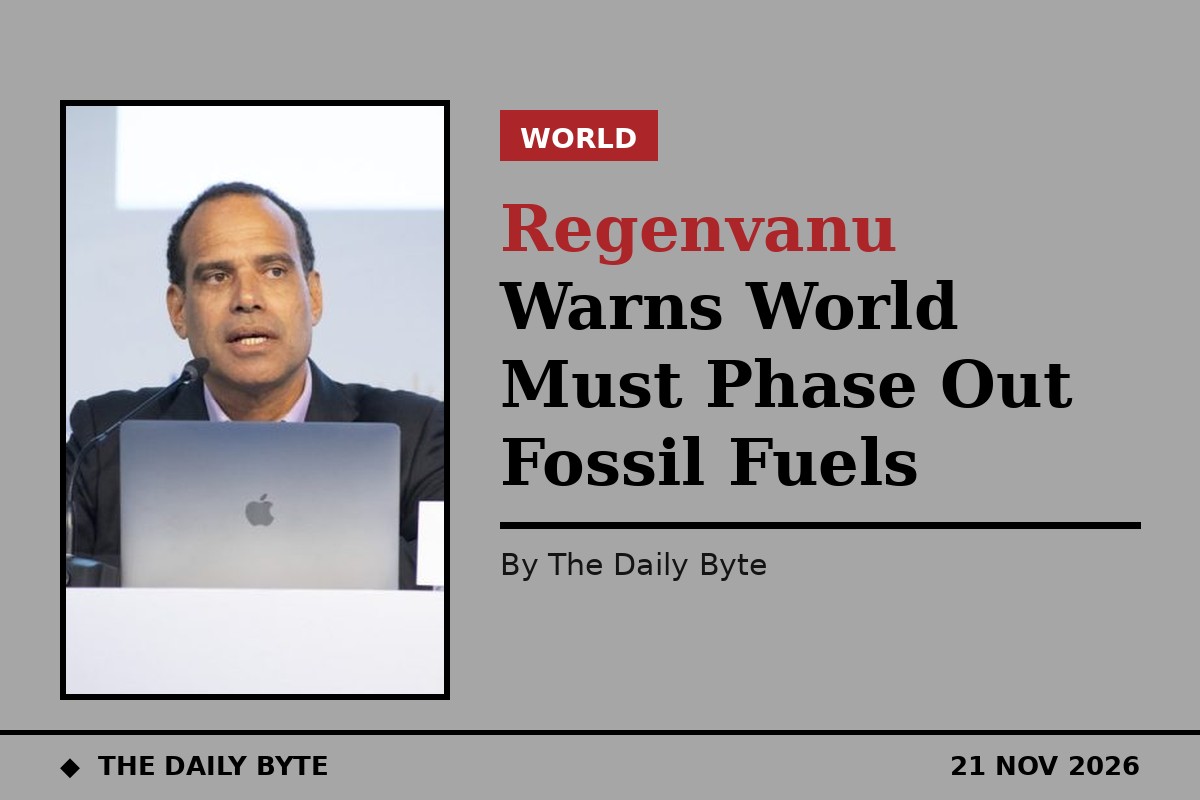
Vanuatu’s climate minister has warned world leaders at the COP31 climate summit that humanity cannot survive on this planet unless fossil fuels are phased out, accusing negotiators of refusing even to discuss the main cause of the climate crisis.
Ralph Regenvanu, Vanuatu’s Minister of Climate Adaptation, Energy and Environment, told the summit in Antalya, Türkiye, that phasing out fossil fuels was the most urgent and collective objective — yet it was, in his words, “not even talked about inside or outside of the room”.
“We all know that consensus-based decision making at these negotiations mean we will not address the root cause of the climate crisis which is fossil fuels,” Regenvanu said.
He pointed to last year’s advisory opinion from the International Court of Justice, which found that countries can be held legally responsible for their greenhouse gas emissions. “And as the court so strongly stated, climate change is a common concern, cooperation is not a matter of choice for states but a pressing need and legal obligation,” he said. “Yet what should be treated as indispensable is contorted and subverted in the negotiation room in the name of consensus.”
Draft deal drops fossil fuels entirely
The COP31 conference slipped into overtime on Friday 20 November, with negotiators from nearly 200 countries struggling to bridge deep divisions over fossil fuels and climate finance. A slimmed-down draft agreement published on Thursday stripped out all references to ending the use of fossil fuels, following objections from Saudi Arabia and other major oil and gas producers. The draft also dropped mention of a 120 billion dollar target for finance to help developing countries adapt to climate change.
Panama’s environment minister, Juan Carlos Navarro, told a press conference: “It is not acceptable to have a COP or a cover document that does not even mention fossil fuels, and we simply will not put up with it.” Regenvanu was blunt about the direction of travel, saying: “We can see where it’s going, and it’s not going to be a high-ambition text.” The European Union warned that the draft risked turning the meeting into a “fossil summit”.
The talks have been further complicated by war and rising living costs competing for the attention of governments and the public, while the United States, the world’s largest historical greenhouse gas emitter, is absent from the talks for a second year running. The conference had been scheduled to end on Friday, but recent climate summits have regularly blown past their deadlines by more than 24 hours.
Pacific ministers call 1.5 degrees non-negotiable
Regenvanu was not the only Pacific voice pressing the case. Fiji’s Minister for Environment and Climate Change, Linda Tabuya, told delegates that for her country and small island developing states across the Pacific, limiting warming in line with 1.5 degrees is non-negotiable, and that beyond that threshold losses become increasingly irreversible.
“The signs and realities that we face on the ground in SIDS and globally is indisputable. From coral reef die off, glacial collapse, increasing heat related deaths. The damage created by fossil fuels is all around us, as the International Court of Justice has confirmed parties of legal obligations to prevent this damage,” Tabuya said.
A United Nations report released at this COP says going beyond the 1.5 degree goal is now inevitable, and that the world must limit the overshoot as much as possible before reversing it.
Tuvalu’s Minister of Climate Change and Environment, Maina Talia, said transitioning away from fossil fuels is not simply an energy policy, but a matter of survival for all. No country, however ambitious, can deliver the transition on its own, he said, adding that international cooperation was fundamental to making it possible for every country. Tuvalu and Ireland will co-host the second International Conference on Transitioning Away from Fossil Fuels in Funafuti next July, building on the first such conference in Santa Marta, Colombia, this year.
What Vanuatu wants from the deal
Vanuatu has called for a COP31 cover decision that welcomes the International Court of Justice advisory opinion, accelerates the transition away from fossil fuels, anchors the second Global Stocktake in the best available science, triples adaptation finance by 2035 and fully resources the Fund for Responding to Loss and Damage. It also wants the Belém-Antalya Mechanism operationalised so no worker or community is left behind, and fossil fuel subsidies redirected to fund the transition.
“For us, 1.5 degrees is not a target. It is our survival line,” Regenvanu told world leaders earlier in the week. COP31 President Murat Kurum told delegates: “We are close to the finish line, but we are not there yet.” Whether the final text mentions fossil fuels at all remains the central question as the talks run on.


