Retadup Worm Returns to Spread CoffeeLoader Malware
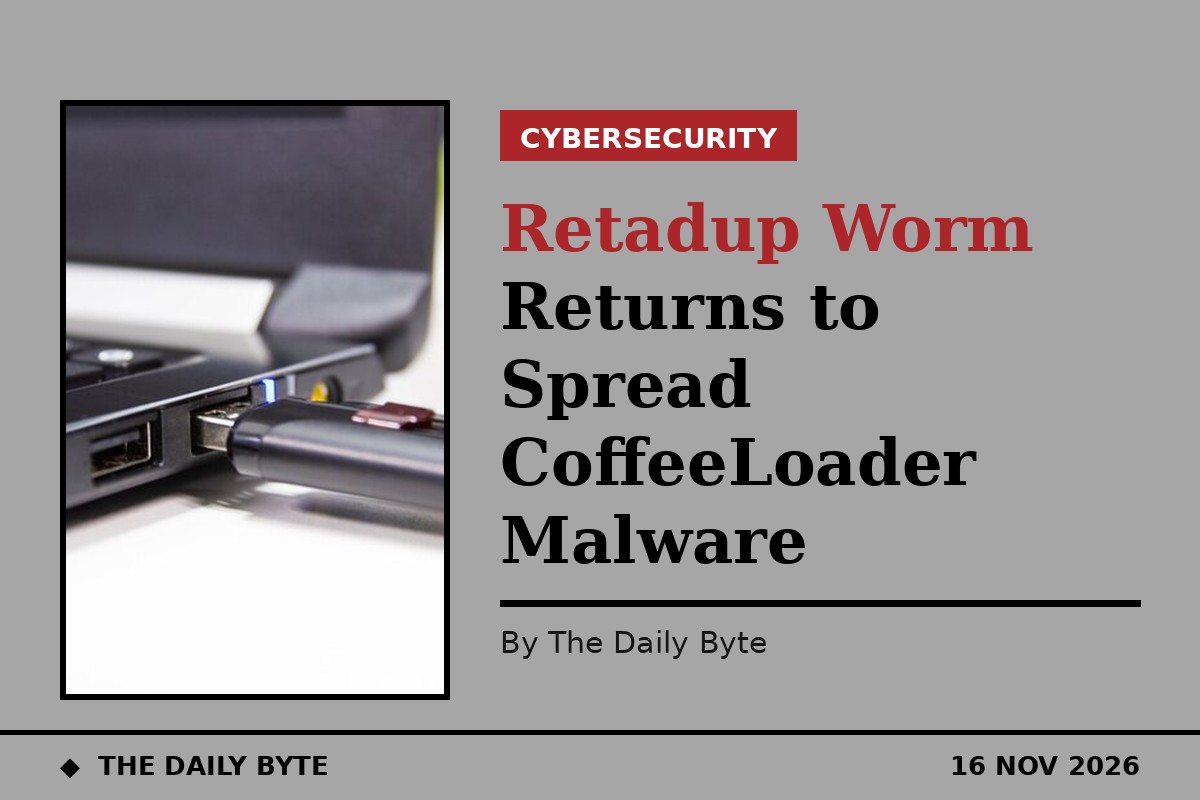
A Windows worm shut down by French police seven years ago is spreading malware again. Security researchers at Kaspersky said on Monday 16 November 2026 that the Retadup worm's old command-and-control servers have been brought back online and are now delivering a modern malware loader called CoffeeLoader through infected USB drives.
The Hacker News, reporting on Kaspersky's analysis, said researchers had disclosed a new variant of CoffeeLoader, a loader designed to fetch and run further malicious software on infected machines. The worm is the delivery route: old infected memory sticks still carry Retadup, and when one is plugged into a computer it checks in with the revived servers and is told to download CoffeeLoader.
A worm the police thought was finished
Retadup was widespread in 2017. Written with the legitimate automation tool AutoIt, it copied itself onto every connected flash drive and external disk as hidden files and shortcuts. Plugging that drive into a new computer and clicking the shortcut infected the new machine, and every infected computer joined a botnet that could download and run further malware on the operator's orders. In its earlier life the worm was used to drop cryptocurrency miners, the Stop ransomware and the Arkei password stealer.
In August 2019 French law enforcement took the botnet down. The National Gendarmerie seized the command-and-control servers and used them to tell every bot to self-destruct, so that as each infected computer checked in it was instructed to wipe the worm from the system. More than 850,000 computers were disinfected, and the botnet effectively ceased to exist.
How the old worm came back
What survived were the infected flash drives. Computers with no internet access, or switched off during the French operation, kept their copies of the worm, and so did old memory sticks gathering dust on shelves. In 2024, someone began re-registering the domain names Retadup had once used as command-and-control servers, including alphanoob and radnewage in the .com domain. Once a domain owner stops renewing it, anyone can register it, and hosting blocks on the expired names are lifted too.
A Retadup command server was then relaunched on the re-registered domains. As soon as someone plugs an infected USB stick into a computer, the old copy of the worm launches, contacts the server and gets a valid response telling it to download more malware. At first the servers served the SmokeLoader downloader, but in early 2025 they started serving CoffeeLoader instead. Kaspersky said it remains unclear whether the worm's author or some other threat actor brought the servers back online.
What is left of the botnet is a shadow of its 2019 self, but it is still active. In the first nine months of 2026, Kaspersky products blocked about 15,000 Retadup infection attempts, most of them in Peru, Angola, Russia and Bolivia. That figure counts blocked attempts, not confirmed infections.
What CoffeeLoader does once it arrives
CoffeeLoader was first documented by Zscaler ThreatLabz in March 2025. The new variant arrives through an NSIS installer that drops a file named 7z.dll into a temporary directory and runs it through rundll32.exe. The file is a patched version of the popular 7-Zip archiver's library, with part of its code replaced by malicious self-decrypting shellcode built on a packer known as Armoury.
The shellcode decrypts itself using the computer's graphics card, a technique that helps it slip past sandboxes that run suspicious files in a virtual environment to study them. The latest version uses the OpenGL library for this instead of OpenCL. Once running, CoffeeLoader copies itself into subfolders of %PROGRAMDATA% or %LOCALAPPDATA%, adds a Run registry key so it starts with Windows, and creates a registry key that stops the user disabling autorun through Task Manager. It then injects itself into a legitimate Windows process such as dllhost.exe and downloads its payload from a hard-coded command-and-control server. From there it can download and run whatever the attackers want next, including infostealers or ransomware. Researchers assess that CoffeeLoader shares source-code similarities with the SmokeLoader family.
How to stay safe from old drives
Kaspersky's advice is to treat old storage with suspicion: install operating system and security updates, scan a flash drive with antivirus software before opening any files on it, turn off autorun for removable media, and do not trust file icons, since a shortcut dressed up as a folder is a classic worm trick. An old computer should also be checked, for example with a bootable antivirus drive made on a clean machine, before it is connected to the internet. Backups should be kept separate, with at least one copy on a drive that stays unplugged. The age of a drive or a computer is no guarantee that it is clean.
Read the original research on Kaspersky's blog and the report in The Hacker News.


