Rezaei Tells US to Accept Iran's Seven Conditions
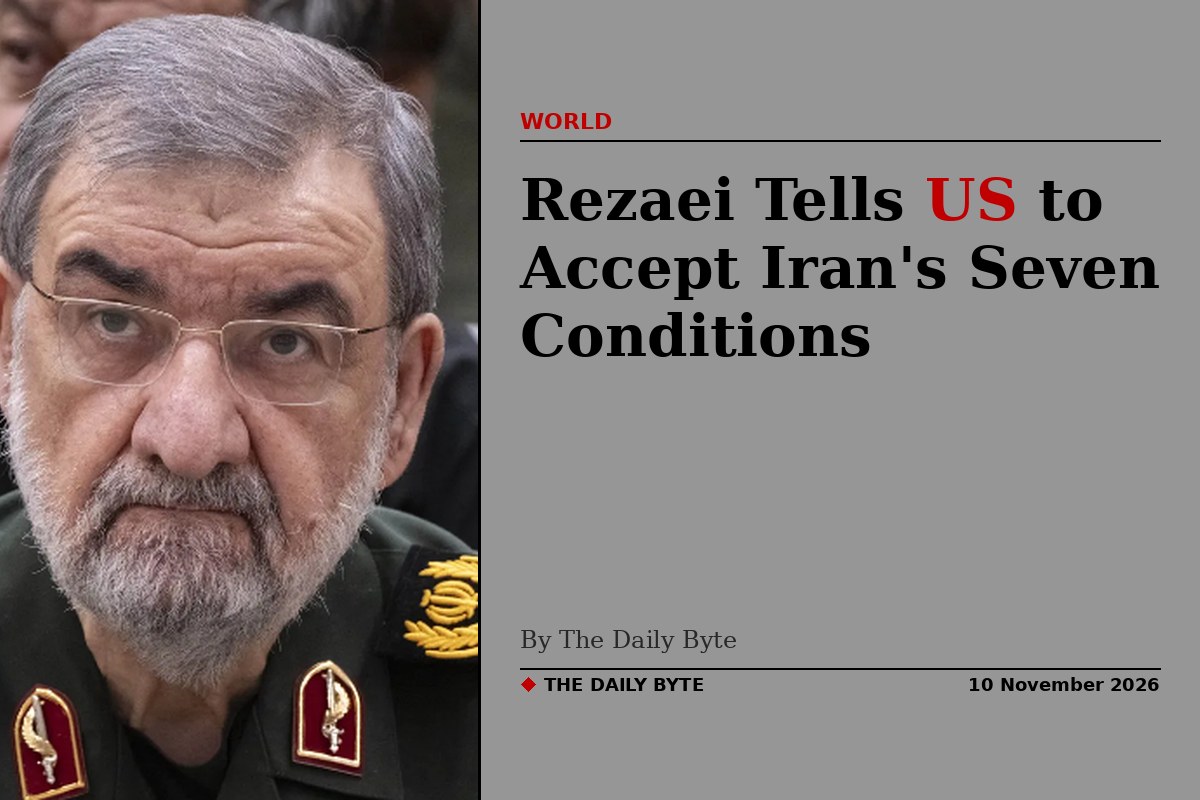
Iran's security chief has told the United States it is time to accept Tehran's seven conditions for ending the war and reopening the Strait of Hormuz, dismissing talk of negotiations as fake news.
Major General Mohsen Rezaei, secretary of Iran's Supreme National Security Council, posted the message on social media on Monday, hours after US President Donald Trump said the war was effectively over militarily and that he would hold off new strikes for now.
“The war on Iran has already wrecked the US government. But Washington flails like a desperate gambler. FOLD YOUR HAND. STOP manufacturing FAKE NEWS about imaginary talks,” Rezaei wrote. “Time to SURRENDER to the seven conditions Iran has repeatedly set out.”
What the seven conditions demand
The conditions, as reported by Press TV, are an end to hostilities on all fronts, including in Lebanon, Gaza and Yemen; the release of Iran's frozen assets held abroad; the complete lifting of the naval blockade; the removal of economic and political sanctions; the withdrawal of US naval and air forces from the region; payment of war reparations; and an end to threats and insults.
The conditions were first formally conveyed to Washington through Qatari and other regional mediators in September, Press TV reported. Iranian officials have said each condition carries further sub-requirements and that implementation must come before any reopening of the waterway or resumption of talks.
Hormuz stays shut, Tehran says
Rezaei has previously said Washington has responded to the conditions but that its response remains insufficient and leaves ambiguities to be resolved. Until then, the strait will remain closed under Iranian control, managed in coordination with Oman, according to Press TV.
The Strait of Hormuz is one of the world's most important oil shipping routes, and its closure has pushed shipping costs and oil prices higher during the war.
Trump opts for the status quo
Trump said on Monday that he plans to keep the naval blockade in place and add a new land-and-sea effort, Operation Iron Gate, aimed at cutting Iran's overland trade routes. The announcement followed talks with Qatar's prime minister, Sheikh Mohammed bin Abdulrahman Al Thani, who has been mediating between Washington and Tehran.
Trump said new military strikes were not necessary at this point but that US forces remained locked and loaded if the situation changed. He also repeated that Iran must never acquire a nuclear weapon, calling that point non-negotiable.
The conflict began in late February, when the United States and Israel launched strikes on Iran, and has lasted more than eight months. Attacks on tankers in the Gulf and around the Strait of Hormuz ramped up sharply in October and have continued at their highest rate since the war began, Reuters reported.
With Tehran insisting on its conditions in full and Washington holding to the blockade, neither side has signalled movement towards the talks both have discussed in public, leaving the strait as the central pressure point in the standoff.


