Robert Knapp murder conviction appeal dismissed
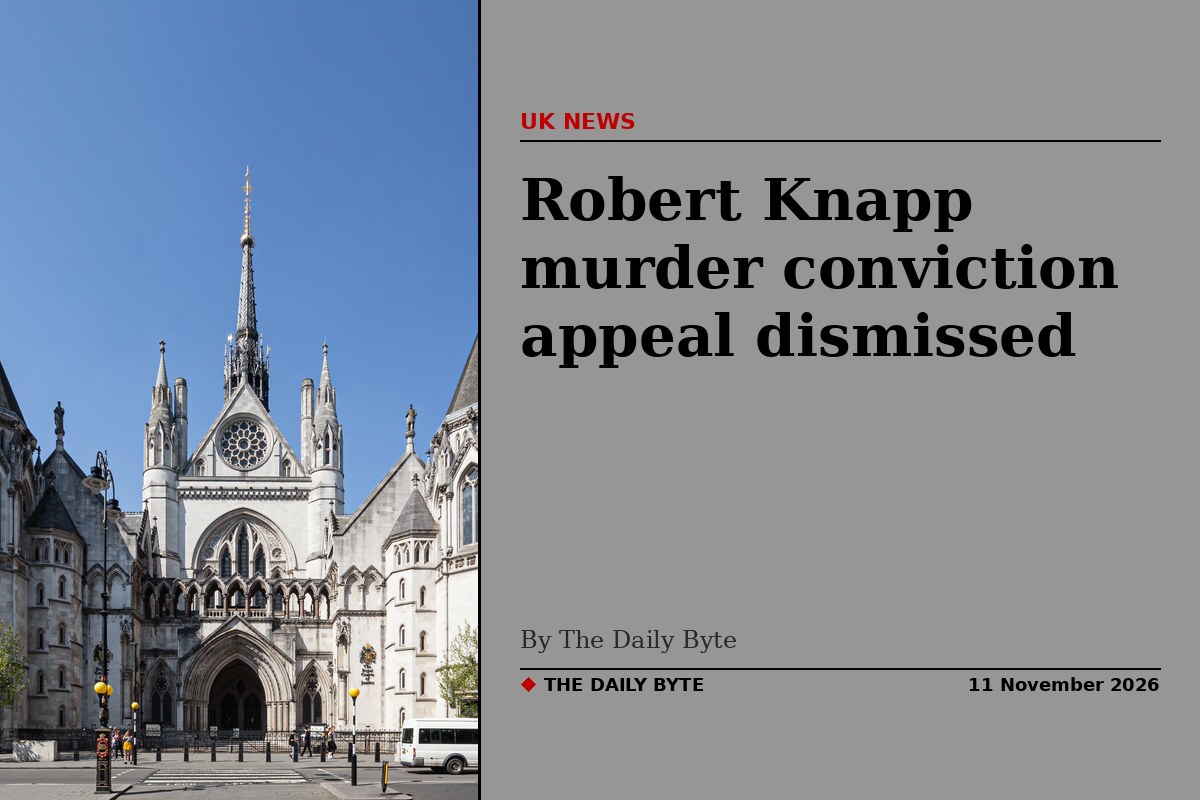
The Court of Appeal has dismissed a challenge to a murder conviction dating back more than two decades, ruling that the trial judge was not wrong to leave manslaughter out of the directions given to the jury.
The decision in Robert Knapp v R, handed down on 10 November 2026, brings to an end the latest stage of a case that had been referred to the Court of Appeal by the Criminal Cases Review Commission (CCRC) after a change in the law.
The original conviction
Robert Knapp was convicted on 19 July 2002 at the Central Criminal Court of the murder of Mohammed Raja in July 1999. He received a sentence of life imprisonment with a minimum term of 20 years.
The prosecution's case was that Mr Knapp had been one of two men who had gone to Mr Raja's home and committed the murder. His application for leave to appeal against the conviction was refused by the Court of Appeal in October 2003. He applied to the CCRC in February 2020.
Why the case was referred
The CCRC referred the conviction in December 2025 because of a new case which changed the law, suggesting that an alternative verdict of manslaughter should be left for the jury's consideration in most murder cases.
The issue was whether the alternative verdict of manslaughter should have been left to the jury. The concern behind the referral was that if manslaughter is not left as an alternative, a jury may convict someone of murder because they are responsible for a death, when manslaughter might be the more appropriate verdict.
Mr Knapp argued that the trial judge should have left manslaughter to the jury as an obvious alternative on the evidence, and that the failure to do so made his murder conviction unsafe.
What the Court of Appeal decided
The Court of Appeal (Criminal Division) examined the trial record, the judge's direction on joint enterprise and identification, and the authorities about when a lesser alternative must be left to a jury. The decision, [2026] EWCA Crim 1437, was handed down by a panel of Lords Justices and High Court judges on 10 November 2026.
The court rejected Mr Knapp's submission that the omission rendered the murder verdict unsafe. It held that, on the evidence in this particular case, the jury were not unfairly deprived of a realistic lesser verdict, and there was no material misdirection of the kind that would typically make a murder verdict unsafe. The appeal was therefore dismissed.
The judgment restates the principle that a trial judge bears the ultimate responsibility for leaving any obvious lesser alternative to the jury, but the obligation arises only where the alternative is obviously raised by the evidence, so that failing to leave it would risk forcing an unrealistic choice between conviction of the serious charge and full acquittal.
For practising lawyers, the ruling is a reminder that defence counsel should press expressly at trial for directions on alternative verdicts if they regard such alternatives as realistically arguable, since appellate intervention will be limited where the trial judge's assessment of whether an alternative is obvious is sustainable.
Mr Knapp's murder conviction stands.


