ROBOTERA 45 Humanoid Robots Sort Parcels at China Post
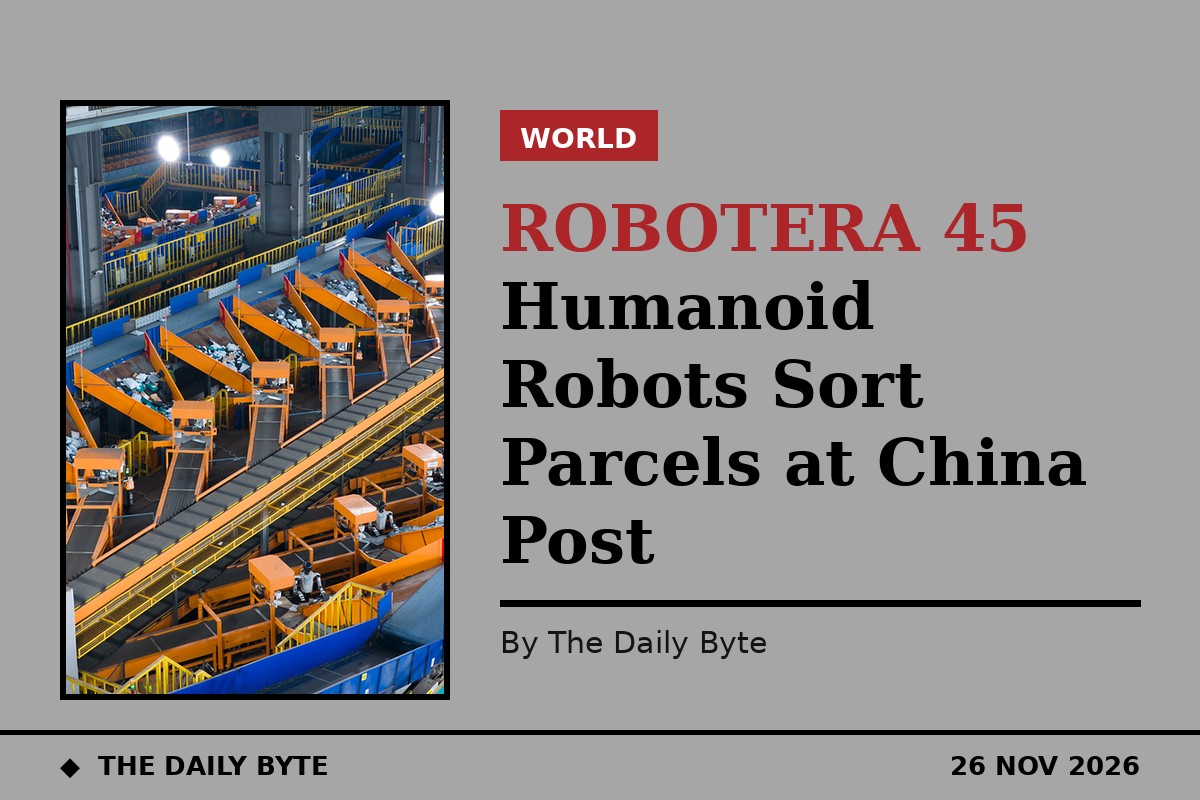
Forty-five humanoid robots are now working as a fleet at China Post's Hangzhou Postal District Center, handling parcel induction in what the robotics company ROBOTERA describes as the largest deployment of its kind in comparable postal operations in the country. The company disclosed the scale of the operation on 26 November.
The robots work on parcel induction, the stage where packages are moved onto induction platforms inside a sorting workflow. Testing at the Hangzhou centre began in April 2026. ROBOTERA says the fleet can independently carry out several steps in the process: picking up parcels, turning them to the right orientation, identifying and rejecting irregularly shaped parcels, placing them onto induction platforms, and handling exceptions that arise during the work.
Faster sorting, measured in testing
Through repeated rounds of optimisation, the company says induction efficiency has risen sharply. In the first phase of testing the robots handled 500 to 600 parcels per hour; during specific testing periods that figure has reached about 1,200 parcels per hour. Operational accuracy has exceeded 90 percent, and the company reports improvements in motion smoothness, recognition accuracy and handling precision alongside the speed gains.
The figures are company-reported and describe testing periods rather than a full commercial rollout. The robots are still in a testing programme at the Hangzhou site, and the throughput figure applies to the periods the company measured, not necessarily to a full working day.
A wider postal rollout
The Hangzhou deployment follows an earlier rollout announced on 17 November, which covered 11 postal hubs across eight cities in Guangdong province. The company has not said how many robots were involved in that earlier phase. The Hangzhou site, by contrast, concentrates 45 robots in a single facility, which is why the company presents it as its largest fleet test in postal work.
China Post's Hangzhou branch plans to extend the use of automated equipment to more parts of its operations, including intelligent sorting and security inspection systems. The aim, according to the announcement, is to use the technology to improve the quality and efficiency of postal delivery services.
ROBOTERA describes itself as an AI-native robotics company specialising in general-purpose humanoid robots, with an in-house approach covering embodied intelligence, motion control, dexterous hands and hardware. It says its robots are already deployed in logistics, manufacturing and other industries.
The announcement is a sign of how quickly humanoid robots are moving from demonstrations into working facilities. A fleet of 45 robots doing the same job in one sorting centre, with measured throughput figures attached, is a more concrete test than a single robot in a showroom. Whether the pace holds outside the testing periods, and whether the accuracy stays above 90 percent at full volume, is what the next phase will have to show.


