Romania Asks Germany for Bigger Military Presence
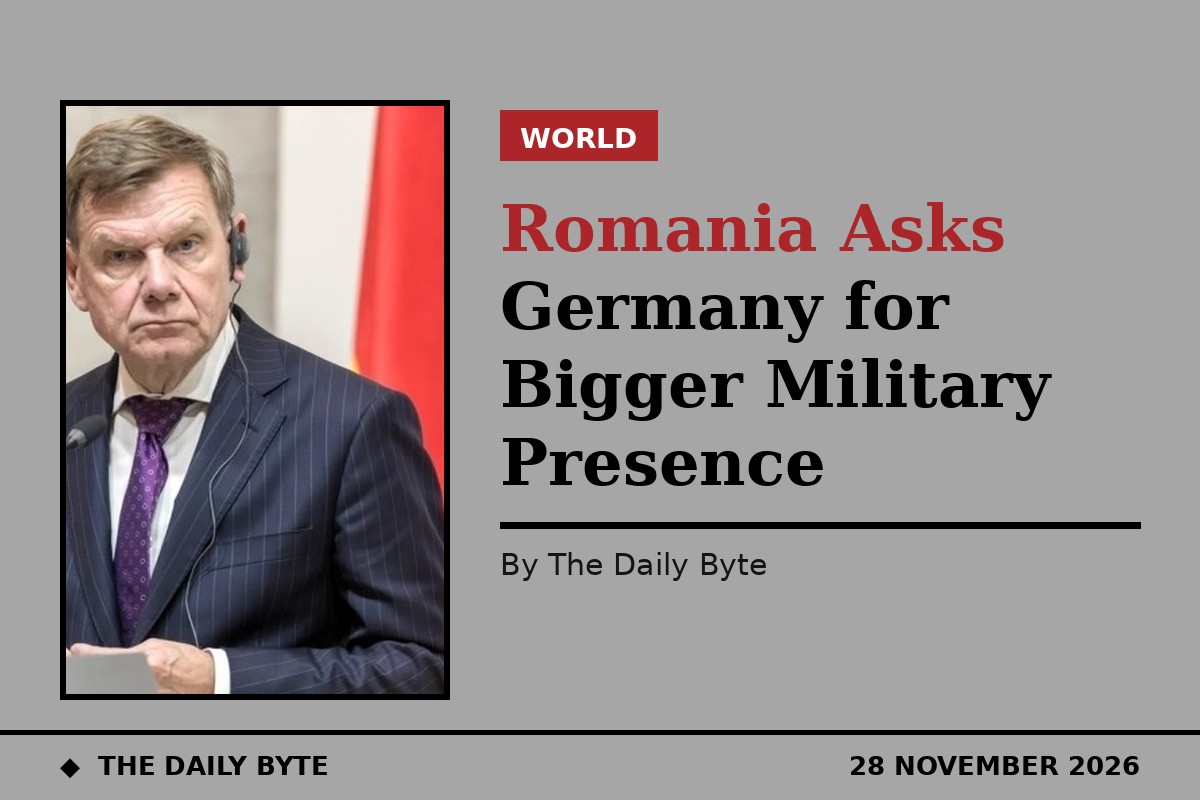
Romania has asked Germany to station a significant military contingent on its territory and invited Berlin to join a new Black Sea maritime security hub, as Bucharest seeks stronger allied backing against Russian pressure on NATO's eastern flank.
Foreign Minister Dan Neculaescu made the request in Berlin on Thursday 26 November, at a joint press conference with his German counterpart, Johann Wadephul. "Today, I asked Germany to ensure a significant military presence in Romania, including military equipment," Mr Neculaescu said, according to APA, citing the Romanian foreign ministry.
The Black Sea security hub
The two ministers also discussed a maritime security centre that Romania is building with Bulgaria under the European Union's Black Sea strategy. Its stated aims are better information sharing, real-time monitoring of shipping, early warnings of threats and protection of critical infrastructure. According to Mediafax, the centre is planned for Constanta in Romania and Varna in Bulgaria, and European Commission President Ursula von der Leyen has promised 50 million euros for it. Mr Neculaescu invited Germany to take part, describing the centre as the bloc's first truly operational presence on the Black Sea.
The minister said Romania was the NATO member most exposed to incidents in the region, pointing to Russian airspace violations, attacks on civilian ships, hybrid actions and sabotage. He told the German newspaper Die Welt that Russia was trying to claim the Black Sea for itself, and called for a common NATO approach to hybrid attacks.
Germany urges a Black Sea ceasefire
Mr Wadephul condemned drone attacks on commercial vessels in the Black Sea as unacceptable and called on Russia to show it was ready for peace talks through concrete steps rather than statements. A ceasefire in the Black Sea, he said, would be one such step. He stressed that protecting commercial shipping mattered for food supplies worldwide and praised Romania's role in the solidarity corridors used to export Ukrainian grain.
NATO will step up its involvement in the Black Sea region, Mr Wadephul said, while the EU is preparing further measures through the maritime security centre. He reaffirmed Germany's solidarity with Romania and recalled Berlin's part in the air policing mission over the country. No German decision on the Romanian request was announced in Berlin; the invitation to join the hub, and the request for a larger presence, remain open.
Neptun Deep gas field in focus
Romania also wants NATO to help monitor the Neptun Deep gas installations in the Black Sea, the EU's largest natural gas production project. Mr Neculaescu said Romanian fighter jets intercepted an explosive-laden maritime drone a few hundred metres from the platform this summer, showing how tense the situation had become. The war in the immediate vicinity already complicates work at the site, he said.
The Berlin talks come as Russian drones have repeatedly crossed into Romanian airspace during attacks on Ukraine, and as commercial ships near the Romanian coast have come under attack. For Bucharest, a bigger German presence and a working maritime hub are two parts of the same answer: allied eyes on the Black Sea, and allied forces on Romanian soil.


