Romania Neptun Deep gas to boost exports
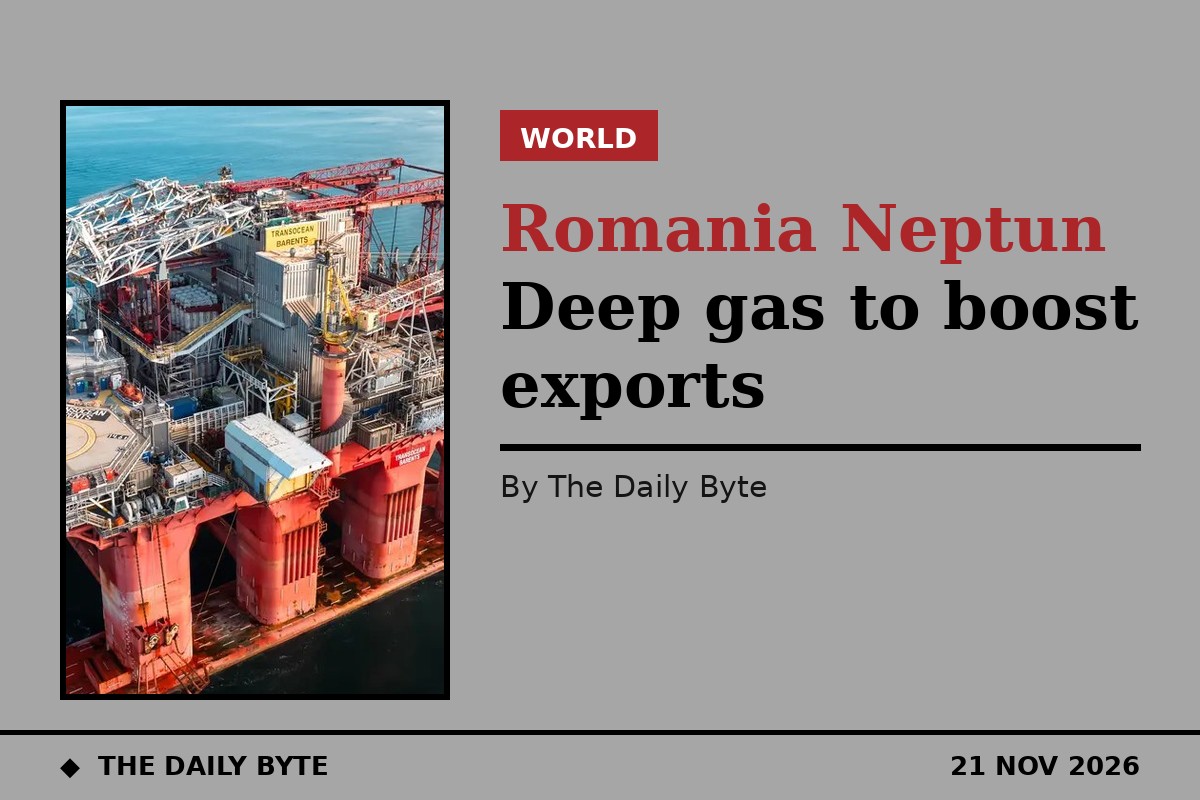
Romania's Black Sea Neptun Deep gas project will strengthen the country's role as a regional gas exporter from 2027 and could cut the need for liquefied natural gas shipped north through Greece, according to analysis by S&P Global Energy published on 19 November.
Neptun Deep holds an estimated 100 billion cubic metres of recoverable gas and is expected to roughly double Romania's gas production, ranking it among the European Union's most significant energy deposits. The project is a joint venture between OMV Petrom, majority-controlled by Austria's OMV and the operator of the field, and Romania's state-owned Romgaz, which each hold a 50 per cent stake. Together they are investing around 4 billion euros in the development, with first gas expected in 2027 and annual production of about 8 billion cubic metres once the field reaches its plateau.
Exports to Germany, Moldova and Ukraine
Romgaz plans to use its share of the gas to supply domestic gas-fired power plants and a fertiliser maker, while OMV Petrom already has long-term contracts to supply Germany and Moldova, with other European countries showing interest. S&P Global Energy told Reuters that additional Romanian supply could reduce the need for some liquefied natural gas volumes to move north via Greece and the Vertical Corridor, the gas infrastructure route designed to carry LNG from the United States and other non-Russian sources into Central and Eastern Europe and Ukraine, where transport costs are high.
The European Commission said earlier this week that Neptun Deep production will support a rebound in Romania's economic growth next year and help lower the country's external deficit. The field sits about 160 kilometres offshore in the Romanian sector of the Black Sea, covering 7,500 square kilometres, and its development includes ten production wells on the Pelican South and Domino fields, three subsea systems, an offshore platform and a 160-kilometre pipeline to shore at Tuzla. Seven of the ten wells had been completed by the end of September 2026, and the pipeline works have been finished.
Security risks in the Black Sea
The project, which directly challenges Russian gas in the region, is exposed to growing security risks as the maritime war between Russia and Ukraine expands into a major challenge for NATO in the Black Sea. In August, the Romanian military intervened twice to destroy air and naval drones near Neptun Deep, and drones struck three commercial vessels off Romania's Black Sea coast on 13 and 14 November.
Romanian President Nicușor Dan said on Thursday: "We see the Black Sea is under strong assault. I am referring to drone attacks, ships that have been hit, sailors who have lost their lives, we see pressure on critical infrastructure including Neptun Deep." He added: "There is a need for deterrence efforts."
Despite the risks, the partners say the project is on schedule. The Neptun Alpha production platform, a normally unmanned installation operated remotely, has been installed in waters about 120 metres deep, and the first gas is expected to enter Romania's national transmission system in the first half of 2027, with production reaching its plateau a quarter later.


