Romania Parliament Censures Health Minister Rogobete
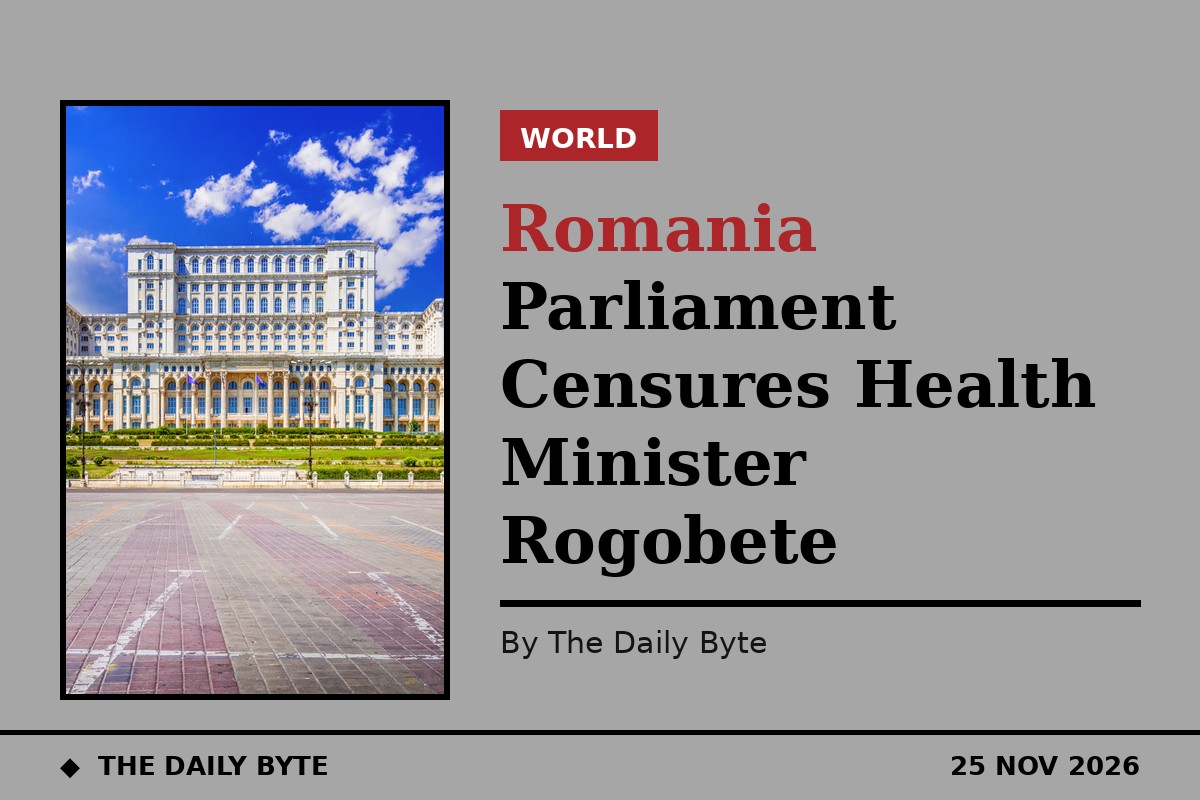
Romania's Chamber of Deputies has adopted a motion against Health Minister Alexandru Rogobete by 154 votes to 91, in the first such vote against a minister in Prime Minister Luca Niculescu's government. The minister has refused to resign.
The vote on Wednesday, 25 November, also recorded 17 abstentions, with six deputies present not voting. The motion was tabled by 71 deputies from the National Liberal Party (PNL) and the Save Romania Union (USR), and its title, as reported by the national news agency Agerpres, reads: "A patient cannot swallow a table. A hospital is not built with press releases. Mr. Rogobete, take responsibility for the political failure!"
The sponsors accuse Rogobete of poor management of the health system, including shortages of essential medicines for cancer patients and people with psychiatric disorders. The row was triggered in part by the absence of the drug Lyrica from pharmacies and by an exchange of remarks between the minister and Liliana Ruse, a journalist and oncology patient. The sponsors also say he is more concerned with his own image than with patients' problems, put together a weak health budget for 2026, and is responsible for losing hundreds of millions of euros in National Recovery and Resilience Plan funds meant for building hospitals. Those are the movers' allegations; they have not been ruled on by a court, and the minister has rejected them.
How the vote broke down
Deputies from PNL, USR, the Alliance for the Union of Romanians (AUR) and SOS Romania voted in favour, together with one deputy from the national minorities group and two unaffiliated members. The Social Democrats voted against, while the Democratic Alliance of Hungarians in Romania (UDMR) abstained and the national minorities group as a whole did not take part in the vote. After the result was announced, opposition deputies applauded and chanted "Resign!"
Rogobete went to the chamber's rostrum and refused to go. "I cannot resign in the face of a motion written by a person under criminal investigation who left Romanians a debt of one billion euros for vaccines bought for four generations," he said, according to Agerpres and G4Media. During the debate he dismissed the motion as politically motivated rather than aimed at solving patients' problems, and said it showed no administrative misconduct that would justify his dismissal.
A motion that does not remove him
A simple motion is a parliamentary oversight instrument, not a motion of no confidence: it states the chamber's view on a minister's record but does not, by itself, remove the minister from office. Under Romania's constitution, dismissing a minister is decided by the president, at the proposal of the prime minister. The minister may also resign.
Prime Minister Niculescu gave Rogobete political cover, saying it was "too early" for a reshuffle and that he supported the minister's efforts to raise the quality of medical services. He pointed to a budget rectification that he said had allocated substantial funding for health, and to an emergency ordinance allowing budget savings to be redistributed to cover payment obligations, including for medical services and medicines.
For the opposition, the result is a political signal that a majority in the Chamber was willing to censure the health minister's record. AUR leader George Simion suggested that, by the next sitting on 7 December, colleagues might consider voting against the government, not only against one minister. For patients, the practical test will be whether medicine stocks, unpaid medical leave and hospital investments improve after a vote that, on its own, changes nothing at the ministry.


