Rugby League World Cup 2030 Heads to Pacific and USA
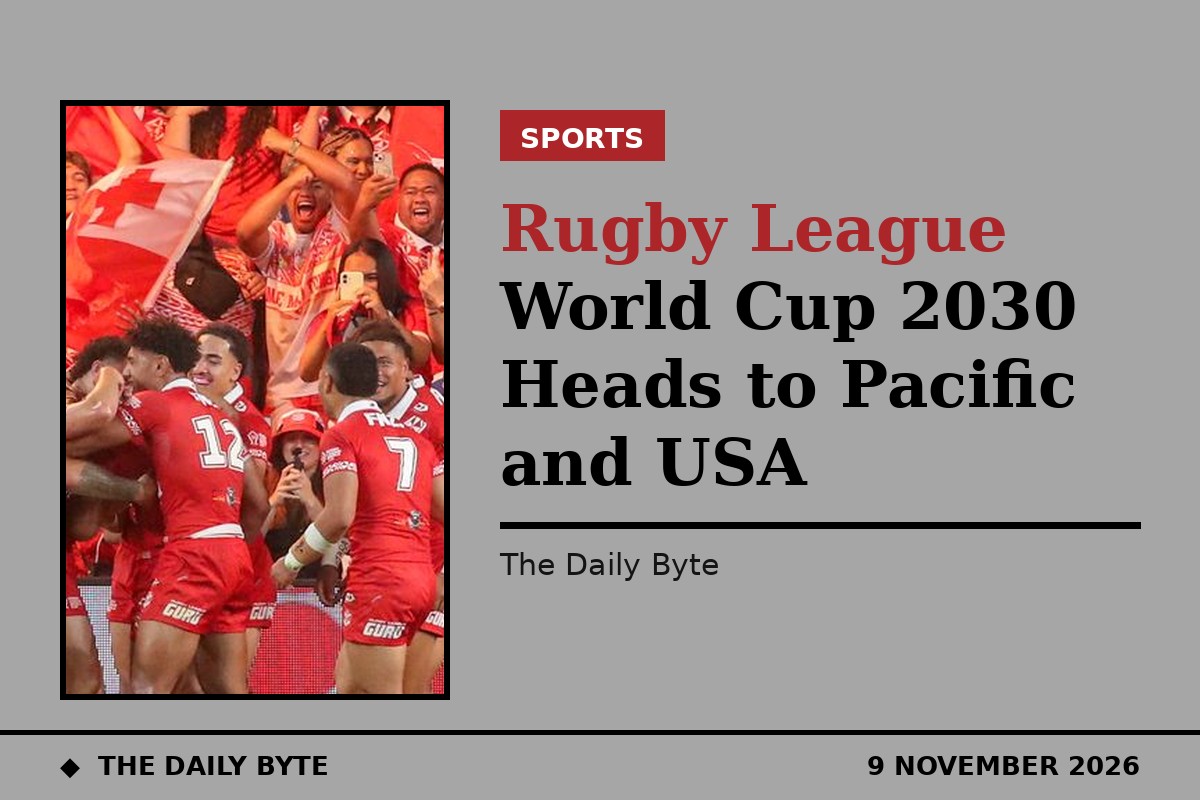
The Rugby League World Cup will head to new territory in 2030, with the men's and women's tournaments set to be played across the Pacific and the United States. International Rugby League (IRL) announced the plan on Monday 9 November 2026, ahead of the finals of this year's World Cup in Australia.
The 2030 edition will be run as a travelling tournament. Rather than staying in one host country, the competition will move from city to city, with each stop hosting a full round of matches over several days. It is a format borrowed from the Magic Round concept used in Australia, where a whole round of fixtures is played at one venue over a single weekend.
Five host cities, more teams
IRL chair Troy Grant said the 2030 World Cup would be run in five locations across the Pacific and the United States, although the host cities have not yet been decided. The governing body said it would go to market to choose the venues, looking for stadiums able to stage matches over multiple days.
"The IRL board has decided that the next Rugby League World Cup for men and women in 2030 will be staged in the Pacific-USA," Grant said. He added that the aim was to take the tournament to new frontiers where the World Cup had not previously been played, and to make the most of the record crowds and television audiences seen at this year's event.
Both tournaments will grow. The men's competition will expand from 10 teams to 12, while the women's tournament will rise from eight teams to 10. The wheelchair tournament will run at the same time, with France the favourite to host it. The Australian Rugby League Commission will stage the men's and women's tournaments.
Tonga and Samoa in line for Tier 1 status
The IRL board has also endorsed the elevation of Tonga and Samoa to Tier 1 status, alongside Australia, England and New Zealand. The move is subject to consultation with both nations, and the board said it would work with them over the coming months to check for any unintended consequences.
The recognition follows strong performances on the field. Both Tonga and Samoa reached the semi-finals of this year's World Cup. Samoa became the first Pacific nation to play in a World Cup final in 2022, while Tonga are the only Tier 2 nation to have beaten Australia, England and New Zealand.
Grant said the board had voted unanimously to engage with the two nations on the change. "We wanted to show them the respect they deserved," he said. "It's long overdue."
Eligibility rules widened
The board also approved changes to international eligibility rules, widening the pool of players who can represent a nation of heritage. A player will now be eligible if a great-grandparent was born in that country, in addition to a parent or grandparent. The change is intended to help developing teams, including Pacific Island nations, remain competitive as later generations of players are born overseas.
The decision followed a submission from the Cook Islands, whose population is under 20,000, with many Cook Islanders living and working in larger countries.
Europe eyed for 2034
Looking further ahead, the IRL board has proposed that the 2034 World Cup be played in Europe, coinciding with the 100th anniversary of the game in France, the country behind the establishment of the World Cup in 1954.
For England, the 2030 announcement sets the long-term calendar. The current World Cup in Australia reaches its finals this month, and the next edition will offer a very different challenge: a travelling tournament across the Pacific and America, with a bigger field and two Pacific nations potentially joining the sport's top tier.