Russian Ship Sparta II Hit by Drones in Gulf of Finland
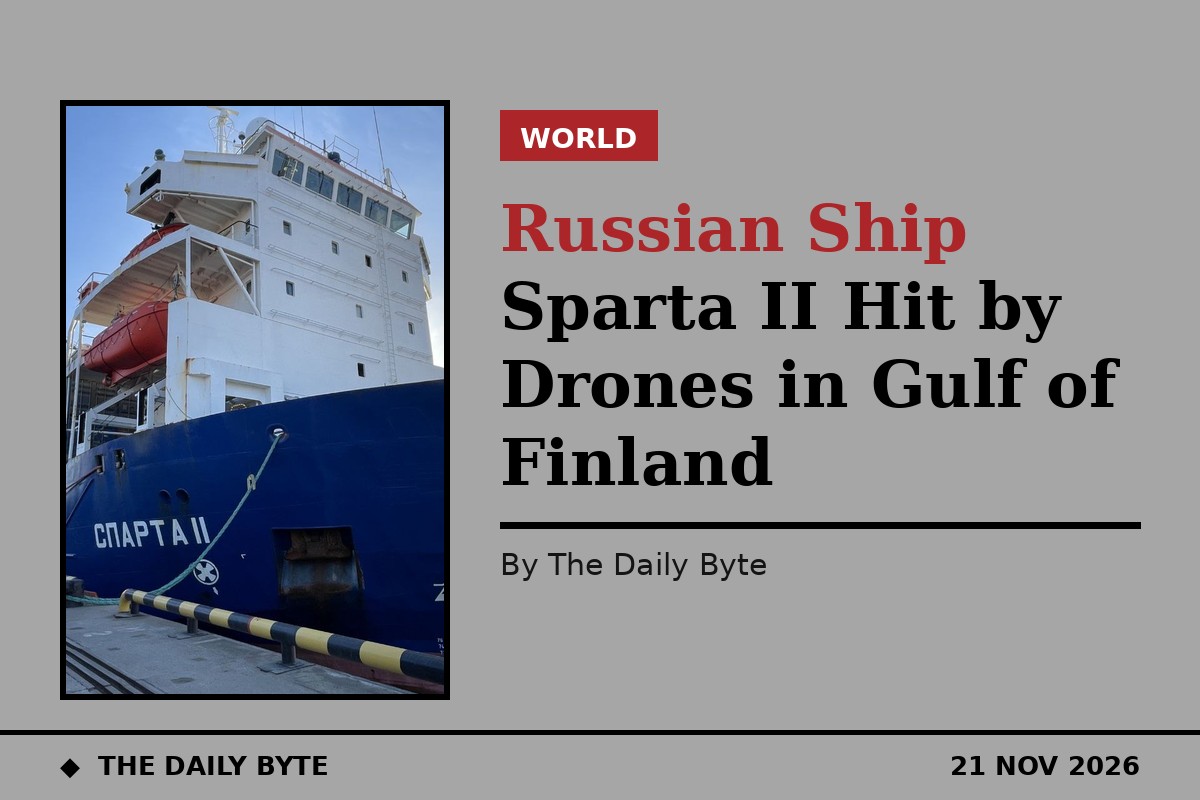
A Russian cargo ship bound for Kaliningrad caught fire in the Gulf of Finland on Saturday morning after being struck by two drones, forcing its crew to evacuate as the burning vessel drifted into Finnish territorial waters.
Aleksandr Drozdenko, governor of Russia's Leningrad region, said the ship was attacked in neutral waters about three nautical miles from the Russian border. He said the crew was being evacuated and the extent of the damage was being assessed. There was no immediate confirmation of casualties.
Estonian authorities identified the vessel as the Sparta II, a Russian-flagged cargo ship travelling from St Petersburg to Kaliningrad, Russia's Baltic Sea exclave between Poland and Lithuania. Estonia's Police and Border Guard Board said it received a report of a fire aboard the vessel at 9.35am on Saturday, with initial information also indicating explosions on board. The ship was about 11 nautical miles north of Estonia's Vaindloo Island when the incident occurred.
The Finnish Defence Forces said they had detected the attack in international waters west of Gogland Island, known in Finnish as Suursaari, in the eastern Gulf of Finland. The Finnish Border Guard said the damaged vessel had crossed into Finnish waters and was leading the maritime rescue operation, while also preparing for possible pollution control measures.
"The situation poses no danger to other maritime traffic," the Border Guard said in a statement. "Preparations for potential rescue operations are being made in cooperation with other authorities in Finland and internationally." Finland said it had informed its allies about the incident.
Orpo says the war is reaching Finland's doorstep
Finnish Prime Minister Petteri Orpo commented on the attack on social media, saying the war was spilling into Finland's immediate vicinity. "Ukraine has the right to fight back against the aggressor," he wrote. He did not say who had launched the drones, and no organisation or country has claimed responsibility for the attack. The origin of the drones remains unknown.
The vessel has previously attracted attention over its reported role in transporting Russian military equipment. According to Ukrainian military intelligence, the Sparta II transported weapons and military equipment, including shipments from Syria to Russia in 2022. The ship, which belongs to the Oboronlogistics shipping company, also appears on the United States sanctions list. Its cargo at the time of Saturday's attack remains unknown.
Alexei Besprozvannykh, the governor of Kaliningrad, said the incident posed no threat to supplies to the region. Kaliningrad is cut off from mainland Russia by land, lying between Poland and Lithuania on the Baltic coast, and depends heavily on sea and transit routes for goods.
Air and sea curbs imposed twice in one morning
Finnish authorities introduced temporary restrictions on aviation and maritime traffic in the eastern Gulf of Finland early on Saturday as a precaution against possible drone activity. The first restrictions were lifted at 7.43am but reinstated at about 9.30am, and the maritime approaches to Kotka were closed. The Defence Forces described the measures as precautions intended to protect civilians and allow the authorities to respond to possible drone threats.
Across the gulf in Estonia, the Defence Forces issued a public warning of a possible drone threat for the north-eastern counties of Laane-Viru and Ida-Viru at 4.42am through the EE-ALARM system. Turkish NATO fighter jets were scrambled in response, and a resident of Laane-Viru county reported hearing a drone followed by a fighter jet at about 6.13am. The warning was lifted at 6.49am, and no violation of Estonian airspace was reported.
The attack occurred amid reports of extensive drone activity over Russia's Leningrad region overnight. Drozdenko claimed Russian air defences had intercepted 80 drones during the night of 20 to 21 November. Those figures have not been independently verified. The incident came a day after Russia launched one of its largest missile and drone attacks of the month against Ukraine, and after Russian missiles and a drone came down in Poland during that assault, underlining how quickly the war's effects are now reaching the Baltic Sea and the borders of NATO states.


