Rutte: Russia War Machine Will Not Stop After Ukraine
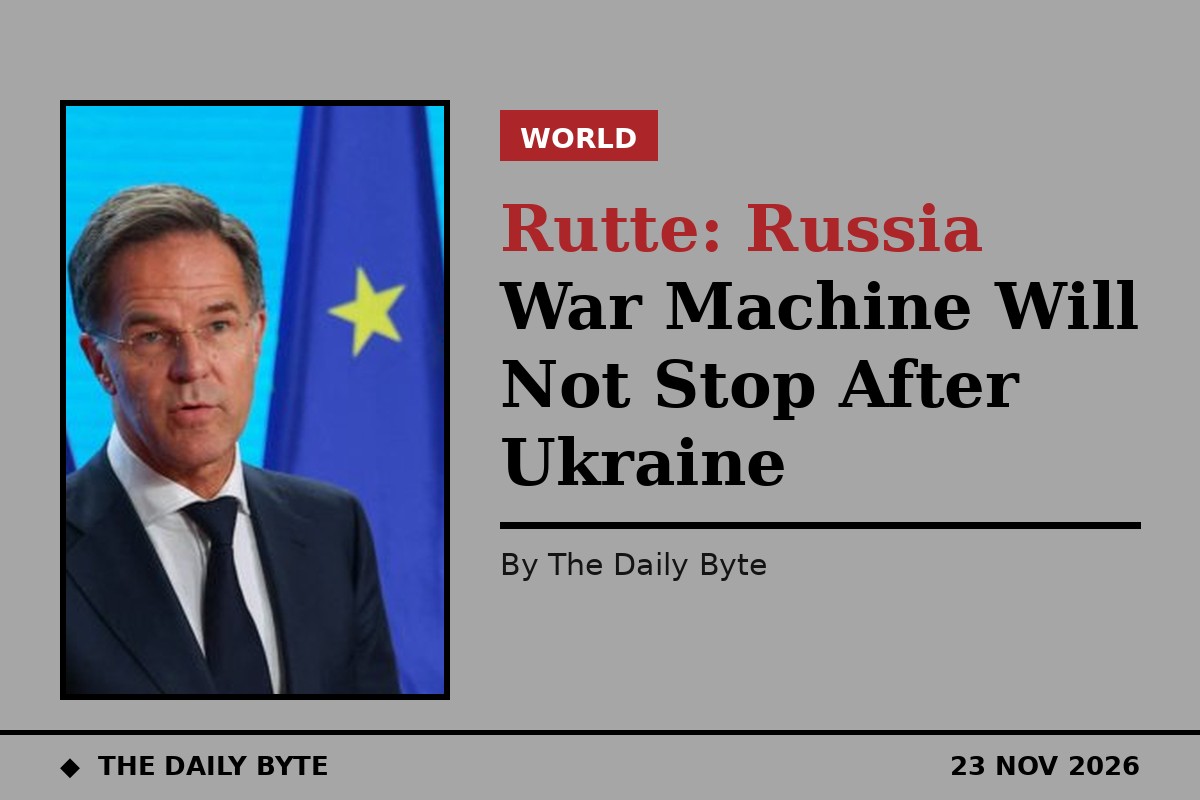
NATO Secretary General Mark Rutte warned in Berlin on Monday that Russia's war machine is running at full speed and will not stop when the war in Ukraine ends. Addressing the 72nd annual session of the NATO Parliamentary Assembly, he told allied lawmakers the threat from Moscow would outlast any peace deal.
“We know that Russia's war machine, at the moment, is running at full speed,” Rutte said. “Its war economy keeps growing. And it won't stand still when the war against Ukraine, hopefully, will end one day. That whole machine is there and will continue.” He pointed to Russia's expanding military production and its deepening cooperation with China, Iran and North Korea as a long-term danger to the alliance.
Rutte also warned against building a separate European army alongside NATO's national militaries, arguing that competing command structures would slow the alliance down in a crisis. “What I would counsel against is having all the nations with their own militaries working together in NATO and then on top of that having a big European structure, because then if Putin attacks, we will first need two or three weeks to agree who will do what, and then he will probably end up in Rotterdam before we have decided,” he said. He held up the United States as the model of an integrated military.
He rejected the idea that only countries bordering Russia face a direct threat. “Let me say once again to everyone here who is not on the eastern flank: I have news for you. You are on the eastern flank too,” he said. “These latest Russian missiles need only five minutes longer to reach Lisbon, Rome or The Hague, my hometown, than to reach Tallinn, Warsaw or Helsinki. So we are all on the eastern flank here.”
Rutte described a campaign of “intensifying malign activities” against allied nations — arson attacks on factories, drones disrupting airports, sabotaged railways, cargo vessels targeted at sea and relentless cyberattacks. “We are all targeted, that we are all affected when it comes to our pipelines, our cables, our energy grids, and our economies,” he said.
His remarks came days after three Russian Kh-101 cruise missiles crossed into Polish airspace on 20 November during strikes on western Ukraine, coming down at three sites in the Podkarpackie and Lublin regions. Polish authorities reported no casualties. Rutte called the incident dangerous and caused by Russia, and said NATO had response options “not always public”. NATO is sending an early-warning aircraft to Poland to strengthen surveillance along the alliance's eastern flank.
On spending, Rutte told allies they must “pull their weight, not only in 2035 but starting now”, and said several members were already projected to meet or exceed the alliance's 5% defence spending target this year. He praised Germany's plan to reach 3.5% of GDP in core defence spending by 2029, and said the alliance was approaching annual production of about four million artillery shells — nearly double the level recorded in 2025. NATO has pledged €70 billion in military equipment, assistance and training for Ukraine in 2026, and the same again for 2027.
Defence, he argued, is not only about armies. “This really takes the whole of society,” Rutte said, urging governments to prepare civilians as well as soldiers for a possible war. He pointed to Norway, Sweden, Denmark and Finland as the countries furthest ahead, having made clear to their citizens what to do if war breaks out.
At a joint press conference with German Chancellor Friedrich Merz, Rutte also rejected any outside say over who joins NATO, saying it was “absolutely out of the question” that the alliance would be forced back to its 1997 borders or that anyone other than its 32 allies would decide its membership. Merz said it had been a mistake not to back the American proposal at the 2008 Bucharest summit to admit Ukraine, arguing the war would probably have been prevented.
The Berlin appearance also touched on a joint investigation published on Monday by German broadcasters WDR and NDR and the newspaper Süddeutsche Zeitung, which reported that Western intelligence agencies believe Russia has assembled a satellite known as “Sputnik-S” that could carry a nuclear warhead, with a launch possible within 60 days. Merz described the reports as “shocking”. Rutte said NATO was continually assessing its defences. “I can assure you, we will always make sure that we defend every inch of NATO territory,” he said. The Kremlin dismissed the reports, and there is no official confirmation of the satellite claim.
Rutte also met Merz, Bundestag President Julia Klöckner and Foreign Minister Johann Wadephul, and met Moldovan President Maia Sandu, who addressed the assembly. “The threat is real, and together in NATO, we are well placed to address it,” he told the parliamentarians.


