Sakurajima volcano erupts again in southern Japan
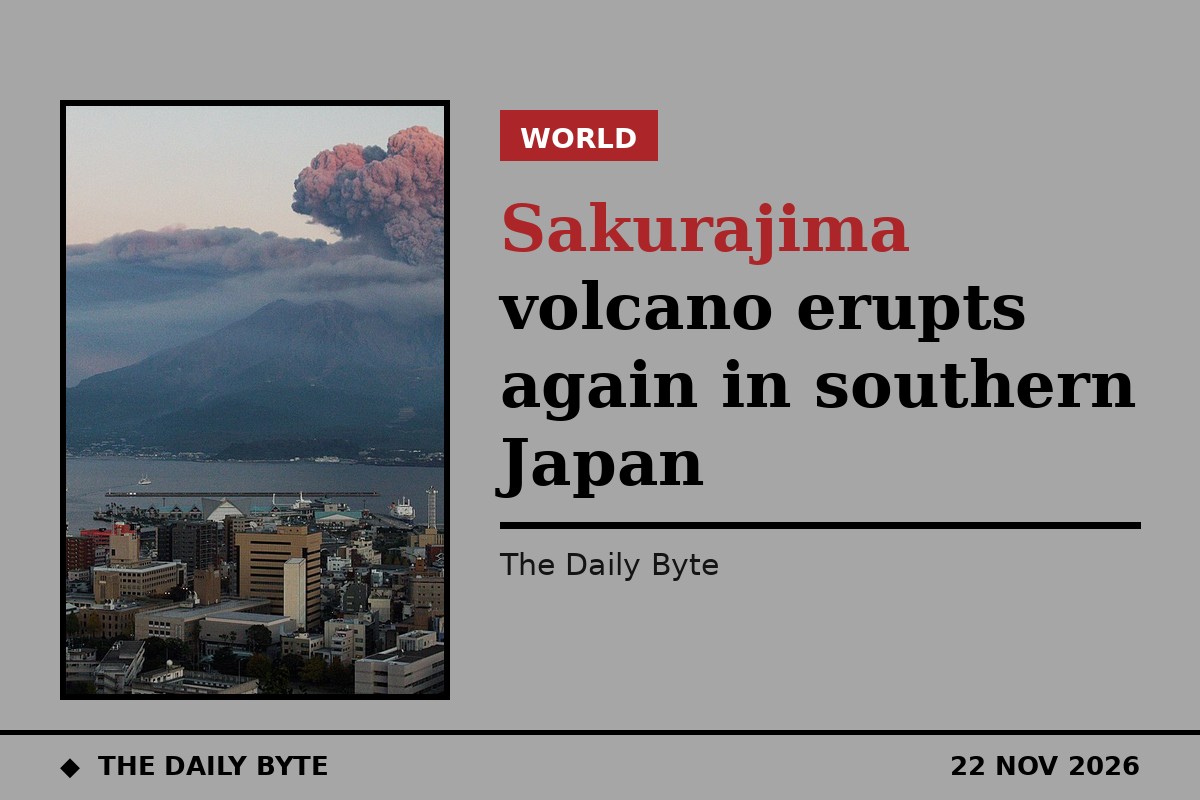
Japan's Sakurajima volcano erupted again on Sunday afternoon, sending a plume of ash 1,200 metres above its summit crater less than a day after a similar explosion, as authorities kept the area under a Level 3 volcanic alert.
The latest eruption took place at 1:48 p.m. Japan Standard Time on Sunday, 22 November, at the Minamidake summit crater on the southern island of Kyushu. The Japan Meteorological Agency reported that the ash plume drifted to the southeast and reached about 2,300 metres above sea level, with the amount of volcanic smoke and ash described as moderate.
The Fukuoka Regional Headquarters and the Kagoshima Local Meteorological Office issued an eruption observation report at 1:55 p.m., seven minutes after the eruption began. The Tokyo Volcanic Ash Advisory Center then issued advisory 2026/350 at 2 p.m., confirming the eruption and the southeastward movement of the plume, although it said the ash cloud was not identifiable in satellite imagery.
Alert level stays at 3
Japan's Meteorological Agency continues to maintain Volcanic Alert Level 3 for Sakurajima, which restricts access to dangerous areas around the volcano. The alert was already in effect before the latest eruptions and was not raised on Sunday.
Authorities warn that large volcanic rocks and small pyroclastic flows could threaten areas within about two kilometres of the Minamidake and Showa craters. Explosive eruptions can also generate powerful air-pressure waves capable of breaking windows, and heavy rainfall over accumulated volcanic ash may trigger volcanic mudflows. Residents and visitors are advised to stay away from the restricted areas around the active craters.
No injuries or significant damage were confirmed in the official eruption observations reviewed, and no widespread airport shutdown or citywide evacuation order was reported.
Second eruption in two days
Sunday's eruption followed an explosive event at 2:35 p.m. on Saturday, 21 November, at the same crater. Initial observations put that ash plume at 1,000 metres above the crater before an updated report confirmed it had reached 1,200 metres, also drifting southeast. Saturday's explosion generated an atmospheric pressure disturbance measuring 19.7 pascals at the Seto monitoring station.
The two eruptions are the latest in a period of repeated activity at the volcano. On 12 November, two eruptions produced ash plumes reaching about 1,200 metres above the crater. The agency recorded sulfur dioxide emissions of about 3,600 tonnes per day on 10 November and 2,700 tonnes per day on 16 November, and also observed volcanic tremors and a nighttime glow in the crater. Its assessment on 20 November said magma remained accumulated deep beneath the Aira caldera and that further eruptive activity was expected.
One of Japan's most active volcanoes
Sakurajima, which rises across Kagoshima Bay from Kagoshima city, is among Japan's most active volcanoes. Its major eruption in 1914 produced extensive lava flows that connected the former volcanic island to the Osumi Peninsula.
Because the volcano sits so close to a city, ashfall is a regular concern for nearby communities, depending on eruption intensity and wind direction. On Sunday the plume initially travelled southeast, away from the city, but authorities continued monitoring possible ashfall as changing winds could carry volcanic material towards populated areas. Japanese authorities continue to watch the volcano through seismic instruments, surveillance cameras, volcanic gas measurements and ground-deformation observations.
Source: Swikblog, citing Japan Meteorological Agency reports


