Salva Kiir Registers to Vote Ahead of February Polls
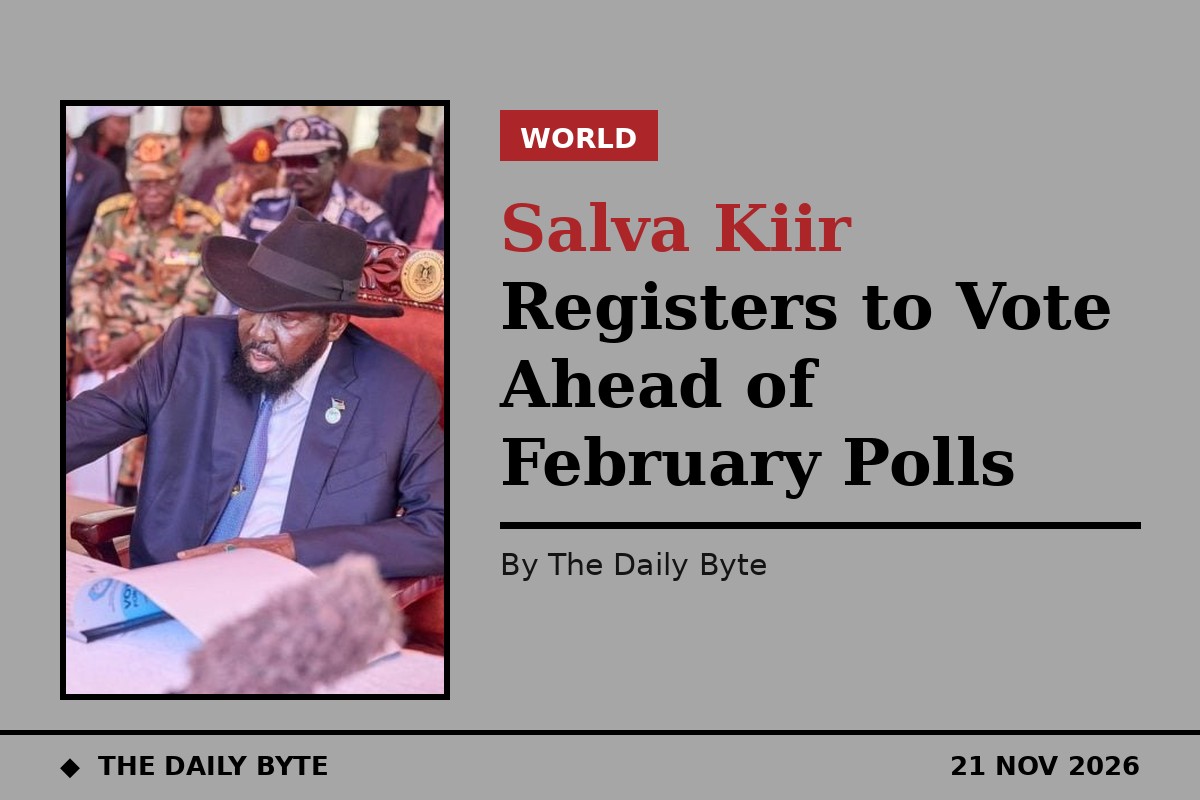
South Sudan’s President Salva Kiir Mayardit has registered as a voter ahead of the country’s first general elections, now scheduled for 11 February 2027. Kiir registered on Friday, 20 November, at the Hai Gonya Registration Centre in Constituency No. 1 in Juba, where his fingerprints were captured and he received his voter registration card.
In a statement published on its official account, the South Sudan government said the president urged eligible citizens to take part in the ongoing registration exercise and collect their voter cards. “After receiving his voter card, he called on eligible South Sudanese to turn out in large numbers, register, and collect their cards,” the government stated.
The registration drive is the most visible step so far towards a vote that has been postponed repeatedly since South Sudan gained independence from Sudan on 9 July 2011. The country has never held a general election as a sovereign state.
Registration runs until 28 November
The National Elections Commission launched the nationwide voter registration exercise on 14 November, and it is scheduled to run until 28 November 2026. The exercise covers South Sudan’s ten states and three administrative areas, with 3,161 registration centres designated to facilitate the process.
Commission chairperson Gabriel Bol Deng had previously announced that the commission recruited and trained 22,127 registration officials to oversee the exercise. It has also appointed 204 constituency returning officers to support the electoral preparations. Eligible citizens are expected to register within the designated period and verify their details before the final voters’ register is published.
Kiir’s registration comes a week into the exercise, and the commission has been working to move registration materials to states across the country, including by air, to meet the timetable.
A vote delayed again
The president’s registration follows the commission’s decision on 14 November to revise the electoral calendar, moving the general elections from 22 December 2026 to 11 February 2027. The revised timetable extended preparations by 51 days, affecting voter registration, candidate nominations, political campaigns and other activities leading up to the polls.
The commission did not give a specific explanation for the postponement in its initial announcement. The decision came amid concerns from political parties, civil society organisations and international partners about the country’s readiness to conduct the elections. On 12 November, Bol Deng held consultations with political parties and other stakeholders in Juba to discuss outstanding preparations, with participants raising concerns about administrative and logistical readiness, funding for political parties and security arrangements for candidates.
Under the new timetable, election campaigns are expected to begin on 27 December and continue until 9 February 2027, ahead of polling day. The vote is set for 11 February, just 11 days before the transitional period is due to end on 22 February, leaving little room for results, disputes and a handover.
Funding and security pressures
The United Nations has warned about political divisions, insecurity and delays in implementing the 2018 peace agreement. The commission has said it needs substantial funding to run the vote: at a United Nations Security Council meeting on 10 November, the African Union’s high representative said the commission had requested 276 million dollars and received 21 million.
The political backdrop is tense. In September, Kiir dissolved the transitional unity government and the national legislature, replacing them with a caretaker administration, while former vice president Riek Machar remains under house arrest. The polls were previously scheduled for 2022 and then for December 2024, before the parties extended the transitional period and set the December 2026 date that has now also slipped.
Kiir’s ruling Sudan People’s Liberation Movement has been holding primaries across the country. Whether the extra seven weeks can be converted into functioning registration centres, inclusive participation and a process whose results are trusted is now the central test for the commission — and for a transition that has already run far beyond its original timetable.