Satellite Images Show Smoke Over Ras Tanura Refinery
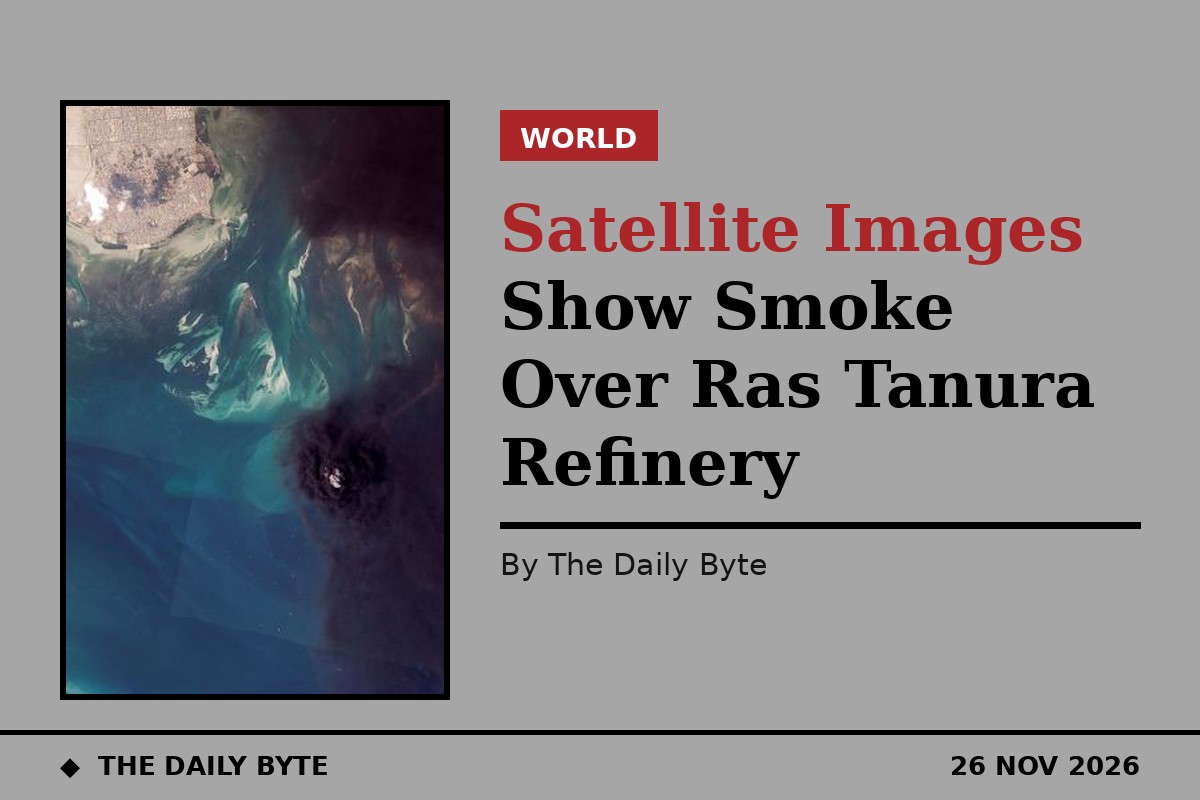
Satellite imagery taken on Wednesday showed a huge plume of black smoke rising from Saudi Arabia's Ras Tanura peninsula, hours after Yemen's Houthi rebels claimed to have struck the kingdom's biggest oil refinery.
The images, reported by CNN on Thursday 26 November 2026, are the first independent visual sign of damage at the site since the claim. Houthi spokesman Yahya Saree said the strikes were “accurate and direct” and caused a fire to break out at the Ras Tanura facility, which sits on one of the world's largest crude oil export terminals.
A shipping source told CNN on Thursday that oil loadings at the terminal were suspended in the aftermath of the attack, and it was unclear whether they had resumed. Ras Tanura has a refining capacity of 550,000 barrels per day and housed the kingdom's main export terminal before the US-Iran war began in late February.
Coalition says four drones intercepted
The Saudi-led coalition battling the Houthis gave a different account of the night. It said on Wednesday that it had intercepted and destroyed four drones over Ras Tanura in the kingdom's Eastern Province, and that falling debris caused no injuries, according to coalition spokesman Major General Turki Al-Malki, citing an initial assessment. The coalition has not confirmed any hit on the refinery itself, and CNN said it had not been able to independently verify the attacks.
Brent crude settled at $94.61 a barrel on Wednesday, up about 3.5 per cent on the day, as traders weighed the risk to Gulf energy supplies. Gulf stock markets were subdued in early trading on Thursday, Reuters reported, with Saudi Arabia's benchmark index little changed and Saudi Aramco shares up 0.7 per cent.
Wider round of strikes on Wednesday
The Ras Tanura claim was part of a wider round of strikes on Wednesday. The Houthis also said they had hit the ports of Jeddah and Jazan on the Red Sea coast, and claimed responsibility for a strike on the King Abdullah Economic City in Riyadh that Saudi authorities said wounded 11 people. It was the third such attack this month in the Saudi capital. An eyewitness in Riyadh told CNN the targeted building, the tallest in the Saudi capital, was the headquarters of Saudi Arabia's trillion-dollar sovereign wealth fund, the Public Investment Fund. The skyscraper was also struck earlier this month in a missile attack.
The Saudi-led coalition said its air defences downed a Houthi drone near Jeddah Islamic Port with no civilian injuries, Reuters reported. Separately on Wednesday, the coalition said it had attacked “operational capabilities” in the Houthi-controlled port of Hodeidah and “destroyed a number of targets” in Saada and Amran governorates. Houthi-affiliated al-Masirah TV reported that Saudi-led forces launched airstrikes on Hodeidah city, including an attack at Hodeidah International Airport. Several Saudi airstrikes were reported on Thursday, including on the Yemeni capital Sanaa, according to al-Masirah TV.
A second front in the wider war
The Houthis have targeted infrastructure in Saudi Arabia repeatedly in recent weeks, including an attack on the capital Riyadh's financial district, as the fallout from the US-Iran war drags on. Fighting between the Houthi group and the Saudi-led coalition reignited in July after years of relative calm brought about by a 2022 UN-brokered ceasefire. Clashes intensified in recent months after the Houthis advanced towards the Bab el-Mandeb Strait, threatening a new front in the Iran war.
For oil markets, the question now is how long loadings at Ras Tanura stay suspended and whether the satellite images point to damage beyond a brief disruption. For the region, the exchange underlines how the Yemen front has become a second front in the wider war, with energy infrastructure, ports and capital-city towers all in range.


