Saudi Strikes Hodeidah Port as Houthis Threaten Red Sea
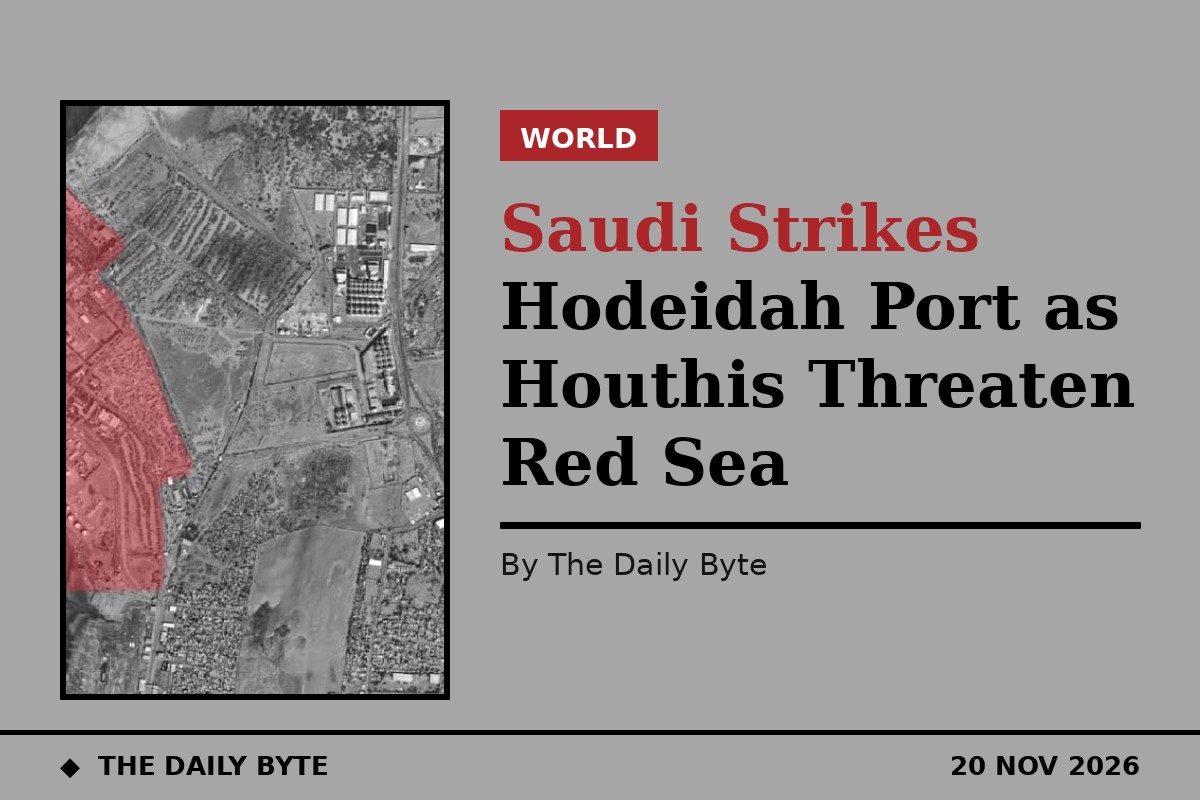
Saudi-led coalition forces struck the Red Sea port of Hodeidah in Yemen on Friday, 20 November, as Yemen's Houthis threatened to attack Saudi Arabia's Red Sea ports in retaliation, in the sharpest escalation yet of a conflict running in parallel with the wider war over Iran.
The coalition said it had hit operational facilities at Hodeidah that it claimed were being used to smuggle weapons and move ballistic missiles. The Houthis, who control the port and much of northern Yemen, warned shipping companies to pull their vessels out of Saudi Red Sea ports and told airlines to stay out of Saudi airspace.
Strikes on Hodeidah and Sanaa
Coalition spokesman Turki al-Malki said the operation at Hodeidah targeted capabilities used in smuggling and in transporting weapons and ballistic missiles. The coalition had earlier urged civilians to leave the area around the port for their own safety.
Hodeidah is the main gateway for food and other supplies entering Houthi-held northern Yemen, which makes any fighting around it a humanitarian concern as well as a military one. Yemen's internationally recognised government defended the operation, saying the Houthis had militarised the port and used it to bring in smuggled weapons, including ballistic missiles. Its information minister said the port remained fully operational and that the flow of goods would continue.
The coalition said it also carried out operations in the capital, Sanaa, targeting ballistic missile and drone capabilities, with further operations under way in the Saada and Taiz governorates. Reporting from Sanaa described Friday morning as among the heaviest rounds of Saudi aerial operations on the capital so far, with strikes and drones hitting positions across the city.
Houthi threats to ports and airspace
Houthi military spokesman Yahya Saree said Jeddah port and all Saudi ports on the Red Sea coast would become targets if the coalition carried out its threat to strike Hodeidah. He warned employees and workers in the vicinity of those ports to evacuate immediately and stay away, and urged shipping companies to remove their ships at once.
Saree also warned airlines to avoid Saudi airspace, saying it would be the scene of Houthi operations in the coming hours, while making an exception for the airspace near the Muslim holy cities of Mecca and Medina. He added that the group would target a power station at Shuqaiq in southern Saudi Arabia.
The coalition said afterwards that it had intercepted and destroyed two ballistic missiles fired by the Houthis towards the southern province of Jazan, with debris falling in the al-Shaqiq area. The Houthis said they had attacked a power station in al-Shuqaiq and a port in Jazan.
A widening front
The exchange came a day after the Houthis struck the tallest skyscraper in Riyadh, the tower in the King Abdullah Financial District that houses the headquarters of Saudi Arabia's sovereign wealth fund. Saudi civil defence confirmed material damage to several floors of the building and nearby buildings, but reported no injuries.
The Houthis claimed four operations against Saudi targets on Thursday, saying they had hit the Riyadh financial district twice, a petrochemical complex at Jubail, an air base at Khamis Mushait and King Khalid International Airport in Riyadh. Saudi Arabia confirmed the damage in the financial district but has not confirmed the other claimed strikes.
Cross-border fighting between the Saudi-led coalition, which backs Yemen's internationally recognised government, and the Houthis, who control the capital Sanaa, has intensified sharply in recent weeks. The Houthis have seized stretches of Yemen's Red Sea coast, and forces aligned with the government have fallen back to defend Aden, the temporary capital in the south.
What happens next
Both sides now appear to be acting on their threats rather than merely issuing them. The coalition has warned civilians away from Hodeidah, the Houthis have warned shipping and airlines away from Saudi ports and airspace, and each side has claimed fresh strikes within hours of the other's warnings.
For shipping, the immediate risk is disruption in the Red Sea, one of the world's busiest trade routes, at a time when the wider regional war has already put tanker traffic through the Strait of Hormuz under severe strain. For Yemen, the danger is that fighting around Hodeidah chokes the main supply route for food and medicine into the north, even though the government insists the port is still working.
Whether the exchange stays a war of warnings and limited strikes, or turns into a sustained campaign against ports and energy infrastructure on both sides, is likely to become clear in the coming days.


