Schools Told to Keep Key Stage 3 GCSE-Free
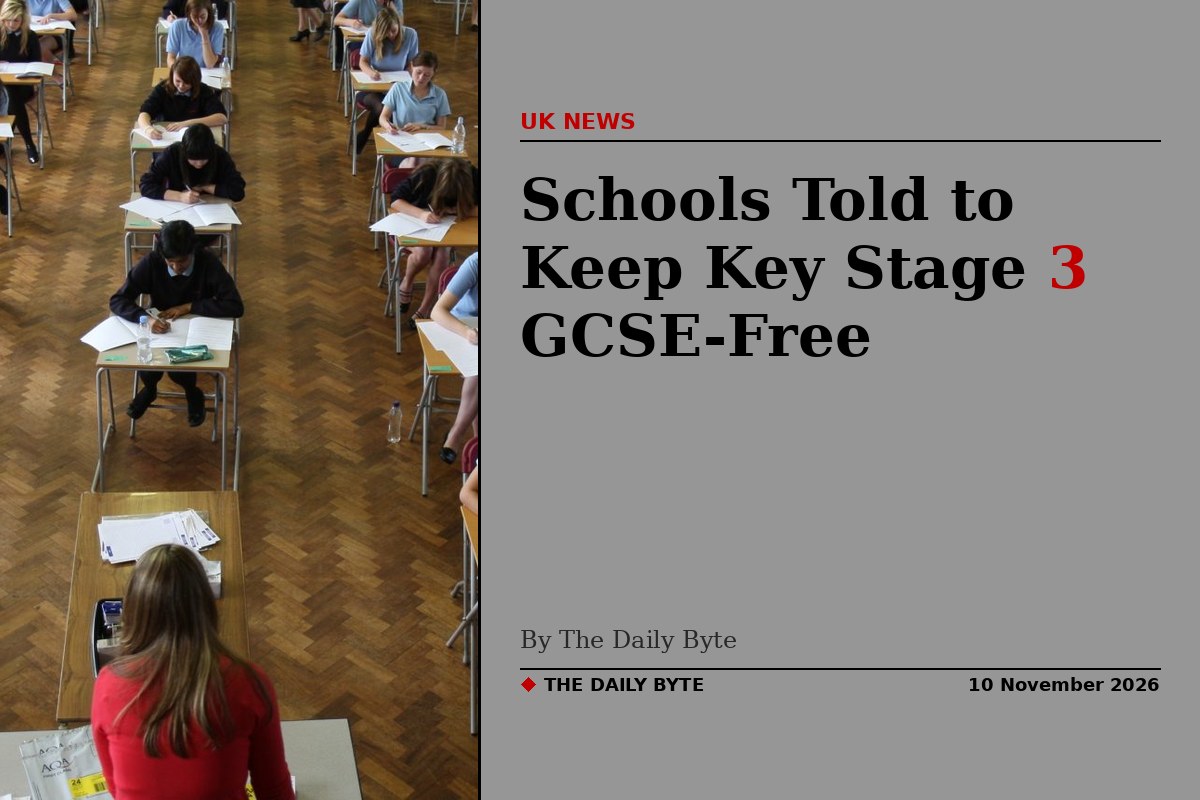
Secondary schools in England will be told to stop teaching GCSE content to pupils in Years 7 to 9, under plans set out by the Department for Education as part of its overhaul of the national curriculum. The move is designed to restore Key Stage 3 as a distinct three-year phase of education in its own right, rather than a run-up to exams.
Education Secretary Lucy Powell announced the change on Sunday 8 November. The full new national curriculum, drawn up by subject experts, is due to be published later this year and taught in schools from September 2028.
What schools will be told
Under the plans, the new curriculum will state that schools should not start GCSE specifications early for large cohorts of pupils, should not routinely require children to narrow their subject options early, and should not routinely enter them for exams early. Teachers will keep the freedom to stretch individual pupils who are ready to go further, as long as that does not narrow their options.
Powell said the early years of secondary school should be a time when children are excited to go to school and engage in broader teaching. She said too many children were receiving a narrower offer during Key Stage 3 and being rushed towards exams without grasping the fundamentals or developing deeper understanding, adding: “I’m putting a stop to that.”
Why the change is being made
The department points to research by PF Global, formerly Public First, for the International Baccalaureate, which found that more than half of teachers say GCSE courses dominate the first three years of secondary school, with some schools beginning GCSE teaching as early as Year 7. A separate poll of 600 teachers by the same firm found only 2 per cent were happy with the current approach to Key Stage 3.
Ministers say the pressure of early exam preparation is leaving pupils disengaged and bored, and that absence nearly doubles between Year 7 and Year 9. The changes are aimed in particular at improving outcomes for white working-class pupils, for whom disengagement in the move to secondary school is markedly worse, according to an independent inquiry.
What else the new curriculum will change
The rewritten curriculum will carry less content, better ordered across every school stage, so that GCSE courses can be taught comfortably within the official two years of Years 10 and 11. Powell also plans to cut total examination time by two and a half to three hours for the average pupil.
Drama will become a distinct module within English at Key Stage 3 for the first time, and modern foreign languages will be made more conversational. Higher expectations are also planned for oracy and confident speaking, reading for pleasure, numeracy, and a more engaging offer in physical education, music and digital and technical skills.
The guidance on not teaching GCSEs early is not expected to be mandatory, so schools could legally ignore it. Powell has said, however, that it will be set out “in black and white” in the curriculum and that schools are expected to teach the national curriculum. The announcement builds on Professor Becky Francis’s independent Curriculum and Assessment Review and the government’s response to it.