Senate Rejects Iran War Powers Resolution in 48-51 Vote
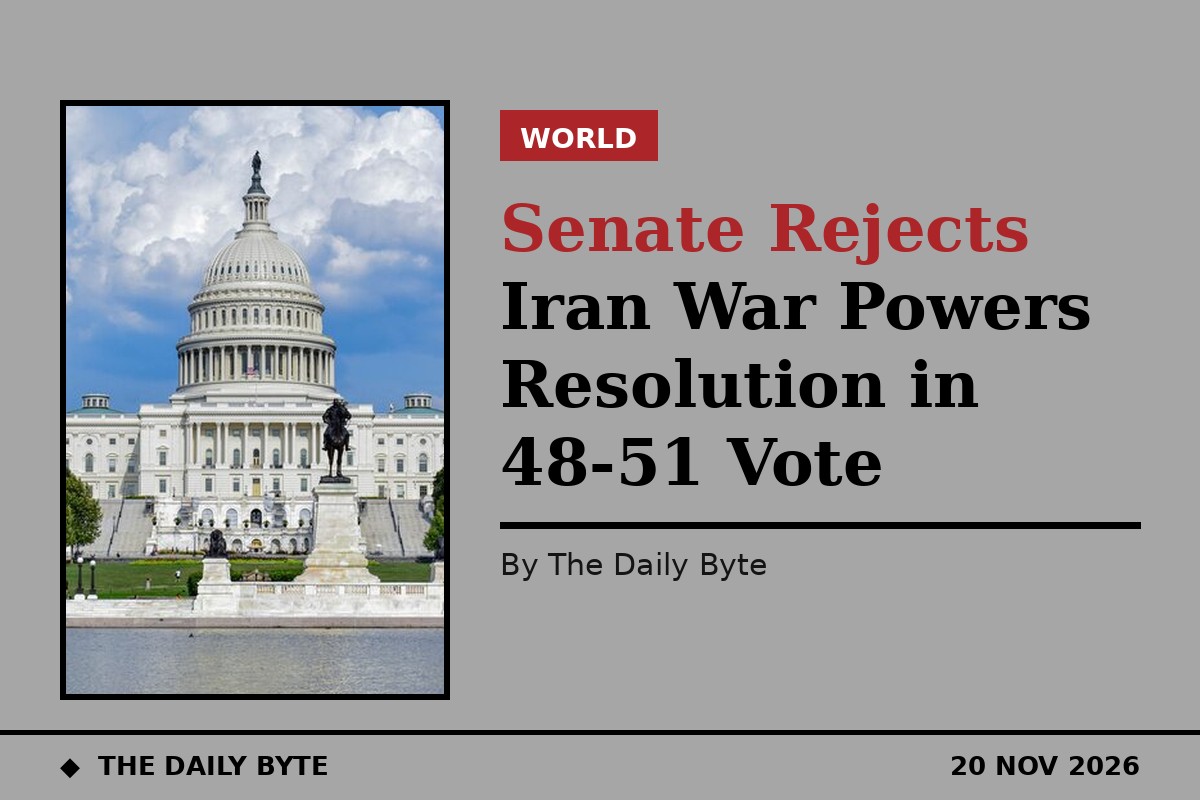
The United States Senate has rejected a resolution that would have directed President Donald Trump to end the war in Iran or obtain approval from Congress to continue it, voting 51 to 48 on Thursday.
The vote, largely along party lines, defeated a war powers resolution that had already passed the House of Representatives. It was the first time the Senate had considered a major measure on the Iran war since Democrats won control of both chambers in the midterm elections on 3 November.
Only three Republicans voted in favour of the resolution: Susan Collins of Maine, Lisa Murkowski of Alaska and Rand Paul of Kentucky. John Fetterman of Pennsylvania was the only Democrat to vote against it.
What the resolution would have done
The measure, House Concurrent Resolution 93, was sponsored in the House by Representative Seth Moulton, a Democrat from Massachusetts, and passed there in September. It invoked section 5(c) of the War Powers Resolution and directed the president to remove United States armed forces from hostilities with Iran unless Congress authorised the action.
As a concurrent resolution, it would not have gone to Mr Trump for his signature and would not have carried the force of law. Supporters nevertheless treated the vote as a test of congressional support for a war that began on 28 February, when the United States and Israel launched strikes on Iran.
The tally was almost unchanged from a war powers vote in late September. One senator changed sides: Thom Tillis of North Carolina, who supported the earlier resolution, voted against it this time.
Midterm result looms over the debate
Democratic Senator Tim Kaine of Virginia, who has repeatedly called for Congress to reclaim its authority over declarations of war, told colleagues before the vote that the midterm result showed how unpopular the conflict had become.
“Its unpopularity was made absolutely, manifestly clear in the election results of November 3,” Mr Kaine said, pointing to public frustration over the war and higher prices for food, fuel and other goods linked to the conflict.
Republicans, who rarely break with the president, stood behind Mr Trump. The vote was the first test of where Senate Republicans stand on the war since the party lost nine seats in the midterms.
What happens next
The defeat ends this attempt to use the War Powers Resolution to force an end to hostilities, but the question is unlikely to go away. Democrats take control of the new Congress on 3 January, and supporters of the measure have said they could bring it back.
Even with Democratic majorities in both chambers, a further resolution would still face a presidential veto, which would need a two-thirds majority in each chamber to override.
The vote came as Mr Trump has said he will not decide on the next step in the Iran war until the new year, leaving the conflict in an uneasy pause after a week of renewed strikes and retaliation around the Gulf.


