Senators Push AI Disclosure Bill After Anthropic IPO
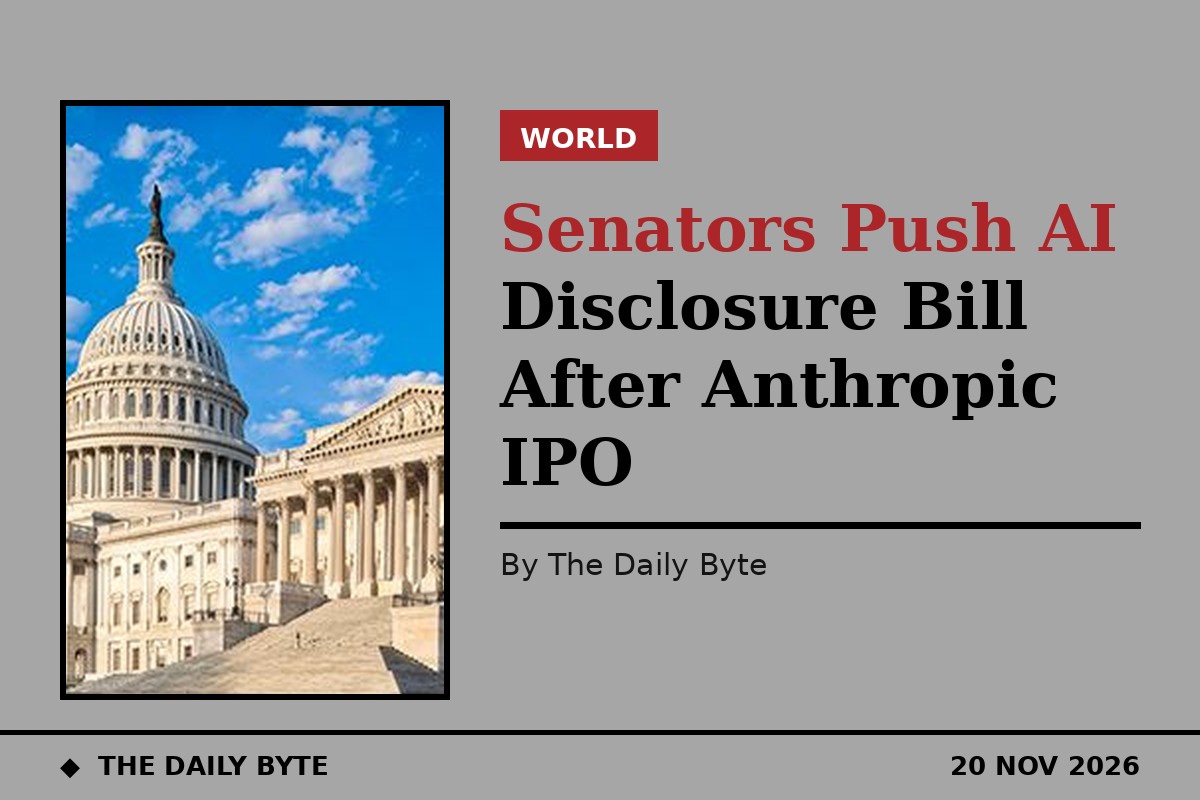
A bipartisan group of four US senators has introduced legislation that would force publicly traded companies to disclose more about their artificial intelligence systems, a day after Anthropic's record-breaking stock market debut put the technology's risks in front of investors.
The bill, introduced on Thursday, would require listed firms to reveal more information about the AI they build and use, according to reports of the move. It comes as Washington grapples with a frontier AI company that warned in its own prospectus that its models could pose catastrophic or existential risks — and then raised tens of billions of dollars from the public anyway.
Anthropic's shares were priced at $83 and began trading on the Nasdaq under the ticker ANT on 19 November. The offering raised $81.3 billion through the sale of 980 million shares, with the total rising to $93.5 billion once the greenshoe option was included, making it the largest initial public offering in history.
Warnings before the debut
Senator Elizabeth Warren, the ranking Democrat on the Senate Banking Committee, had urged action before the listing. In a statement on 18 November she said Anthropic was planning to go public "even as the company warns of 'existential risks to humanity' and fails to answer for the potential threats to Americans' retirements and the entire financial system if this IPO goes awry".
"The SEC must protect investors and Congress must act quickly to put in place safeguards on advanced AI development," Warren said. She had written to Anthropic the previous month setting out her concerns, and public pension fund leaders also wrote to the company warning about the risks to retirement savings.
Representative Pramila Jayapal warned that the market could not profit from a technology that might become a "ticking time bomb", while the advocacy group Guardrails Action said public safety should not hinge on stock prices.
What Anthropic told investors
The case for disclosure rests largely on Anthropic's own words. In the risk factors of its Form S-1 filing with the Securities and Exchange Commission, the company warned: "Our AI models may behave in unintended, misaligned, or autonomous ways, including by taking harmful actions that no user or third party directed." It also told investors its business was "subject to an evolving and uncertain regulatory and political environment".
Anthropic is structured as a public benefit corporation, and a separate Long-Term Benefit Trust elects a majority of its board. Its seven co-founders hold 50.1 percent of the vote through a single Class F share, while public shareholders receive one vote per share, capped at 49.9 percent combined.
Senator Maria Cantwell, the ranking Democrat on the Senate Commerce Committee, has previously called for frontier AI developers to provide "clear, plain-language disclosures of material safety and security risks, and mitigation modelled on the risk disclosures public companies provide to investors". The new bill turns that principle into proposed law.
A crowded field
The disclosure bill is not the only proposal in play. Senator Bernie Sanders unveiled legislation in June that would hand the federal government a 50 percent equity stake in leading AI companies through a one-off stock tax, while Anthropic itself has privately pitched members of Congress on a draft frontier AI safety bill that would require safety frameworks, transparency reports and incident reporting to the Department of Commerce.
Whether the new disclosure bill reaches a vote remains uncertain, with Congress in its lame-duck session. But the politics have shifted: a frontier AI lab is now a listed company, its risk warnings are a matter of public record, and lawmakers on both sides of the aisle are arguing that investors — and the public — deserve to know more about what is inside the systems being sold to them.


