Senegal's Faye enacts rejected budget by decree
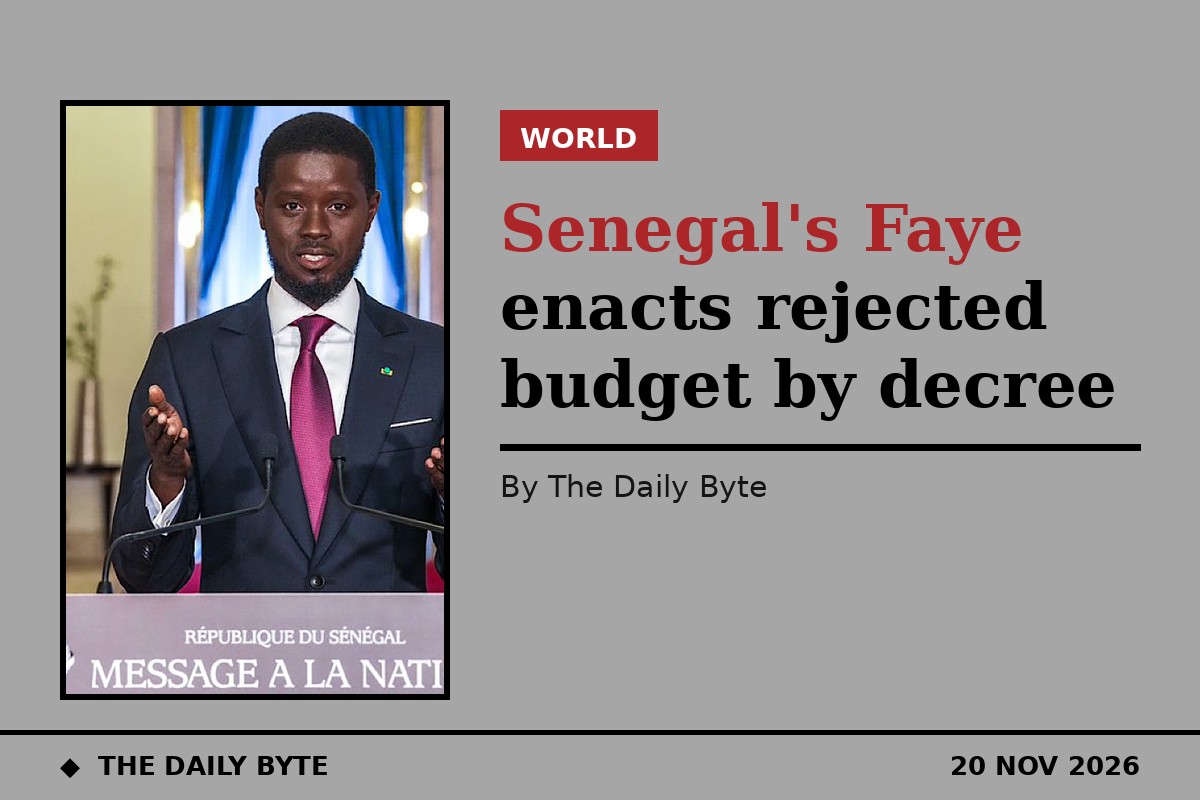
Senegal's President Bassirou Diomaye Faye has put a rejected revision of the 2026 budget into force by presidential decree, escalating a confrontation with the parliament controlled by his former party over the country's public finances.
The decree, numbered 2026-2416 and dated 19 November, was announced by the presidency a day after lawmakers voted down the first part of the government's proposed 2027 budget. It brings the revised 2026 finance law, known as the LFR 2026, into force without a parliamentary vote.
The presidency said Faye acted under Article 68 of the constitution, which gives the National Assembly at most 60 days to vote on finance bills and provides that a bill not definitively voted on within that period is put into force by decree. The revised budget was tabled on 18 September and had not been adopted by 17 November, according to the presidency's explanatory note.
Two budget defeats in a fortnight
Parliament had already rejected the revised 2026 budget on 3 November, by 109 votes to 20 with three abstentions. On Wednesday 18 November, lawmakers then voted down the first part of the 2027 finance bill, which covers revenue, spending authorisations and borrowing linked to public debt, by 128 votes to 18 with three abstentions. Ousmane Sonko, the president of the National Assembly, said the second part of the bill could not be put to a vote until the first was adopted.
The proposed 2027 budget projected revenues of 5.65 trillion CFA francs and spending of 7 trillion CFA francs, leaving a forecast deficit of 1.35 trillion CFA francs, equivalent to 4.7 percent of gross domestic product. The parliamentary finance committee had already issued an unfavourable opinion on the government's projections, questioning the reliability of revenue estimates, inconsistencies between budget documents and the sustainability of public borrowing.
Finance Minister Cheikh Diba warned lawmakers during the debate that failure to pass the 2027 budget could delay social protection programmes and investment projects. The government has also warned that rejecting the revised 2026 budget could jeopardise electricity supply, payment of the state's debts to companies and teachers' salary arrears.
A governing camp split in two
The budget fight is the clearest expression of a political rupture between Faye and his former prime minister, Ousmane Sonko, who now heads the National Assembly. The two men came to power together in April 2024, but their relationship has deteriorated since Sonko left the premiership in May 2026, and Faye launched his own political movement in July.
The split deepened this week when the National Council of Pastef, the party Sonko leads, voted on 17 November to strike 32 people, including Faye, from its membership lists, and dismissed seven ministers who had joined the government of Prime Minister Ahmadou Alhaminou Lo. Pastef controls the National Assembly and opposes both budget bills in their current form.
Reaction to the decree has been divided. Pastef lawmaker Amadou Ba, who moved the procedural motion that killed the revised 2026 budget, said the president was gravely mistaken and described the decree as "not even illegal, but non-existent". The CNTS-FC trade union federation, by contrast, welcomed the decision, saying it would let the state pay internal debts that weigh heavily on working people. Pastef itself had not officially reacted by Friday.
What happens next
The impasse threatens Senegal's ability to secure a new lending programme from the International Monetary Fund, which wants the government to rein in spending and rework its external debt. Faye's government says the 2027 budget must still go through parliament, and the decree covers only the revised 2026 law.
Analysts have noted that Faye could dissolve the legislature from 2 December, the date the constitution permits, a step that would set up legislative elections in the first quarter of 2027. For now, the president faces a parliament controlled by the party that brought him to power, and a budget dispute that has become the sharpest test yet of whether the two camps can still govern together.
Sources: Reuters, Meridian Zero


