SenseNova RoboRSI-27B Robot Model Switches to Code
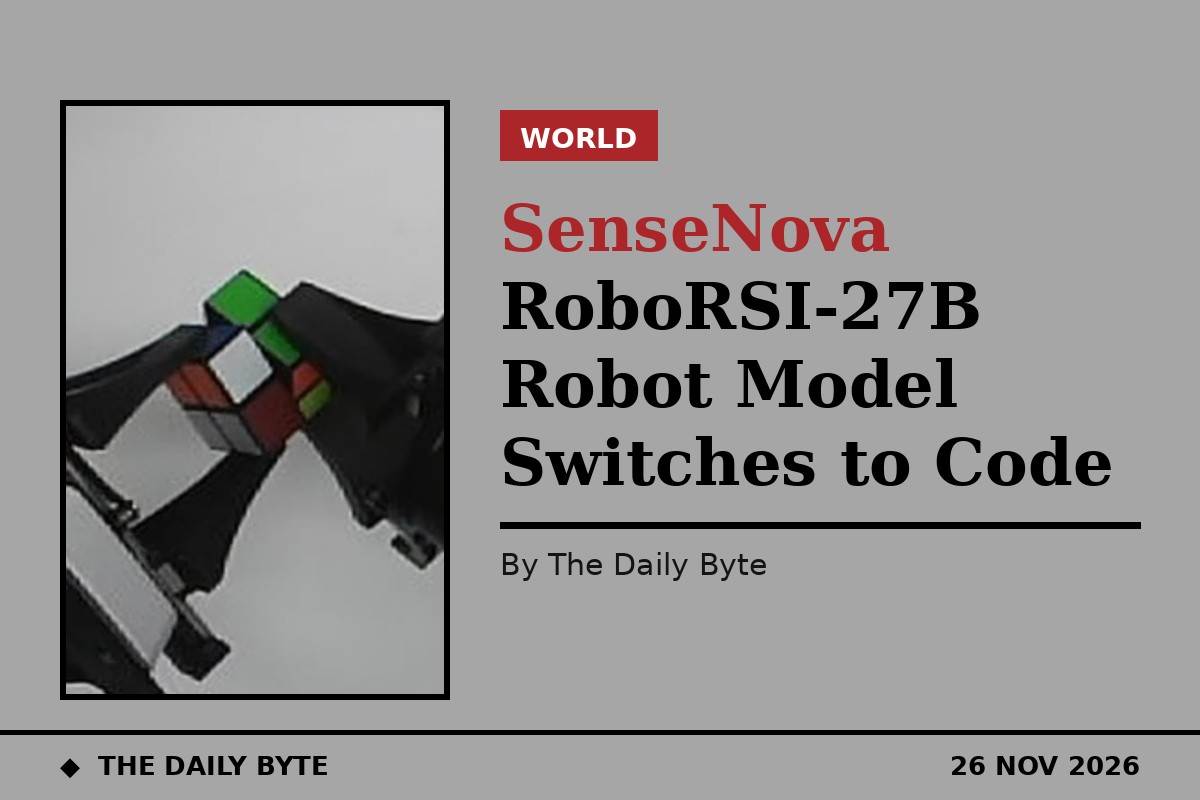
SenseTime's SenseNova team has released SenseNova-RoboRSI-27B, a 27-billion-parameter open-weight model that lets a robot decide, step by step, whether to follow a learned motion or write code to move its own arm. The team published a technical account of the full release on 25 November, presenting it as the finished version of a preview checkpoint released in October.
The model is a vision-language model built for robot manipulation. It works inside a software layer called the RoboRSI Harness, which supplies camera views and robot state and carries out the actions the model requests. The central idea is that the robot has two ways to act. A vision-language-action policy, known as a VLA, proposes a motion based on what the robot can see. The model can inspect that proposal, use only the part it needs, or set it aside and write a short program that positions the gripper and coordinates the next few actions. The team calls this second approach Code as Policy.
In one example from the report, the model used the VLA to approach a keypad, then wrote code to press the key and lift the gripper. When the VLA then proposed a motion that risked pressing the same key twice, the model rejected it. In a bowl-stacking task, the model kept the gripper closed, lifted the upper bowl two centimetres, shifted it two centimetres to the right in code, and then lowered it onto the stack. Across the released agent's recorded environment steps, VLA motions accounted for 41.9 percent and Code as Policy for 58.1 percent.
Model and tools trained together
The model and its harness were developed together through three rounds of what the team calls recursive self-improvement. Each round began with a teacher model attempting tasks through the current harness, and the failures were used to revise the tools and retrain the 27-billion-parameter student. Tested on the RoboDojo benchmark, revising the harness alone lifted the preview's average progress score from 10.0 to 24.8, training the model alone reached 32.2, and doing both together reached 34.7.
Under RoboDojo's newer Agent protocol, the agent receives no task-specific examples, skills or preset procedures at evaluation time. On that protocol, at a fixed seed and layout, RoboRSI-27B scored an average progress of 34.7, against 10.0 when the preview was retested. The team reports that this is 7.1 points above the 27.6 the RoboDojo team reports for GPT-6 Astra on its leaderboard, and just above GPT-6.1 Sol at 33.7 in shared-harness runs. Those comparisons come from the vendor's own testing and have not been independently verified.
Sharper gripper targets
The team also worked on precision. A method called VLA2Agent turns existing robot demonstrations into examples of exactly where a gripper should finish. Adding those examples raised the share of predicted gripper targets landing within 50 millimetres from 24.9 percent to 49.2 percent, and median error fell from 119.7 millimetres to 51.6 millimetres across 374 recorded local actions. At a tighter five-millimetre tolerance, only 15.5 percent of predictions met the mark, a gap the team says matters when a robot must line up a test tube with its opening. The team estimates that building a target from an existing demonstration costs about two US cents, against about 50 cents for one collected through long agent interactions.
From simulation to real robots
The same checkpoint was then tested on two physical robots, using only simulation data for its embodied post-training. On a Piper arm doing pick-and-place into a dish, using Code as Policy only, it succeeded in six of ten trials. On a Piper X stacking blocks, using both control modes, it succeeded in nine of ten. The Qwen3.8-27B base model scored zero on both tasks, and the preview scored two and three respectively. In one trial the gripper opened too early and the block landed in front of the dish; the next camera view showed the miss, and the agent picked the block up again and placed it inside.
The weights and the harness are published openly, with the model listed under the Apache 2.0 licence on Hugging Face and the framework maintained on GitHub. A nine-billion-parameter version and a GGUF build of the 27-billion model are listed as future releases. The team plans to test training across simulators, try unfamiliar layouts and measure how quickly the robot corrects a mistake after observing it.
The results are still narrow. The physical trials involved ten attempts per task, the benchmarks are vendor-reported, and the model was trained only in simulation before meeting real hardware. What the release shows is a concrete design choice: instead of asking one learned policy to do everything, give the model a second, programmable way to act and let it choose between them.


