Seven EU states unite to push for smaller budget
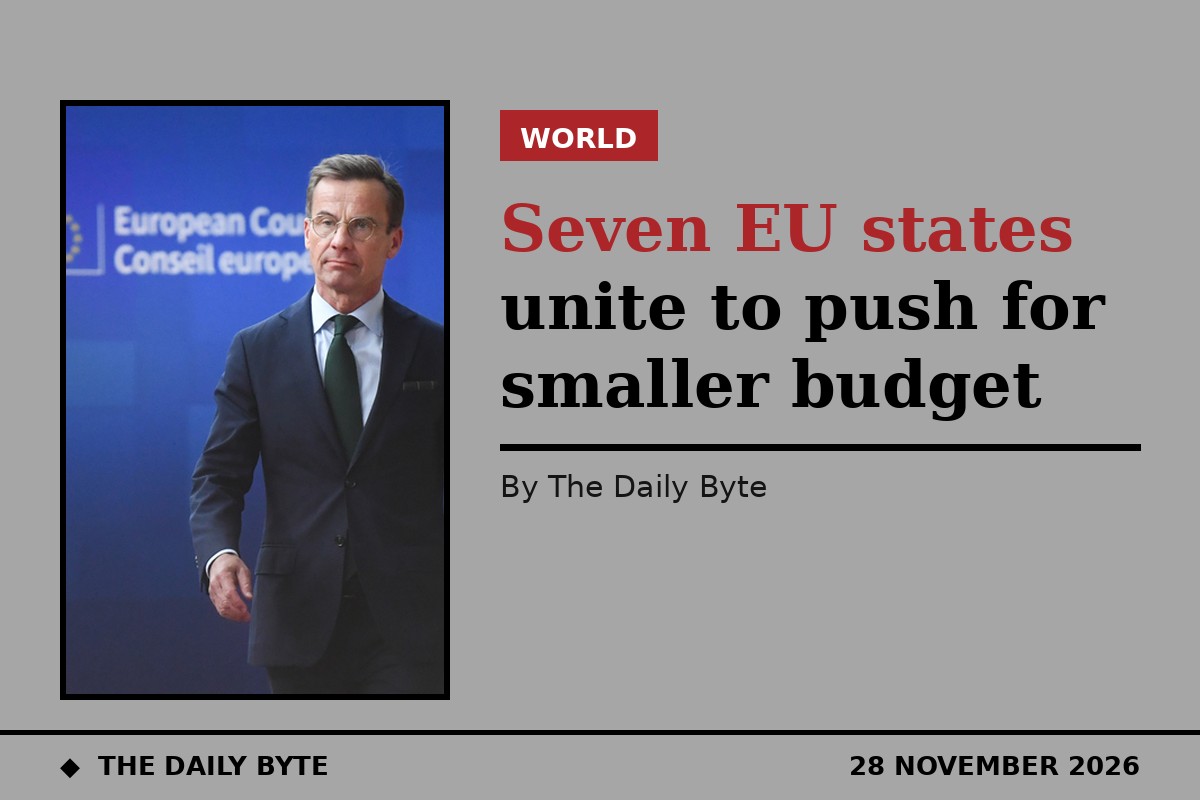
Seven European Union countries have agreed to negotiate jointly for a smaller long-term EU budget, forming a coordinated bloc that could shape the most difficult spending talks the union has faced in years.
The seven are Germany, Sweden, the Netherlands, Denmark, Finland, Austria and Belgium. Swedish Prime Minister Ulf Kristersson announced the pact in Brussels on the sidelines of a special summit on the EU's 2028-2034 budget, after the group met separately with European Council President António Costa.
A joint front for budget discipline
The countries, all net contributors that pay more into the EU budget than they receive, believe the spending proposed so far is far too high. They intend to coordinate their positions in the coming period and to prevent separate negotiations in which individual governments could be offered concessions in exchange for accepting a compromise.
The move came as EU leaders ended the special summit in the early hours of Friday 27 November without agreement on either the seven-year budget or a proposed €45 billion loan for Ukraine. The meeting, scheduled to last two days, was cut short after the seven countries declined to take part in further small-group negotiating sessions organised by Costa.
At the centre of the dispute is the size of the next Multiannual Financial Framework, the EU's seven-year spending plan. The European Commission proposed a budget of nearly €2 trillion in July 2025. Costa tabled a compromise on 21 November that would cut it by about 10 percent, to roughly €1.58 trillion at constant 2025 prices, or about €1.78 trillion at current prices.
The seven governments consider even that reduction insufficient. According to the Swedish government's calculations, the proposal on the table would lead to a 57 percent increase in Sweden's contribution to the EU budget. Sweden paid a gross amount of 46 billion kronor in 2025. Kristersson was blunt about his government's position, saying: "We cannot be an ATM for the European Union."
Two camps pull in opposite directions
The frugal countries, as the group is known in Brussels, want deeper cuts, particularly to regional cohesion funds and farm subsidies, so that spending can be directed towards defence, innovation and competitiveness. They are opposed by the 17-strong Friends of Cohesion group, including Italy, Poland, Romania and Spain, which wants to protect agricultural and regional development funding and a fair sharing of the burden.
The budget argument has become entangled with the question of funding for Ukraine. The European Commission has proposed a €45 billion loan to cover about two-thirds of Ukraine's estimated €70 billion financing gap in 2027. Costa said 24 of the 27 member states backed the loan, while the Czech Republic, Hungary and Slovakia remained opposed, and Bulgaria sought an exemption from the military part.
German Chancellor Friedrich Merz has threatened to block the entire budget unless all 27 countries help finance the Ukraine loan, and has warned that countries that refuse to take part could see their regional aid reduced. Czech Prime Minister Andrej Babiš disputes that the two issues can be linked under the EU treaty, pointing to his country's need for infrastructure spending.
Kristersson criticised governments that want support from a large EU budget but do not want to help pay for Ukraine, calling it unacceptable for some countries to benefit while others finance the response to what he described as a threat to Europe.
Next round in December
Leaders will return to both questions at the regular European Council meeting on 17-18 December. Costa is pushing for agreement before the end of the year, a timetable France considers important because it holds presidential elections in the spring. Several leaders have openly doubted that even the December meeting will produce a deal, raising the prospect of talks running into the second half of 2027.


