Shehbaz Tells COP31 Pakistan Added 22GW Rooftop Solar
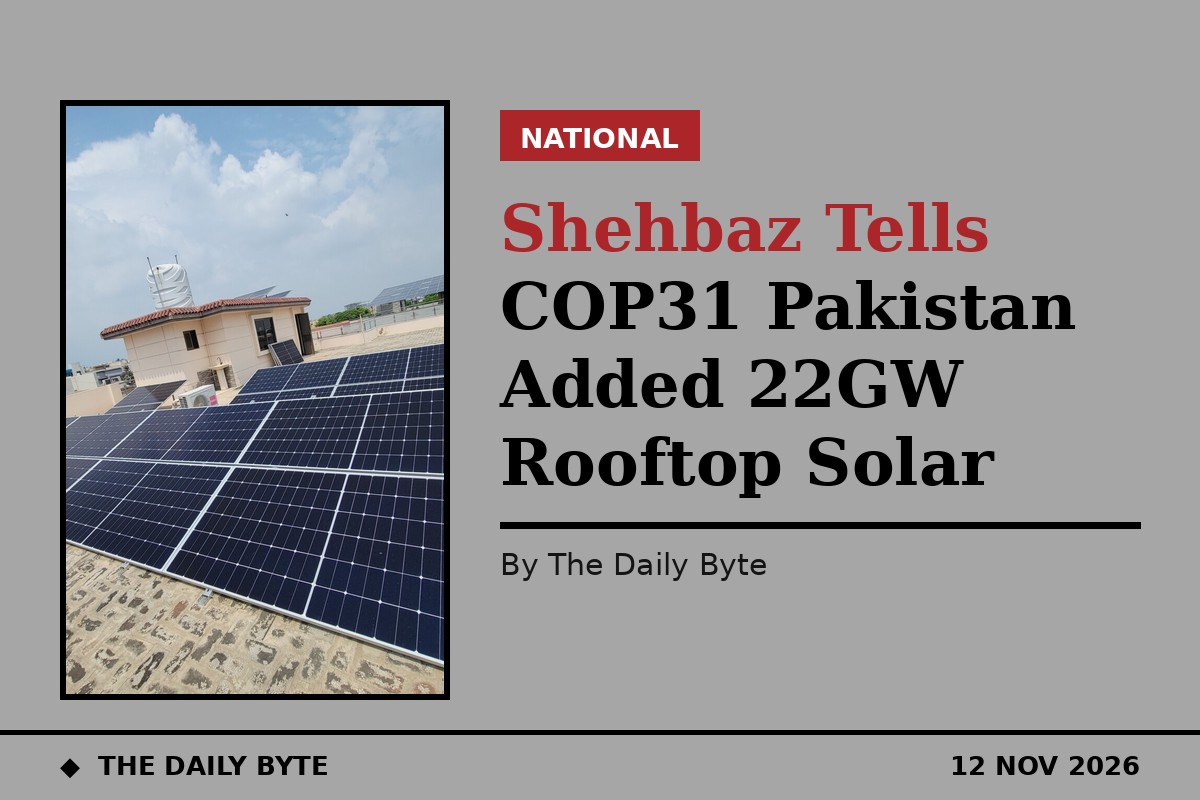
Prime Minister Shehbaz Sharif has told world leaders at the COP31 climate summit in Antalya that Pakistan has added nearly 22 gigawatts of rooftop solar capacity in just two years, describing the shift as a quiet revolution led by ordinary households and businesses.
Speaking at a high-level dialogue on clean energy transition, titled “Clean Energy Transition by 2035: Powering the Future”, the prime minister said the change had been driven by people looking for cheaper and more reliable electricity, rather than by government programmes alone. The session was held on the sidelines of the 31st Conference of the Parties to the United Nations Framework Convention on Climate Change, which Türkiye is hosting in the Mediterranean city of Antalya.
According to a statement from the Prime Minister’s Office, Mr Sharif said the momentum behind Pakistan’s energy transition was real and accelerating, but warned that it could not be sustained without far greater financial support from the international community.
Pakistan puts $188bn price on clean energy switch
The prime minister told the dialogue that Pakistan needs about $138 billion by 2035 to build low-carbon electricity generation, along with a further $50 billion to replace coal-fired power with solar energy. Together, the two figures put the cost of the country’s clean-energy transition at roughly $188 billion over the next decade.
He said developing countries could not meet their climate ambitions without affordable finance and the transfer of affordable technology, arguing that the global electrification target known as “35 by 35” would only be reached if money flowed at the speed of ambition. Under that pledge, participating countries aim to raise electricity’s share of total final energy consumption to about 35 per cent by 2035.
Mr Sharif reaffirmed Pakistan’s support for the pledge and called for concessional capital, faster expansion of electricity grids, greater investment in energy storage and easier access to emerging technologies.
Solar boom, nuclear power and electric vehicles
Setting out the scale of change already under way at home, the prime minister said clean energy sources now account for nearly 55 per cent of Pakistan’s energy mix. He also pointed to the recent placement of the dome at Chashma-5, the country’s seventh nuclear power plant, which he said would add 1,200 megawatts of clean electricity to the national grid.
He said a major change was also taking place in transport. Pakistan’s recently drafted automobile policy supports a national target of making 30 per cent of new vehicles electric by 2030, with reduced tariffs and other incentives to encourage buyers. He added that more than one in every 10 motorcycles sold in Pakistan this year was electric, and that all future government buses and motorcycles would be electric.
The 22-gigawatt rooftop solar figure is the prime minister’s own, and estimates of how much capacity has actually been installed vary. It has not been independently verified, although the rapid spread of rooftop panels across Pakistani homes and businesses in recent years, driven by high grid electricity prices, is widely documented.
Pakistan’s case at the leaders’ summit
Mr Sharif arrived in Antalya on Tuesday for a visit running from 10 to 12 November, and was welcomed at the conference hall by Turkish President Recep Tayyip Erdogan and United Nations Secretary-General António Guterres. He also took part in a group photograph with other world leaders and held meetings with figures including Saudi Arabia’s energy minister, Prince Abdulaziz bin Salman Al Saud, the Prime Minister of Bangladesh, Tarique Rahman, and World Bank President Ajay Banga.
The prime minister is also addressing the Antalya Leaders’ Summit, where he is setting out Pakistan’s climate priorities and pressing for predictable, adequate and accessible climate finance for developing countries. A dedicated Pakistan Pavilion has been set up at the conference venue, hosting 54 events on climate-related themes.
Closing his address to the clean-energy dialogue, Mr Sharif said: “Let us resolve to power our economies without impoverishing our people and light up our homes without darkening our planet.”