Sierra Leone steps up Ebola readiness with Japan-WHO backing
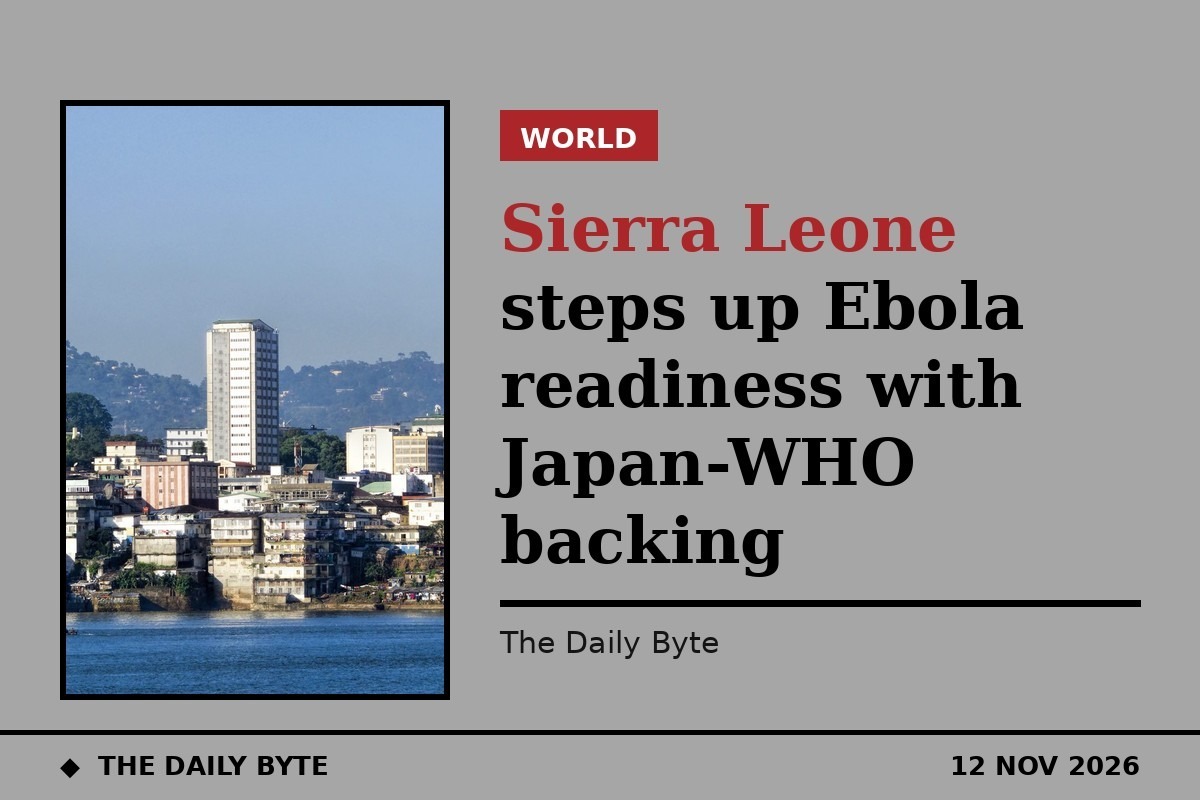
Sierra Leone is stepping up its defences against Ebola, with Japanese-backed support from the World Health Organization (WHO) strengthening community surveillance, testing and public awareness across all 16 of the country's districts.
Japan's ambassador to Sierra Leone, Hiroshi Yoshimoto, and the WHO representative in the country, Dr George Ameh, visited Grafton on Thursday, 12 November, to see the work at first hand. They met community members and networks of people living with HIV, and joined a health awareness session with pupils at WAR Wounded Secondary School.
The visit was part of a Japan-funded WHO project to scale up detection, diagnosis, case management and community engagement in the response to mpox, which is also being used to strengthen readiness for Ebola and other infectious diseases. The project covers every district in Sierra Leone and uses an "Each One Teach One" approach, in which trained community members pass on accurate health information through people they know and trust.
Readiness score rises to 83 per cent
The push comes as Sierra Leone's National Public Health Agency (NPHA) reports a sharp improvement in the country's Ebola preparedness. An assessment in October put overall readiness at 83 per cent, up from 51 per cent in May and above the WHO benchmark of 80 per cent.
Infection prevention and control capacity rose from 18 per cent to 82 per cent, preparation for safe and dignified burials increased from 20 per cent to 73 per cent, and contact tracing and risk communication both reached 84 per cent. The national laboratory at Jui can now confirm an Ebola infection within three hours, without sending samples abroad.
WHO donated 480 PCR test kits and about 500 laboratory extraction materials to the NPHA in late October to strengthen detection capacity. The kits can detect all five strains of the Ebola virus, including the Bundibugyo strain behind the outbreak in the Democratic Republic of Congo, as well as the Marburg virus. More than 300 test kits have already been placed in hospitals around the country, with about 495 at Kenema Government Hospital, the national centre for viral haemorrhagic fevers, and about 560 reagents in stock.
Health Minister Dr Austin Demby has warned that 83 per cent preparedness is not enough for a disease as deadly as Ebola, and has told the NPHA to close the remaining gaps within a month.
No confirmed case, but the regional risk is real
Sierra Leone has no confirmed case of Ebola, but officials say the risk of an imported infection is real. The outbreak in the Democratic Republic of Congo had recorded more than 9,400 cases and more than 4,500 deaths by late October, according to reports at the time, and has spread to neighbouring countries, with cases reported in Uganda and Kenya and an imported case confirmed in Nigeria in October. WHO has declared the outbreak a public health emergency of international concern, and there is no approved vaccine yet for the Bundibugyo strain, with vaccine candidates still in trials.
That history weighs heavily in Sierra Leone. The Zaire strain of Ebola infected more than 14,000 people and killed nearly 4,000 in the country during the 2014-2016 epidemic.
As a precaution, health declaration forms are now mandatory for passengers arriving at and leaving from Freetown International Airport at Lungi, with travellers asked to complete their health and travel history online within 72 hours before travel and present a QR code on arrival. District rapid response teams have been activated, fever screening has been reinforced at airports, seaports and land crossings, and protective equipment and isolation units have been restocked.
Officials are urging anyone who develops a sudden fever, weakness, headache, muscle pain, vomiting or diarrhoea within 21 days of travel from an affected country to call the national emergency number, 117, and seek help immediately. The NPHA has stressed that preparedness should not be mistaken for panic, and that no case has been confirmed in the country.