Singapore core inflation eases to 1.5% in October
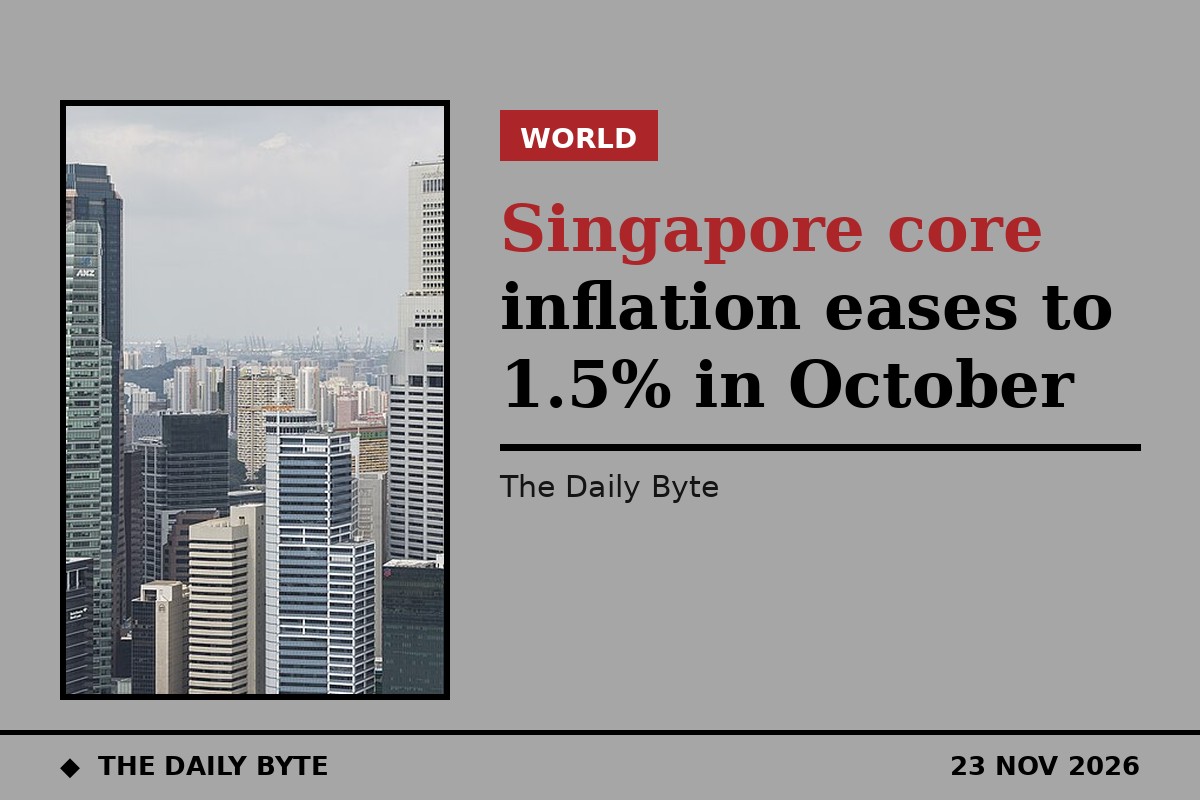
Singapore's core inflation eased to 1.5% in October 2026, down from 2% in September, according to official figures released on Monday, 23 November 2026 — coming in below the 1.7% median forecast in a Reuters poll of economists.
Headline inflation also slowed, to 1.9% year on year in October from 2.2% in September, matching the poll forecast, Business Today reported. The figures were published by the Department of Statistics, with the Monetary Authority of Singapore (MAS) and the Ministry of Trade and Industry (MTI) explaining the drivers in a joint statement. CNA also reported the figures on Monday.
What drove the slowdown
The moderation was driven by slower increases in services and electricity and gas prices. Services inflation eased to 1.1% in October from 1.7% in September, reflecting smaller increases in airfares and in the costs of health insurance and healthcare services.
Electricity and gas saw the sharpest decrease of any sector, with inflation falling from 8.7% in September to 1% in October, largely because the regulated electricity tariff was lower in October than in September. Food inflation edged down from 2.4% to 2.3%, and private transport inflation eased to 6.7% from 7.1% as car prices rose more gradually.
Not every category cooled. Retail and other goods inflation picked up from 1.2% to 1.6% as furniture prices rose and household appliance prices fell more slowly. Accommodation inflation was unchanged at 0.9%, with housing rents rising at a similar pace as in September. On a month-on-month basis, core prices were unchanged in October, while overall prices fell by 0.3%.
What core inflation measures
Core inflation is the measure MAS uses for monetary policy. It excludes accommodation and private transport costs, which tend to be volatile and heavily influenced by administrative policies, to give a clearer picture of underlying price pressures faced by households.
So far in 2026, core inflation has averaged 1.6% over January to October, inside MAS's forecast of 1.5% to 2% for the year, while headline inflation has averaged 1.9%, against MAS's forecast of around 2%. The central bank kept its monetary policy unchanged at its October review.
Pressures expected to pick up in early 2027
MAS and MTI cautioned that price pressures are expected to pick up in the first quarter of 2027 before easing more noticeably from the middle of the year. Imported cost pressures are expected to remain firm in the near term, as energy commodity prices remain volatile and elevated compared with a year ago, and global and regional food prices are expected to pick up as costlier inputs feed through.
For 2027, MAS forecasts both core and headline inflation at 1.5% to 2.5%, above the historical average of 1.5%.
Frequently asked questions
What was Singapore's core inflation in October 2026? Core inflation was 1.5% year on year in October, down from 2% in September and below the 1.7% median forecast in a Reuters poll.
What was headline inflation? Headline inflation, measured by the Consumer Price Index for all items, was 1.9% year on year in October, down from 2.2% in September.
What is the difference between core and headline inflation? Core inflation excludes accommodation and private transport costs. Headline inflation covers everything households buy.
Will inflation rise again? MAS and MTI expect price pressures to pick up in early 2027 before easing more noticeably from the middle of the year. Their 2027 forecast is 1.5% to 2.5% for both core and headline inflation.
Sources: Business Today, CNA and Reuters via The Star. Published 23 November 2026.


