Singapore launches SPIRE Asia $500m farm climate fund
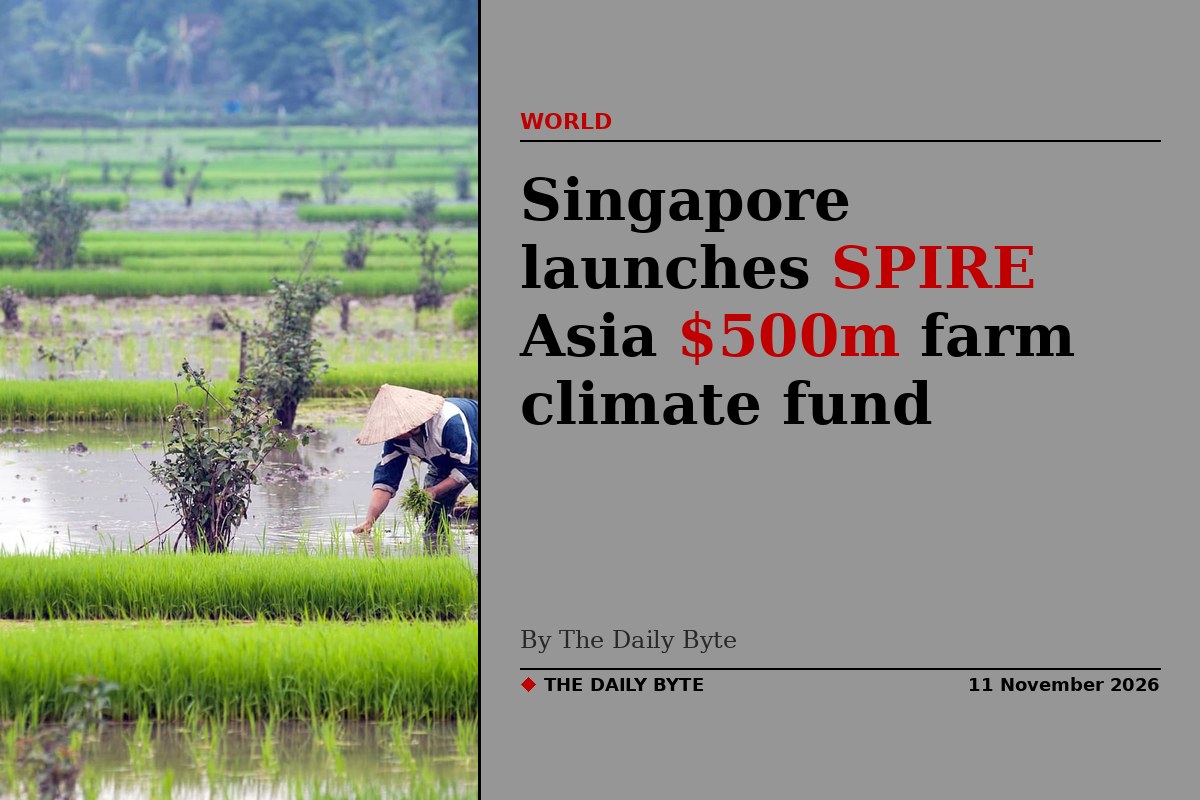
Singapore has launched a new regional programme to draw private investment into climate adaptation for Southeast Asia's farms and food systems, with a blended finance fund targeting up to $500 million. The initiative, known as SPIRE Asia, was unveiled at the COP31 climate conference on Tuesday, 10 November 2026.
The programme's full name is the Scaling Projects and Investments for Resilience in Asia Programme. It is designed to turn climate resilience in the region's agri-food sector from a funding problem into a set of projects that investors can back, according to a statement from the Monetary Authority of Singapore (MAS) reported on Tuesday.
Singapore's ambassador for climate action, Ravi Menon, launched the programme at COP31 in Antalya, Türkiye. He argued that the challenge is not only the amount of money available, but where it goes. Asia, he said, is the region most underserved by adaptation finance relative to its needs.
Asia faces a $400 billion annual adaptation gap
Menon put the scale of the shortfall in stark terms. He cited an annual regional need for adaptation finance of up to $400 billion, against actual flows of only $34 billion in 2021 and 2022. Globally, he added, agri-food systems received just 20 percent of adaptation finance, even though they account for 54 percent of the costed adaptation needs set out in developing countries' national plans.
Climate change is already raising risks for farms and food supply chains across Southeast Asia, as higher temperatures, shifting rainfall and extreme weather disrupt production and rural livelihoods. For Singapore, the stakes are direct: the city-state imports more than 90 percent of its food, and Menon said regional food resilience is part of Singapore's own food security.
The programme was shaped by consultations with more than 60 stakeholders, including development banks, investors, philanthropies and agri-businesses. Those discussions identified three gaps holding back investment: data, projects and financing. SPIRE Asia is built around three linked pillars designed to close each of them.
Three pillars: data, projects and finance
The first pillar is a data platform that will bring together climate, agricultural and investment datasets, led by Enterprise Singapore. It will include a Solutions Centre for Regional Smallholder Farmers that Singapore is setting up with ecosystem partners, aimed at the small farmers who produce much of the region's food but are often invisible to investors.
The second pillar is a market development facility led by Temasek Trust. Its job is to turn small, farm-level projects into investment-ready portfolios and connect them with investors, buyers and implementation partners. Many promising adaptation projects struggle to attract finance because they are too small, too early in development, or lack the data investors need to judge them.
The third pillar is the blended finance fund itself, with a target size of up to $500 million. It will use catalytic capital to absorb specific risks and attract commercial lenders into projects they would otherwise consider too risky. The $500 million figure is a fund-size target, not money already raised or deployed.
A steering committee made up of the National Climate Change Secretariat, the Monetary Authority of Singapore, Enterprise Singapore and Temasek Trust will coordinate the three pillars. The programme is jointly developed by the National Climate Change Secretariat, MAS and Enterprise Singapore.
Why food systems are the focus
The focus on agri-food reflects a wider shift in climate finance. Farming, fisheries and food supply chains are among the sectors most exposed to a warming climate, yet they have historically received a small share of adaptation funding compared with energy and transport. SPIRE Asia is an attempt to correct that imbalance in a region where agriculture still employs large numbers of people and underpins food security for hundreds of millions.
Singapore's move also fits its broader role as a financial centre for the region. By building the data, project pipelines and risk-sharing structures that investors need, the programme aims to crowd in commercial capital rather than relying on public money alone. Whether it succeeds will depend on how quickly the data platform and the fund move from launch announcements to funded projects on the ground.
For now, the launch at COP31 puts Southeast Asia's farm resilience on the agenda at the world's biggest climate gathering, with Singapore betting that better information and shared risk can unlock the private money the region's farmers need.


