Sisi Urges Full Israeli Withdrawal From Gaza in Cairo
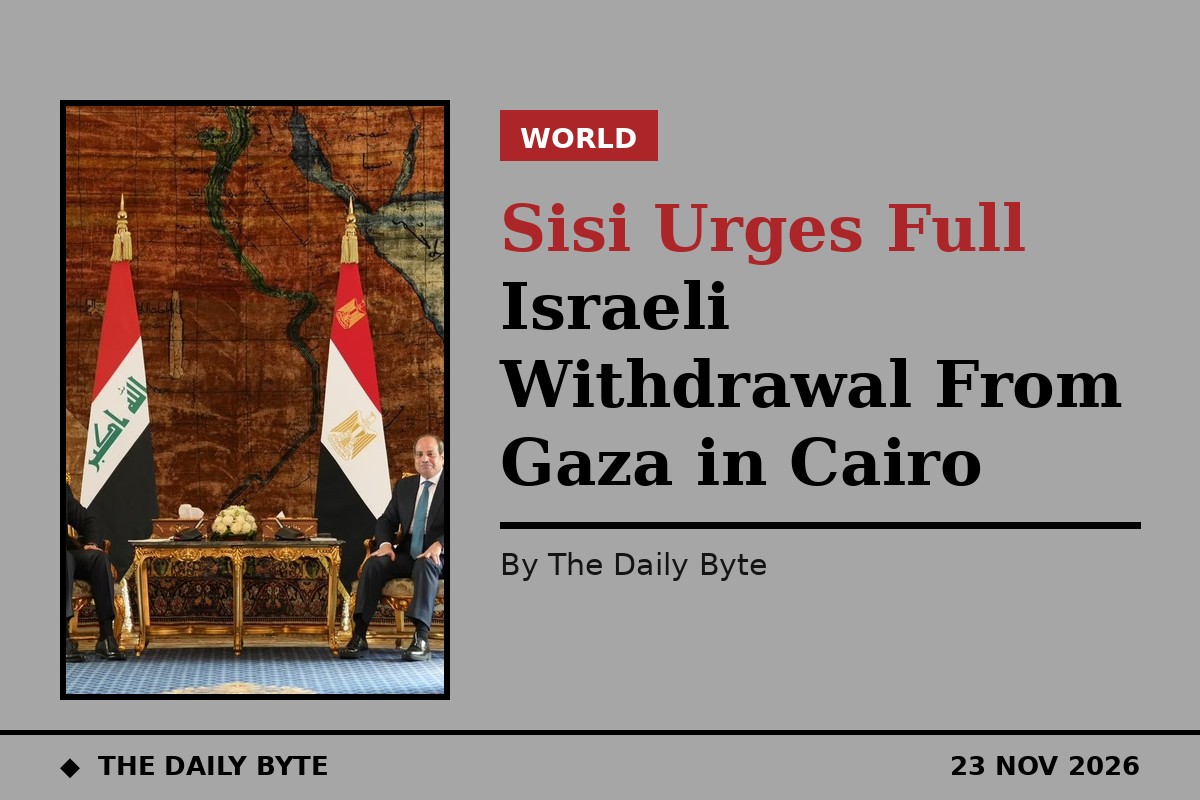
Egyptian President Abdel Fattah el-Sisi has called for Israel to complete its withdrawal from the Gaza Strip and for an international stabilisation force to be deployed to monitor the ceasefire, in remarks made alongside Iraq's prime minister in Cairo on Monday.
Sisi made the call at a joint press conference with Iraqi Prime Minister Ali al-Zaidi at the Ittihadiya presidential palace, on the first day of Zaidi's first official visit to Egypt since taking office. The Egyptian presidency said the two leaders reviewed regional developments and agreed on the need to strengthen joint Arab action to safeguard Arab national security, according to IANS, reporting on the presidency statement via Xinhua.
What Sisi called for in Gaza
Sisi said Israel should fulfil its commitments under the first phase of the ceasefire agreement, including allowing humanitarian aid and early recovery supplies into Gaza and rehabilitating damaged infrastructure and hospitals across the enclave. He also pressed for the National Committee for the Administration of Gaza to be empowered to carry out its interim mandate from inside the territory.
The Egyptian president said implementing the second phase of the arrangements should end with the Palestinian people exercising self-determination and establishing an independent state along the June 4, 1967 borders, with East Jerusalem as its capital, in line with international resolutions. No timetable for the withdrawal or the force's deployment was set out in the statement.
Maritime security and water
The two leaders also discussed freedom of navigation, stressing the importance of preserving the security, safety and freedom of maritime shipping in line with international law and rejecting any attempt to disrupt shipping lanes in the Gulf, the Bab al-Mandeb strait and the Red Sea. Sisi said the security and governance of the Red Sea remained the sole prerogative of the Arab and African states on its shores.
On water, they called for closer coordination to tackle scarcity and desertification, upholding international law on shared watercourses and rejecting unilateral measures, under the principles of prior notification, consultation and consensus.
A first visit with a wider agenda
Zaidi was received at Cairo airport by Egyptian Prime Minister Mostafa Madbouly before the palace talks, which began one-to-one and then widened to both delegations, The Insight International reported. Presidential spokesman Mohamed el-Shenawy said Sisi described Iraq's stability as "a fundamental pillar of Arab national security" and restated Egypt's support for Iraq's sovereignty and unity.
Zaidi told reporters the two countries held "unified" political positions and shared an approach based on lowering tensions and settling regional crises through dialogue. "Egypt is the heart of the Arab nation," he said.
The visit also produced a bilateral announcement: Zaidi said the two countries had agreed to lift visa requirements between them, although neither government had published details by Monday afternoon of when the change would take effect or which travellers it would cover. The two leaders also discussed energy, investment, trade and military cooperation, and Zaidi and Madbouly were due to chair the fourth session of the Iraqi-Egyptian Higher Joint Committee later on Monday, with memoranda of understanding expected to be signed.
Oil featured in the talks: Iraq's deputy trade minister, Sattar al-Jabiri, has said a proposal to supply Egypt with about 10 million barrels of crude is still under study, with no delivery dates or payment terms agreed, and officials have discussed reopening a branch of Iraq's state-owned Rafidain Bank in Cairo. Baghdad has also been looking for export routes that avoid the Strait of Hormuz, where shipping has faced growing security risks.


