Somalia Alone Votes Against UN Women Violence Text
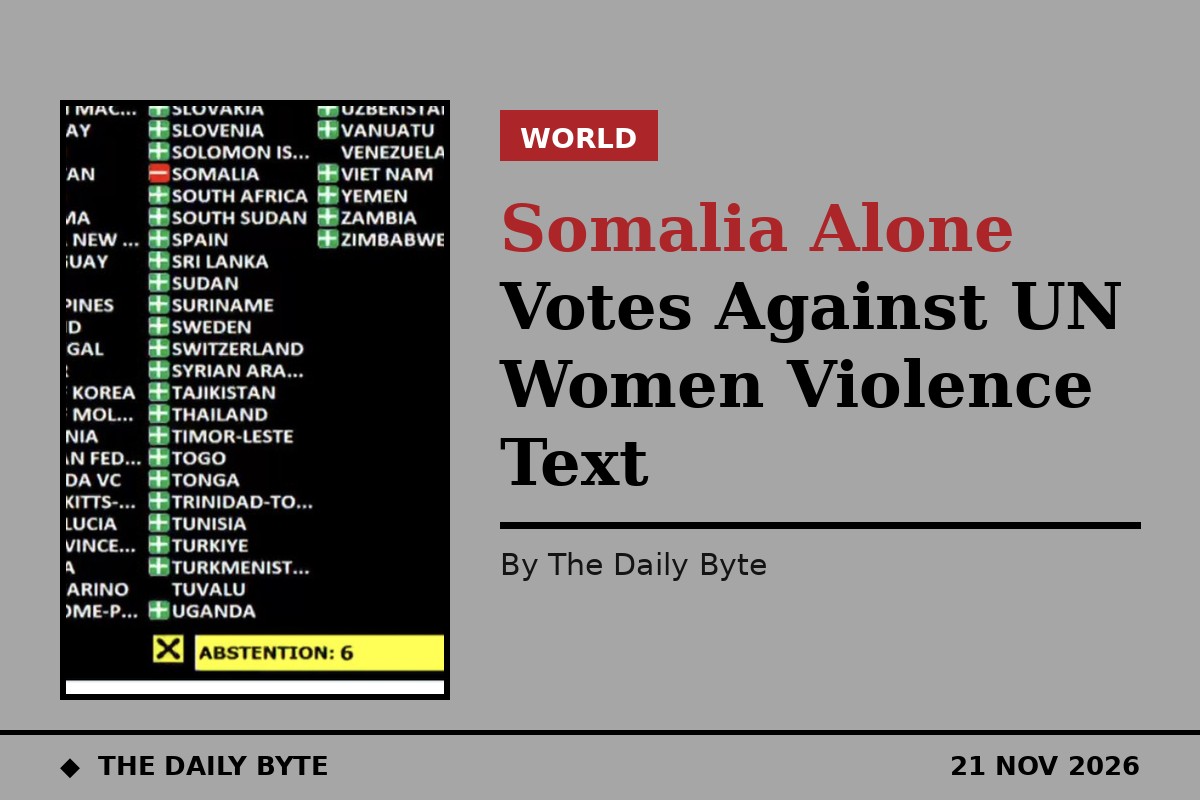
Somalia cast the only vote against a United Nations resolution on violence against women and girls, standing alone as 175 countries voted in favour and six abstained.
The vote took place in the UN General Assembly's Third Committee on Tuesday 17 November, on a resolution titled "Intensification of efforts to prevent and eliminate all forms of violence against women and girls". The text was approved by 175 votes to one, with six abstentions. The United States, Russia, Argentina, Belarus, Burkina Faso and Cameroon abstained.
Somalia's delegation took no part in the debate, spoke on none of the eleven amendments discussed before the vote, and entered no reservation afterwards. At the time of reporting, its Permanent Mission to the United Nations had issued no public explanation of its opposition.
What the resolution covers
The resolution urges member states to take comprehensive and gender-responsive measures to prevent and eliminate all forms of violence, intimidation and attacks against women and girls, and to address the risk factors by implementing legislation and policies. Its definition of violence extends to online and digital technologies, and it calls on countries to adopt laws and policies to protect women and girls from defamation and hate speech online.
Introducing the draft, France stressed the importance of its focus on the digital landscape, noting that more than half of women in some parts of the world have been affected by online violence. A report from the UN Secretary-General in August noted that almost 50,000 women and girls were killed by their partners or another family member in 2024.
"Technology has extended the continuum of violence against women and girls into the digital sphere, where online harms increasingly function as precursors to and instruments of lethal violence," the report said, pointing to online stalking, digital surveillance and harassment.
Language dispute behind the split
The resolution had been the subject of lengthy debate, as has been the case for most UN resolutions concerning women, girls and gender in recent years. Various member states contested terminology such as "sexual and reproductive health" and "safe abortion", and some sought to remove references to "multiple and intersecting forms of discrimination", "intimate partner violence" and "marital rape". A proposed amendment that would have subjected the entire resolution to "national sovereignty" was defeated.
The United States explained its abstention by saying it was disappointed to see what it called controversial terminology on sexual and reproductive health and safe abortion retained in the text. Washington maintained that there is no international right to abortion and that states retain sovereign authority to legislate on the issue.
Somalia has previously opposed resolutions containing references to sexual and reproductive health rights and broader gender terminology, with reporting noting arguments that such provisions may conflict with its domestic legislation, Islamic principles and cultural values. Other countries with similar reservations have generally abstained or voted in favour while registering objections, rather than voting against the text outright.
Regional split and what happens next
The vote placed Somalia at odds with several of its East African neighbours. Kenya, Ethiopia, Uganda, Burundi and Rwanda all voted in favour of the resolution, while Burkina Faso and Cameroon were among the African countries that abstained.
The European Union's delegation at the UN welcomed the outcome, saying: "Gender-related killings are a global scourge. Today's vote: 175 to 1 marks the international community's commitment to end violence against women and girls worldwide." The UK, which co-sponsored the text, said: "Every 10 minutes, a woman is killed by her partner or a family member. This is appalling. And it must end."
The resolution has so far been approved only at committee level during the General Assembly's 81st session. It still needs to be formally adopted by the full General Assembly in plenary in December.
The vote comes days before the annual 16 Days of Activism Against Gender-Based Violence, which begins on 25 November, the International Day for the Elimination of Violence Against Women, and concludes on 10 December, Human Rights Day. According to UN Women, an estimated 840 million women, or nearly one in three worldwide, have experienced physical or sexual violence during their lifetime.


