Somalia Opposition Rejects President's New Talks Offer
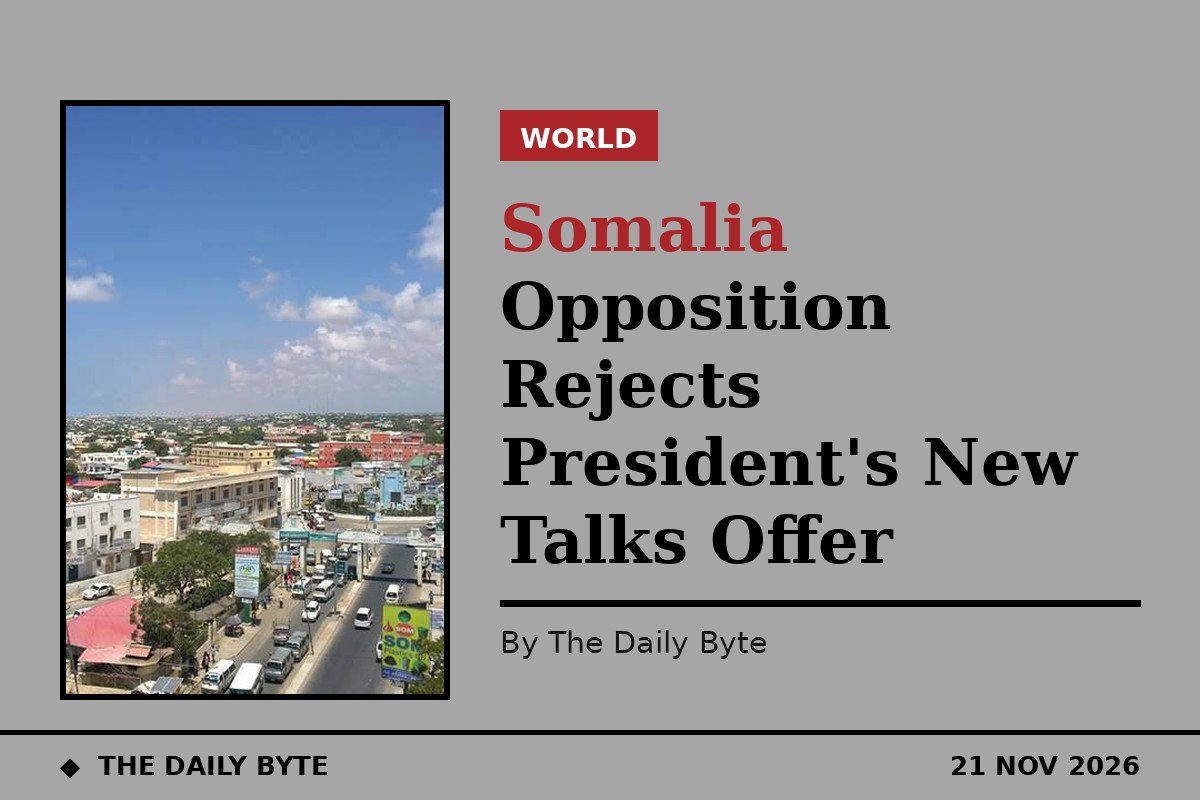
Somalia's opposition leaders have unanimously rejected any talks with President Hassan Sheikh Mohamud, after he telephoned former Prime Minister Abdi Farah Shirdon and asked him to host a meeting at his home.
The president promised major concessions and said Somalia's future and its upcoming elections would be settled through broad-based consensus, according to the Somali Guardian. Shirdon relayed the offer to opposition leaders, who met at length on Thursday night, debated the proposal and reconvened on Friday. In that second session they rejected both the meeting and any further engagement with Mohamud.
The refusal is the latest turn in a political crisis that has paralysed the country for months. Earlier talks collapsed because the president made no meaningful concessions and continued to insist on a one-person, one-vote election conducted on terms he favours, an arrangement widely viewed as intended to secure him a third term. Opposition leaders are demanding that Mohamud first abandon that model and accept that both the type of election and the manner in which it is held must be decided through a consensus process involving all political stakeholders.
The president has stated that no decision will be placed "in the middle", conveying that only the government will determine the election model and the country's political direction, while others may merely offer advice that may or may not be considered.
What the opposition is demanding
The opposition's conditions go beyond the election model. They include international mediation, binding guarantees that the president will negotiate in good faith, reversal of the election model and the constitutional changes he has introduced, and security assurances for the presidents of Puntland and other regional states, as well as for other attending leaders.
According to Horn Africa News, the two main opposition blocs, the Salvation Council and the Future Council, rejected the proposal, and the rejection itself triggered disagreements within the opposition camp. Representatives of the Midowga Xaqsoor and Heybad Qaran groups separately held a meeting and accepted the opposition's position that no direct talks should take place with President Hassan Sheikh until he formally relinquishes power.
Opposition leaders view the latest offer as a tactical manoeuvre designed to occupy, divide and co-opt members of their coalition, the same method they say was previously used to draw former parliamentary speaker Sharif Hassan Sheikh Adan, former Prime Minister Omar Abdirashid and Dahir Mohamud Gelle into supporting the president's election model after they attended earlier talks.
A court ruling hangs over the standoff
The standoff unfolds against a severe political, constitutional and security crisis. A court ruling earlier this month held that the mandates of the president and parliament had expired, declared the term extension null and void, ordered elections within 90 days and required a political agreement within 30 days. The government has contested the practical force of the judgment while continuing to defend the electoral commission's timetable, which schedules parliamentary elections for 15 April 2027 and a presidential vote for 15 May 2027.
Mohamud's approach to Shirdon, regarded as one of the less hardline opposition figures, comes under intensifying international pressure. The opposition Future Council had already told the United States, Britain, the European Union and Turkey that it would stay away from a meeting at the presidential palace, and it has insisted that any substantive talks require international mediation and guarantees rather than a government-hosted format.
The talks that never opened
The latest rejection follows the collapse of a National Consultative Conference that the president had scheduled in Mogadishu for 14 to 18 November. The talks failed to open as planned after the main opposition alliance boycotted the gathering at Villa Somalia, and the presidency said only that contacts were continuing and the meeting would open soon, without giving a new date.
Puntland and Jubaland, two federal member states that have rejected the government's election plans, had already refused the invitation outright, describing it as a device to prolong institutions whose mandates, they argue, have expired. Their absence left the proposed gathering without the two federal member states most openly at odds with Mogadishu's electoral roadmap.
For now, the two sides are further apart than ever. The president has offered concessions and a venue of the opposition's choosing, and the opposition has answered by refusing to meet him at all. With a court-ordered deadline for a political agreement falling in early December, the window for a negotiated way out is narrowing fast.


