Somalia Rejects UN Findings on Chief Justice Removal
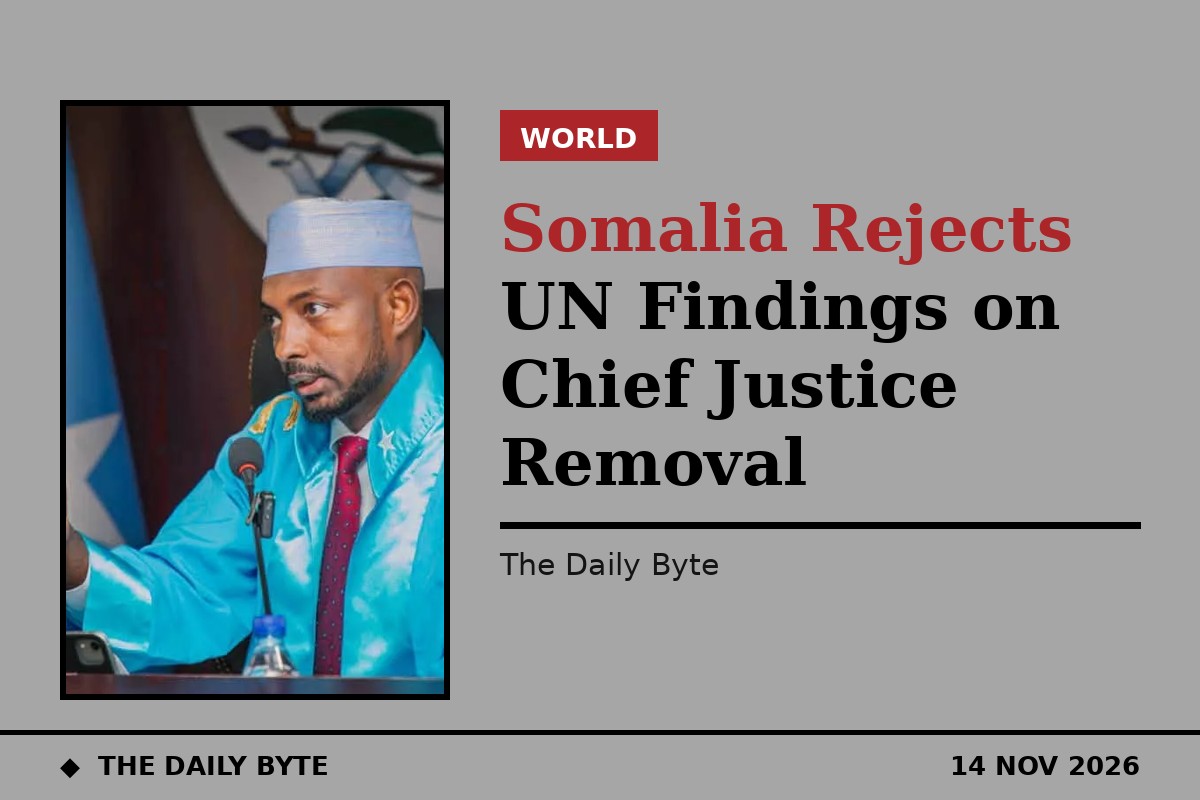
Somalia’s government has formally rejected the findings of two United Nations human rights experts who condemned the dismissal of Chief Justice Bashe Yusuf Ahmed as unlawful, insisting that the removal was carried out under transitional arrangements and that a Supreme Court ruling on President Hassan Sheikh Mohamud’s term has no legal effect.
In a statement issued on Saturday, 14 November 2026, the Ministry of Justice and Constitutional Affairs defended the president’s decision to remove the chief justice by decree on 4 November, arguing that the process followed the transitional arrangements under which he was initially appointed.
The ministry said the High Council of the Judiciary provided for under the 2026 Constitution had not yet been established, and that the removal therefore followed the same transitional procedure used for the appointment.
It maintained that the president’s decision was unrelated to the Supreme Court’s deliberations on the constitutional dispute surrounding his tenure, and that pronouncements made in the name of the court after the removal took effect had no legal basis, because a ruling could only be issued by a lawfully constituted bench presided over by a chief justice who held the mandate.
UN experts condemned the dismissal
The government’s response came two days after the UN experts, Margaret Satterthwaite, the special rapporteur on the independence of judges and lawyers, and Ben Saul, the special rapporteur on human rights and counter-terrorism, condemned the dismissal in a statement issued in Geneva on 12 November.
“We strongly condemn this blatant interference with the independence of the judiciary,” the experts said. They argued that the president could not unilaterally remove the country’s chief justice without following the constitutional process, which includes a proposal from the Judicial Services Commission and approval by parliament.
The experts also raised concerns about the security situation surrounding the Supreme Court, saying hundreds of security personnel had been deployed around the institution to disrupt its operations and intimidate judges. They said seven Supreme Court judges had lost their personal security protection and had been barred from travelling, and called for the chief justice to be restored to office, for the judges’ protection to be reinstated, and for security forces to withdraw from the court.
Mogadishu criticises how the UN statement was issued
Mogadishu rejected the criticism and accused the UN experts of issuing their statement without first seeking the government’s position on the dispute.
“Regrettably, the experts did not seek clarification from the State before issuing their statement, as the Code of Conduct for Special Procedures Mandate-holders of the Human Rights Council requires,” the Justice Ministry said.
The ministry said Somalia’s diplomatic mission in Geneva had requested an official communication outlining the concerns ahead of an emergency meeting, but the experts did not provide the requested letter. It also accused the experts of sharing their press release with the government only after it had already been published.
The government also pointed to a statement by the Attorney General on 6 November, which raised preliminary objections about the court’s jurisdiction, the composition of the bench, and the claimant’s standing. It argued that these were questions of law that had to be resolved before the substance of the dispute could be determined.
The ministry said it remained open to dialogue with the UN experts and was ready to provide further information. Its response, however, does not address the experts’ specific demands, and the chief justice remains out of office, the judges remain without their protection, and the Supreme Court’s ruling that the president’s mandate had expired remains unenforced.
How the crisis unfolded
The dismissal came the night before the Supreme Court was due to rule on the constitutionality of measures extending the terms of the president and parliament from four to five years. On 5 November, five judges of the court’s Constitutional Division went ahead with the case, ruling that the extensions were unlawful and that the terms of both parliament and the president had expired.
On 7 November, a ceremony was held to swear in Ibrahim Idle Suleiman, a former presidential legal adviser, as the new chief justice. President Hassan Sheikh Mohamud attended the ceremony.
The dispute has left Somalia facing a deepening constitutional crisis, with the government and the court offering rival accounts of who lawfully holds the country’s top judicial office, and of whether the president and parliament may lawfully remain in office.


