SonicWall VPN flaw that skips MFA faces 20 November fix deadline as attacks continue
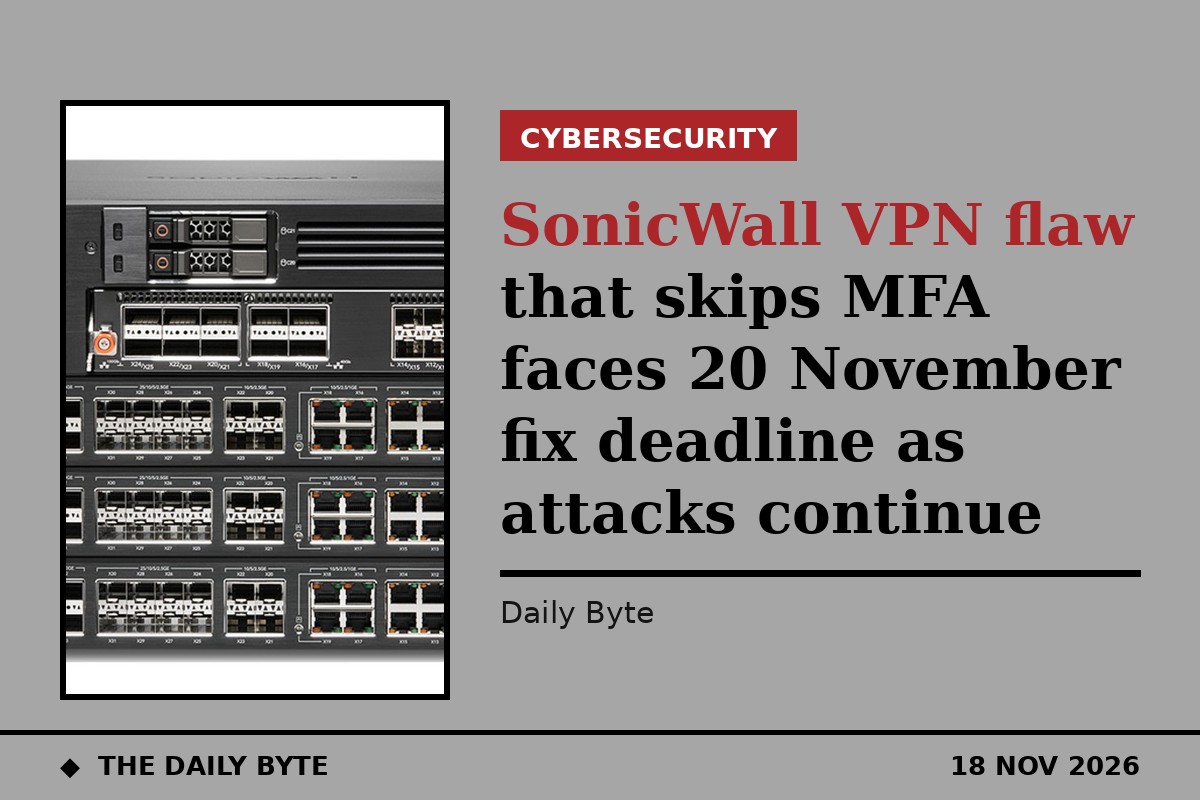
A flaw in SonicWall firewalls that lets an attacker skip multi-factor authentication on the company VPN must be fixed by 20 November, the deadline the US cybersecurity agency CISA has set for federal agencies, and security teams are being urged to patch before attackers make wider use of it. The vulnerability, tracked as CVE-2026-19868, is already listed by CISA as exploited in the wild.
SonicWall published advisory SNWLID-2026-0014 on 6 November 2026, saying its security team had investigated a report indicating potential exploitation and urging customers to upgrade as soon as possible. The same day, CISA added the flaw to its Known Exploited Vulnerabilities catalogue and set a remediation deadline of 20 November 2026 for US federal civilian agencies.
How the SonicWall flaw works
CVE-2026-19868 is an authentication enforcement flaw in the SonicOS SSL VPN service, classed as CWE-308, use of single-factor authentication. It affects firewalls where SAML single sign-on handles SSL VPN logins, the setup many organisations use so that their identity provider, such as Entra ID or Okta, can enforce multi-factor authentication before anyone reaches the network.
An attacker who holds valid credentials for a different login method on the same firewall can bypass the SAML controls, and with them any MFA the identity provider enforces. In practice, a password the firewall accepts through another path — a local account, an old LDAP or RADIUS user, or a service account nobody retired — can get a user onto the VPN without the second factor. SonicWall rates the flaw 7.1 under CVSS 3.1, while CISA’s assessment scores it 7.5; both put it in the high severity band. CISA lists known ransomware use as unknown, and no public proof-of-concept code had been reported.
Which firewalls are affected?
The flaw affects SonicOS 7.3.3-7015 and older on Generation 7 firewalls, including the TZ, NSa and NSsp series and NSv virtual firewalls, and SonicOS 8.2.2-8015 and older on Generation 8 firewalls. The fixed builds are SonicOS 7.3.4-7013 and later for Gen7, and 8.2.3-8015 and later for Gen8. Firewalls that do not use SAML for SSL VPN logins are not affected by this flaw, although the same advisory fixes six other SonicOS vulnerabilities.
The advisory bundles seven CVEs in total. Two flaws in the web management interface, CVE-2026-107154 and CVE-2026-107155, score 8.8, and the rest cover denial-of-service issues and weak password hashing. The same firmware upgrade addresses all of them.
What to do before the deadline
SonicWall offers a workaround for organisations that cannot upgrade immediately: if SAML is in use, disable or delete any active LDAP, RADIUS and TACACS+ authentication servers configured on the firewall, removing the alternate login paths the flaw depends on. The firmware upgrade remains the proper fix.
Patching closes the hole, but it does not show whether anyone used it first. Compare SSL VPN logins recorded on the firewall with sign-ins at the identity provider: every legitimate login on a SAML-configured firewall should line up with an identity provider sign-in for the same user a moment earlier, so a VPN login with no match deserves a closer look. On SonicOS 7, the Successful SSLVPN User Login event, event ID 1080, records each login once enabled.
This is the second time in under two years that a SonicWall SSL VPN has allowed MFA to be skipped through a side door: in March 2025, SonicWall explained that a separate flaw, CVE-2024-12802, let an alternate Active Directory name format avoid MFA. The lesson is the same: MFA that protects one login path does not stop a password that works on another. Any credential the firewall still accepts outside SAML should be listed, and every account that is not needed should be removed, with the passwords of the rest rotated. Source: SonicWall PSIRT advisory SNWLID-2026-0014. Second source: CISA Known Exploited Vulnerabilities catalogue, which lists CVE-2026-19868 with a due date of 20 November 2026.
Frequently asked questions
What is CVE-2026-19868? An authentication enforcement flaw in the SonicOS SSL VPN service. A user with valid credentials for an alternate authentication method can bypass SAML login controls, including MFA enforced through SAML. SonicWall rates it 7.1, high severity.
Which SonicOS versions fix it? SonicOS 7.3.4-7013 and later on Gen7 firewalls, and 8.2.3-8015 and later on Gen8. Affected builds are 7.3.3-7015 and older, and 8.2.2-8015 and older.
Is it being exploited? CISA added CVE-2026-19868 to its Known Exploited Vulnerabilities catalogue on 6 November 2026, with a federal remediation deadline of 20 November. SonicWall said it had investigated a report of potential exploitation.
Am I affected if I do not use SAML? No, not by this CVE, which only applies where SAML handles SSL VPN logins. The same advisory fixes six other flaws, so firewalls on affected firmware should still be upgraded.


