South Africa Cuts Western Cape Water Allocations as Dam Levels Fall
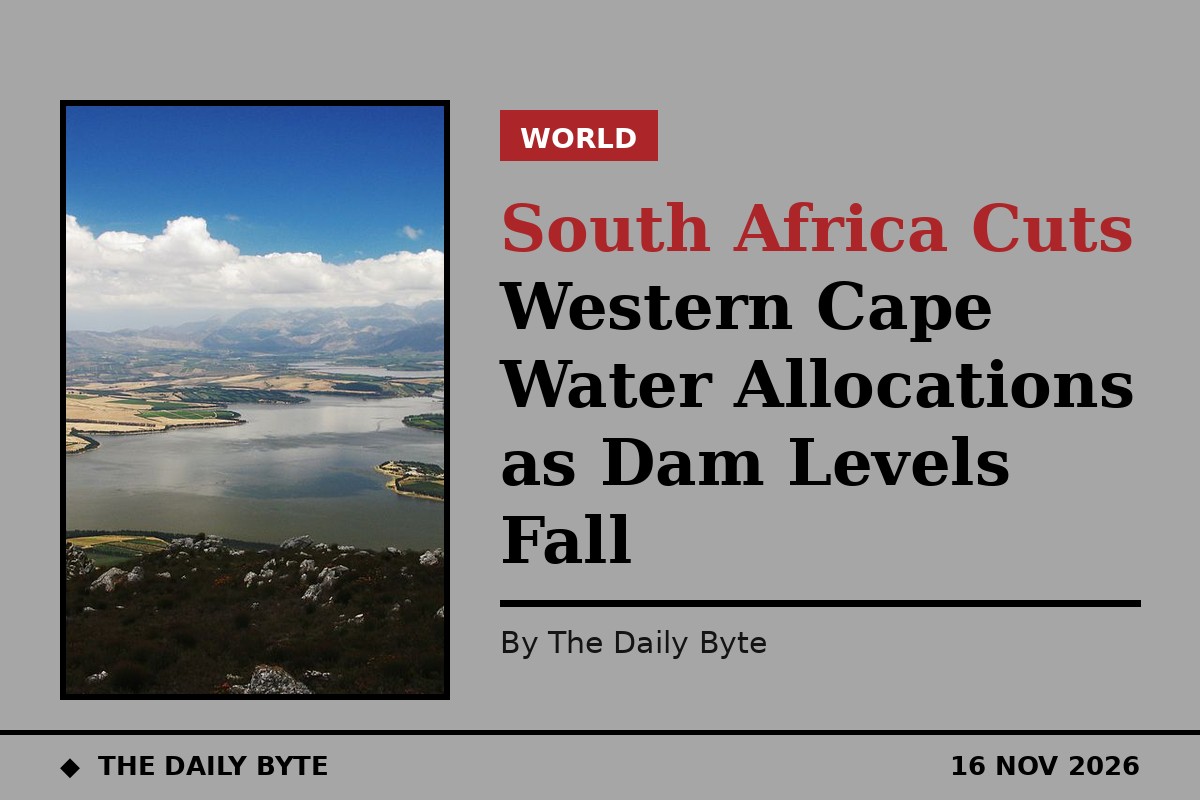
South Africa will cut water allocations in the Western Cape by 7% for domestic and industrial use and by 15% for irrigation, after poor rainfall depleted the dams that supply Cape Town and the surrounding farming region. Water and Sanitation Minister Pemmy Majodina announced the reductions on Monday, 16 November 2026, saying users could no longer draw their full share without raising the risk of shortages.
The cuts follow the Department of Water and Sanitation's Annual Operating Analysis of the Western Cape Water Supply System for the 2026/27 water year. The department said the reductions would save about 56.8 million cubic metres of water a year, made up of 27.2 million cubic metres from domestic and industrial allocations and 29.6 million cubic metres from irrigation.
Briefing the media on the state of water security in the province on Monday, Majodina said the precautionary measures were based on scientific assessments of water use, future demand, dam storage, rainfall patterns and the long-term reliability of the system.
Dam levels well below last year
The Western Cape Water Supply System, which supplies Cape Town, the West Coast region, several towns and agricultural users, is made up of six interconnected dams with a combined storage capacity of about 898.2 million cubic metres.
As of 2 November 2026, combined storage in the system stood at 72.5%, or 646.5 million cubic metres, compared with 84.4%, or 694 million cubic metres, at the same point last year. The current level is below the preferred operational threshold of 80% and about 11.9 percentage points below the 10-year average of 84.49%.
Majodina attributed the decline mainly to below-normal rainfall during the 2026 winter rainfall season. The province recorded 722.7 millimetres of rain in the 2024/25 season and 752.8 millimetres in 2025/26, against a long-term average of 964 millimetres.
Although current dam levels remain significantly higher than those recorded during the severe drought of 2016/17, the latest analysis points to growing pressure on the system, according to the department.
El Nino adds to the risk
Climate forecasts point to a strong to extreme El Nino event, which could bring higher temperatures, increased evaporation and reduced runoff into the dams, the department said.
Modelling by water resource specialists shows that if households, businesses and farms kept drawing their full allocations, the risk of water shortages and mandatory restrictions would rise substantially from 2027 onwards.
"The annual analysis indicates that the system remains operationally stable and capable of supplying current water requirements. However, it also highlights emerging risks that require careful management and require us to act now to protect this precious resource," Majodina said.
She thanked water users for using the resource responsibly and not drawing their full allocations, and urged them to maintain current consumption levels. The allocation cuts are intended to protect strategic water reserves, improve resilience against future droughts, and ensure enough water for households, economic activity and essential environmental needs.
Conservation must become permanent
Majodina called on municipalities, businesses, industries, farmers and households to step up water conservation and demand management.
"Water conservation is no longer a temporary response to drought. It must become a permanent feature of how we manage this precious resource," she said.
Residents have been urged to observe municipal water-use restrictions and to report water wastage and breaches of municipal by-laws, while municipalities have been called on to enforce their regulations. The department said it would keep monitoring dam storage, weather conditions and water demand through the year and could introduce further measures if conditions worsened.
"Let us act now, not when our dams are empty. By working together, we can secure water for our communities, our economy and future generations," Majodina said.
The Western Cape is one of South Africa's main economic and farming regions, where cities and export-crop farms share limited water supplies, and the cuts underline the pressure on the resource after two below-average rainfall seasons. Further details are available from Reuters and the official announcement on SAnews.


