South Africa Murders Fall, But 60 Killed Every Day
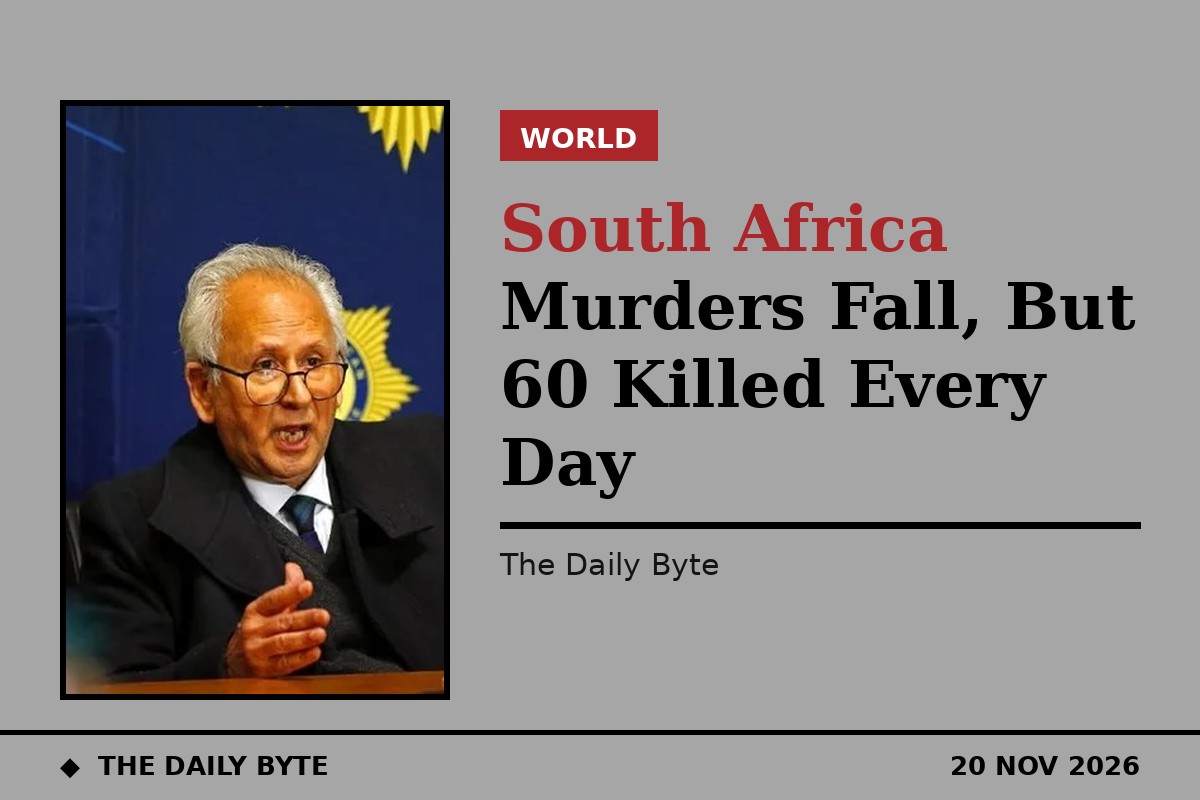
South Africa recorded 5,590 murders between July and September 2026, an average of 60 people killed every day, even as the murder total fell for another quarter, according to crime statistics released in Pretoria on Friday.
Acting Police Minister Firoz Cachalia presented the figures for the second quarter of the 2026/27 financial year, covering 1 July to 30 September. Police recorded 204 fewer murders than the 5,794 in the same three months a year earlier, a fall of 3.5 percent, continuing a decline in murder that began in the 2024/25 financial year.
“During this quarter, 5,590 murders were recorded, which is still far too high as it means that on average 60 people were murdered per day,” Cachalia said. He added that the figures showed progress in some areas and “ongoing challenges that we need to confront”.
Falling, but still 60 a day
The minister said most violent crime categories continued to fall across the country, including murder, sexual offences, serious assaults and armed robberies. The decline matters, he said, because for 13 years between 2012 and 2025 most violent crime categories had been rising.
Carjackings fell by 16.8 percent and truck hijackings by 27.9 percent in the quarter, while robberies of homes and businesses each fell by 7 percent. Reported sexual offences fell by 2.7 percent, a far slower rate than the other categories.
Police recorded 9,908 rapes in the three months. Of the 9,705 cases in which the victim’s sex and age could be verified, 4,362 victims were children under 18, while 5,116 were adult women and 227 were adult men. Attempted murders rose by 215 on the same period last year, to 7,470.
Where the killings happen
Murder is not spread evenly across South Africa, Cachalia said, but concentrated in specific hotspots. The risk of being murdered is highest in the Eastern Cape, followed by the Western Cape and KwaZulu-Natal.
Around 80 percent of all gang-related murders and almost 60 percent of all taxi-related murders take place in the Western Cape, while Gauteng records the most robbery-related murders. Nearly 3,000 murders in the quarter happened in public places such as streets, open fields, parks and beaches.
Firearms were used in 2,552 murders, more than any other recorded weapon. In the Western Cape firearms were used in 732 murders, in Gauteng 675 and in KwaZulu-Natal 560. Fifteen police officers were murdered in the quarter, down from 23 a year earlier.
Guns, alcohol and public places
Cachalia put alcohol and firearms at the centre of the government’s prevention plans. Police recorded 8,201 alcohol-related contact crimes in the quarter, including 271 murders, 589 attempted murders, 1,483 rapes and 5,858 assaults with intent to cause grievous bodily harm. A further 235 murders happened in or around liquor outlets such as shebeens, taverns and nightclubs.
He said law enforcement would step up compliance operations against unlicensed outlets and those breaking their licence conditions, while provincial liquor authorities and municipalities were expected to play their part on licensing, trading hours and enforcement in high-risk areas.
On firearms, the minister said police would intensify efforts to trace and recover illegal guns, investigate supply chains and link recovered weapons to crime scenes through forensic work. “A firearm turns a dispute into a death,” he said.
What the police say comes next
The statistics were released at a sombre time for the police service. Cachalia opened his address by paying tribute to Lieutenant-Colonel TG Sithole, a station commander killed in a shootout near Greytown in KwaZulu-Natal, and Sergeant Madikizela, killed during an operation in Mthatha in the Eastern Cape. He also referred to two mass shootings hours apart that left 17 people dead, nine near Atteridgeville in Gauteng and eight in Sweetwaters, KwaZulu-Natal.
Police arrested 1,670 people for murder and 1,711 for attempted murder during the quarter, and 3,292 accused people were sentenced to imprisonment. The minister said enforcement would stay focused on “the people, places, times and criminal networks driving violence, firearm offences, kidnappings, extortion and organised robbery”.
“There is no acceptable level of murder, rape, kidnapping or violent assault,” Cachalia said. “The reductions in carjacking and truck hijacking demonstrate that focused action can work. The increases in kidnapping and the continuing scale of violent crime demonstrate that much more must be done.”
Sources: South African Government | Sowetan


