South Africa nuclear build: first reactor by 2036
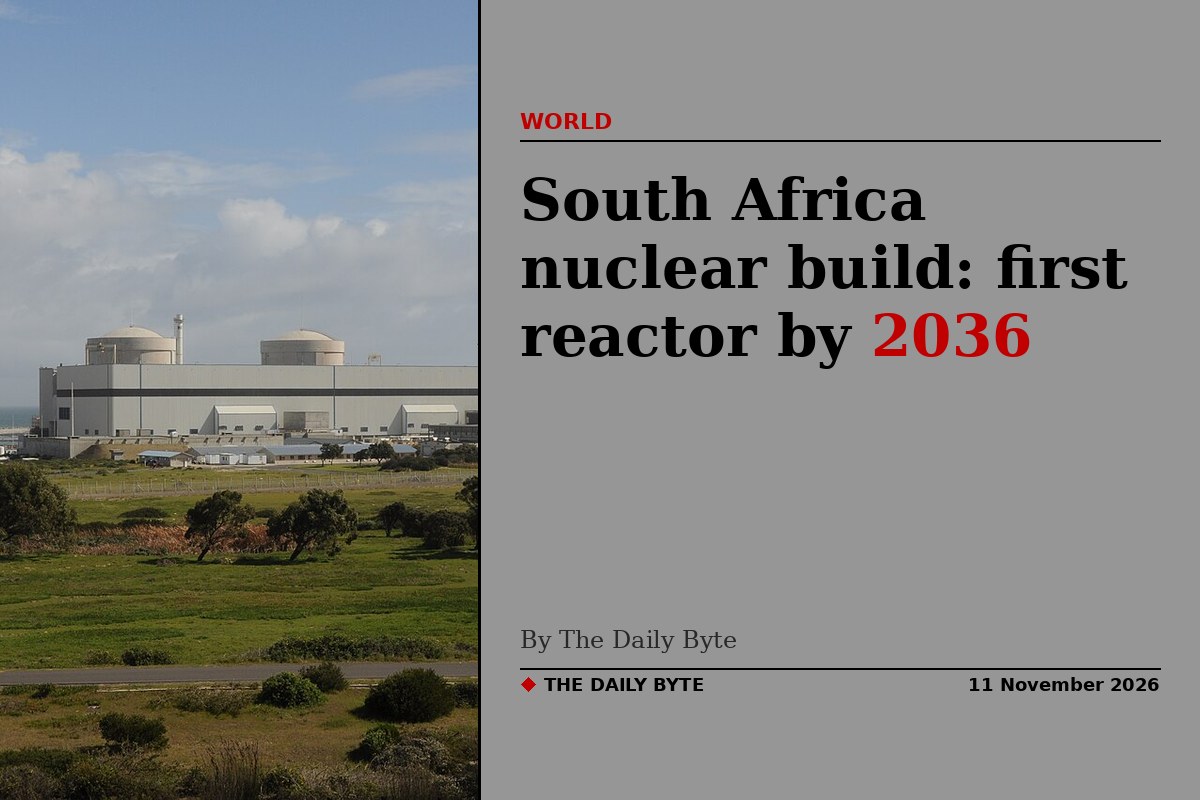
South Africa has set out its clearest timetable yet for a return to nuclear power, with the government planning to publish its formal case for 5.2 gigawatts (GW) of new capacity later this month and the first reactor potentially coming online by 2036.
Energy minister Kgosientsho Ramokgopa laid out the plan on Tuesday 10 November at the South African Nuclear and Clean Energy Conference in Irene, Pretoria, telling delegates that the state-owned utility Eskom has submitted its feasibility programme for a 5,200-megawatt nuclear build under the Integrated Resource Plan 2025.
The programme is the first phase of a wider nuclear industrialisation plan that Ramokgopa wants to expand to 10GW. Two sites have been selected: Duynefontein, next to the existing Koeberg plant in the Western Cape, and Thyspunt in the Eastern Cape. Eskom has not yet said how the 5.2GW will be divided between the two sites.
Public consultation before procurement
Ramokgopa said the government would publish a position paper setting out the case for nuclear alongside a proposed determination under the Electricity Regulation Act, with 60 days allowed for public comment. He said he was aiming for a determination in April 2027 and intended to publish the final document before June 2027.
Publication of the determination is a statutory trigger for procurement, and the National Nuclear Regulator will retain independent authority over safety and licensing. Ramokgopa insisted the consultation would be judged on evidence rather than ideology, saying the case for nuclear was that it is dependable, low carbon and cost-effective.
The extra consultation step is designed to head off the litigation that has dogged earlier attempts. In August 2024 Ramokgopa withdrew a ministerial determination for 2.5GW of new nuclear capacity to allow further public consultation after the Democratic Alliance launched a legal challenge. Two non-governmental organisations had also gone to court.
Ramokgopa was blunt about the prospect of fresh challenges, joking that it would be an extraordinary feat if nobody took the government to court over the planned 5.2GW. He added: "We are going to build nuclear in this country. Take us to court."
Skills gap is the biggest risk
The minister was equally candid about the practical obstacles. He said one of the biggest inherent risks in the programme was that South Africa had not built a nuclear power plant in roughly 50 years, and that engineers with experience of building one were in short supply.
"I must admit that one of the biggest inherent risks in this program is that we have not built a nuclear power plant in the past 50 years or so," he said. "The ones we have at Koeberg, they know how to run an already built power station. So, the inherent risk is we don't have people who have built nuclear power stations before."
He said the gap would be closed by working with international partners to build a pipeline of local engineers, and by accumulating experience as the first, second and third reactors are built. The government is also reviving the Pebble Bed Modular Reactor programme, halted in 2010, and transferring it from Eskom to the South African Nuclear Energy Corporation.
Timeline, sites and costs
Eskom group chief executive Dan Marokane told the conference that the determination would be followed by procurement, working on roughly a 10-year timeline, so the first reactor could potentially come online by 2036. Ramokgopa said it would take at least seven to 10 years.
At Duynefontein, the then environment minister upheld an environmental authorisation in August 2025 for a 4GW plant, which Ramokgopa said paved the way for the first 2.4GW of the programme. At Thyspunt, the environmental process covers a station of up to 5.2GW on its own, although the site carries provisional Grade I cultural landscape protection until 1 February 2027.
Small modular reactors already feature in the programme: in May, Eskom said it was proposing 4.8GW from conventional pressurised water reactors and 400MW from small modular reactors. Nuclear will remain in state hands, Ramokgopa said, with Eskom designated as owner and operator, although funding could include private-sector participation through public-private partnerships and project finance.
What the programme will cost is still unknown, and the effect on electricity tariffs has not yet been finally determined. Ramokgopa also stressed that coal and nuclear could operate alongside one another, describing coal as a strategic mineral and saying the coal fleet would be reviewed on its own merits.
He said the government had learnt from the troubled Medupi and Kusile coal builds, calling them a template on how not to do things, and promised the nuclear programme would not become a casualty of poor planning.


