Rand Near One-Year Low After SARB Holds Rate at 7.25%
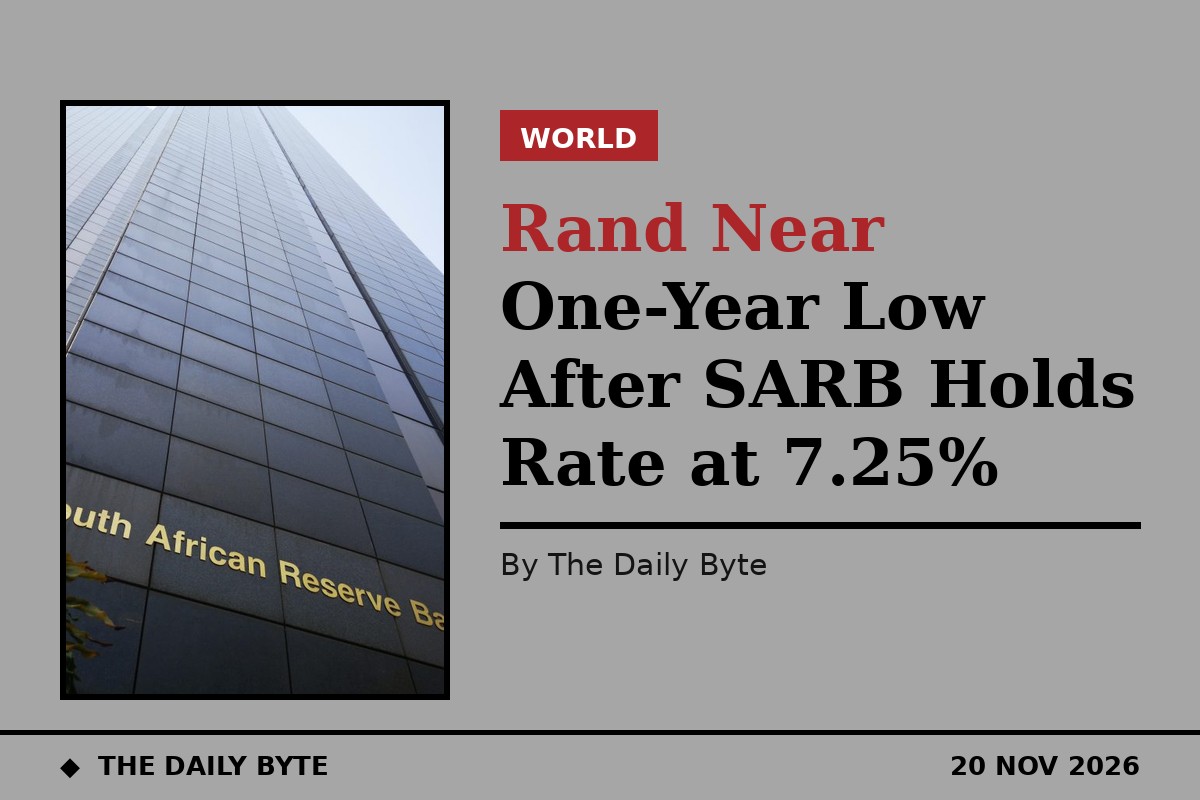
The South African rand touched a one-year low in early trade on Friday, weakening on uncertainty over coalition talks after local elections, pressure from a stronger dollar and a split decision by the country's central bank to hold interest rates.
By 0540 GMT the rand traded at 17.56 to the dollar, hovering near its weakest level in 12 months, Reuters reported. The currency has been under pressure in recent weeks as the dollar has strengthened and investors have watched negotiations over local power-sharing after the municipal elections.
The South African Reserve Bank kept its key repo rate unchanged at 7.25% on Thursday, in a decision that split its Monetary Policy Committee. Four members voted to hold rates, while three favoured a 25-basis-point increase, underlining how finely balanced the decision was.
A close call at the Reserve Bank
Governor Lesetja Kganyago said monetary policy was tight enough after two increases earlier in the year, in May and September. The bank's final meeting of 2026 had been expected to end with rates on hold, and the decision matched the view of most economists surveyed by Reuters.
The hold came a day after Statistics South Africa reported that consumer inflation rose to 5.2% in October, up from 4.5% in September and near a two-and-a-half-year high. Higher transport costs, driven in part by fuel prices, were behind much of the increase, and the Reserve Bank has warned that fuel and food inflation remain a risk for households and businesses.
The prime lending rate, the rate at which commercial banks lend to their best customers, stays at 10.75%. For borrowers, the pause offers relief from further increases this year, but economists quoted in South African media cautioned that the next move is more likely to be up than down if inflation stays high.
Kganyago also pointed to a deeper problem: fixed investment in South Africa stands at only about 13% of output, well below historical peaks and one of the lowest rates in the world. He said 2026 had been a challenging year, with inflation higher than expected at its start, growth lower and unemployment rising.
Coalition talks in focus
Investors are watching coalition negotiations as a test of whether increasingly fragmented politics can deliver stable government in South Africa's economic heartland. As the African National Congress and its partners negotiate local power-sharing, they are nearing a deal with smaller rivals to govern Johannesburg, sidelining the pro-business Democratic Alliance despite its first-place finish in the city.
The Bureau for Economic Research warned that ousting the Democratic Alliance at local level could spill over into the national government of national unity, with potentially significant implications for investor sentiment.
Kganyago pushed back on the idea that the rand's weakness this week was driven by the coalition talks, and the bank kept its inflation and growth forecasts largely unchanged for 2026 and 2027. He also flagged pressure from fuel prices, linked to a months-long squeeze on global oil supply.
South Africa's benchmark 2035 government bond was steady in early trade on Friday, with its yield at 8.635%.
What comes next
The Reserve Bank's next interest-rate decision is scheduled for 28 January 2027. Until then, traders will watch the coalition negotiations, the dollar and the monthly inflation figures for signs of whether the pause can hold, or whether the three members who wanted a rise will get their way early next year.
For now, the rand's slide is a reminder of how quickly domestic politics and global currency moves can combine. A weaker rand raises the cost of imports, including fuel, which feeds back into the inflation the Reserve Bank is trying to contain.
Sources: Reuters; Business Day.


